- Experimental
- Pilots
- Scale
- Consolidation
Experimental: there is no consolidated data on Brazilian arenas running a licensed private network integrated with IoT at scale; this analysis builds on the existing regulatory framework and on market signals. Private networks have already advanced in industry (mining, ports, manufacturing) — the gap in entertainment is neither technology nor suppliers, but an unassembled business case.
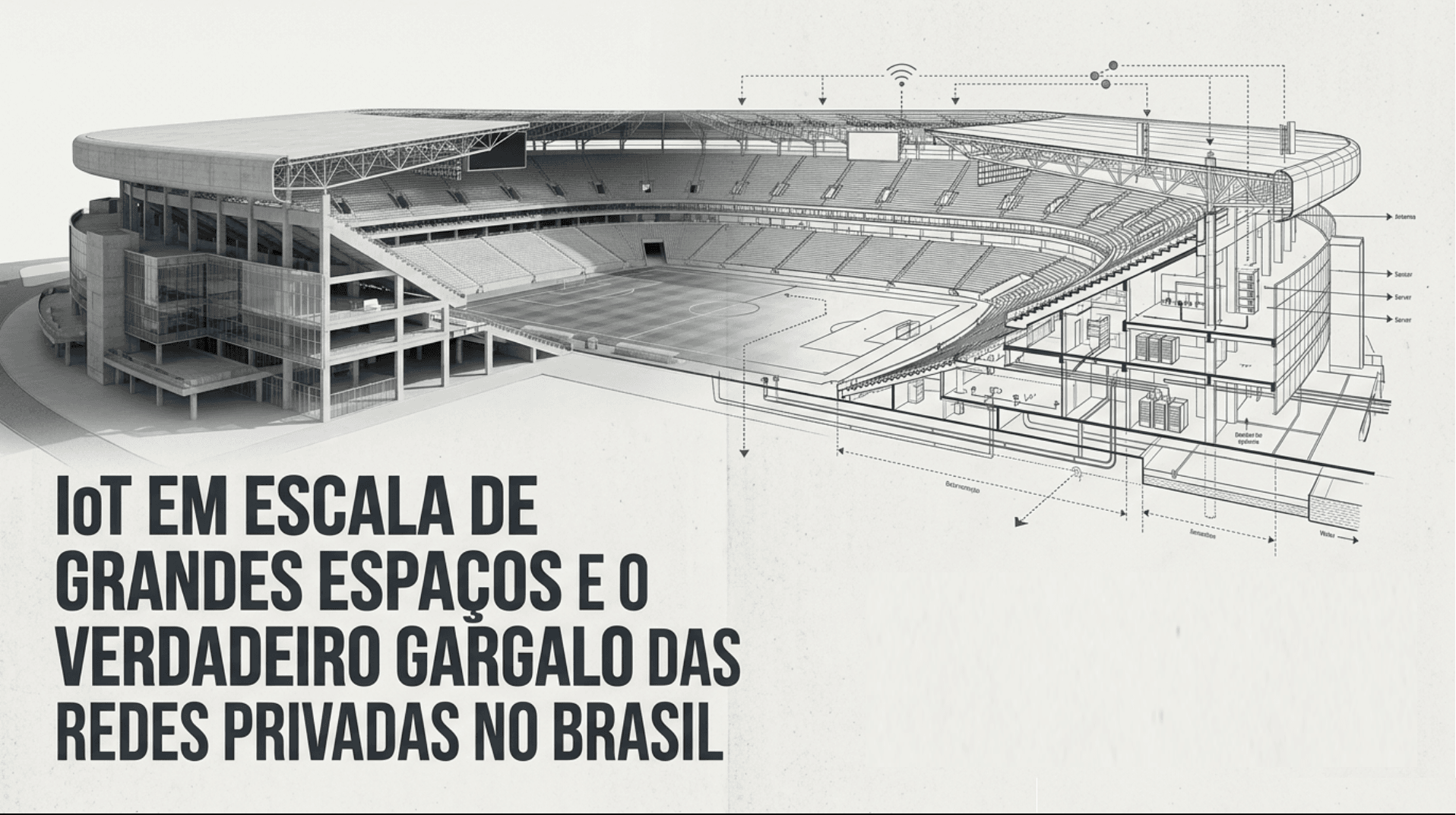
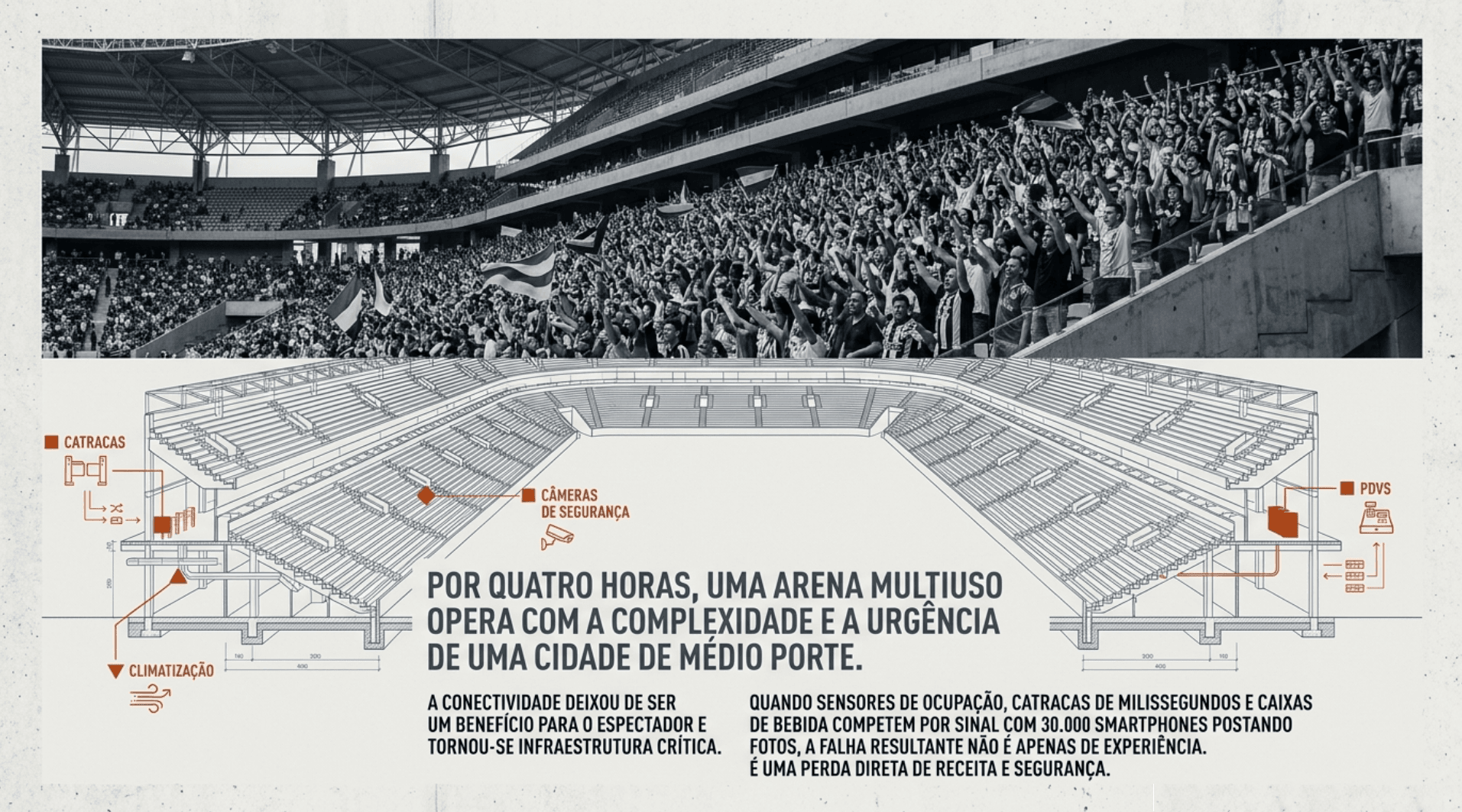
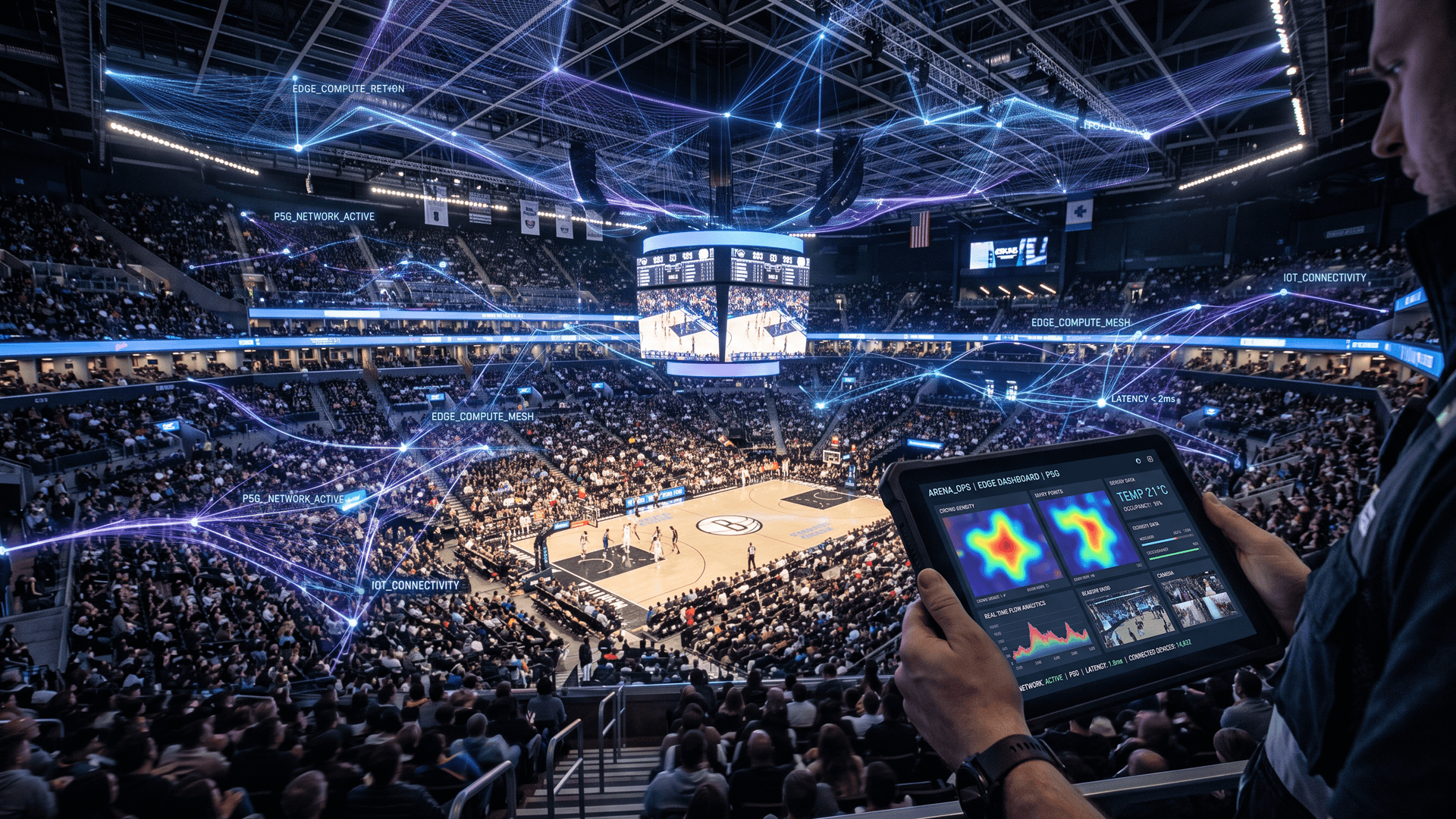
Private 5G in stadiums is treated in Brazil as a technology of the future. It is not. For a few hours on match day, a large arena is a mid-sized city with its own network: tens of thousands of smartphones competing for spectrum, turnstiles that must respond in milliseconds, crowd-counting cameras, occupancy sensors, climate control, lighting, beverage tills and digital signage. Abroad, that operation no longer runs on the same network fans use to post photos.
Here, however, the conversation usually stops at the question of when private 5G will reach arenas. That is the wrong question: spectrum has already been allocated and the rules already exist. The real issue is who takes on the investment, who operates the network day to day, and who owns the data generated inside the stadium. This edition separates what already works abroad, what remains a promise even there, and what a Brazilian arena operator needs to solve before buying radios.
1Context and urgency
Why private 5G in stadiums became critical infrastructure
The technical shift was not 5G itself, but the possibility of the venue having its own licensed network, isolated from public traffic. Multi-purpose arenas in Europe and North America have migrated from Wi-Fi and shared cellular to private-network architectures combined with low-power sensor meshes, with processing inside the stadium.
What changes in practice is the nature of connectivity: it stops being an amenity offered to spectators and becomes critical infrastructure for operations. Security, ticketing, access control, energy, climate control and in-venue retail come to depend on a link with predictable performance. When that link competes with thirty thousand phones, the failure is not one of experience — it is one of revenue and safety. The urgency comes from there, not from any promise of a stadium of the future.
 2Market noise
Three promises that deserve technical scrutiny
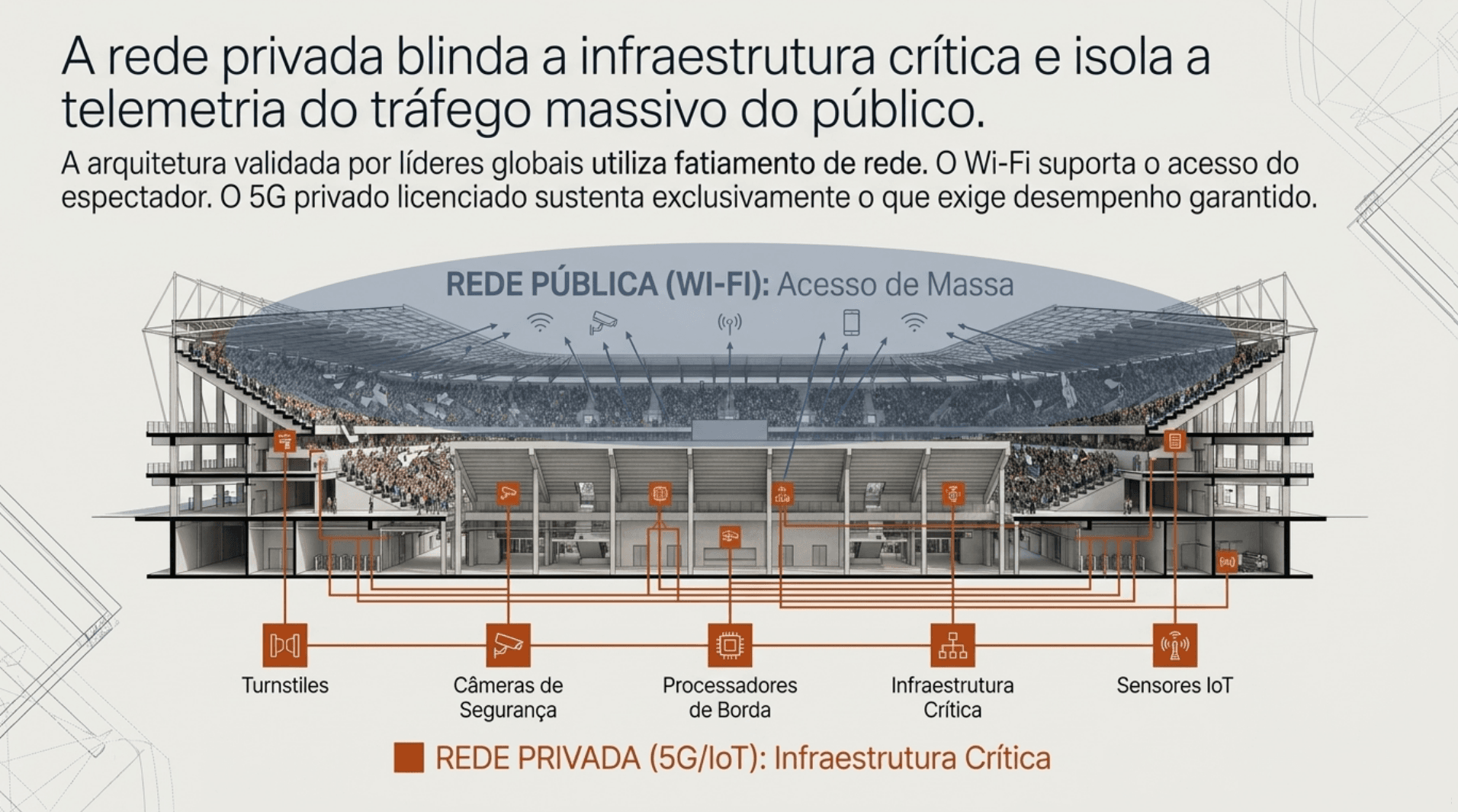
The architecture validated by major vendors is hybrid: Wi-Fi absorbs the general public; the licensed private network sustains what requires guaranteed performance — operational IoT, security and ticketing. Whoever buys full replacement pays twice for the same coverage.
The virtual replicas in operation today are predictive dashboards that support human decisions. Autonomous, end-to-end crowd-flow control is not what has been deployed.
Arena telemetry becomes revenue when a contract defines ownership and use of the data among club, concessionaire, sponsor and operator. Without it, what exists is an expensive, legally locked archive.
3What is really happening
The model has consolidated — with local processing
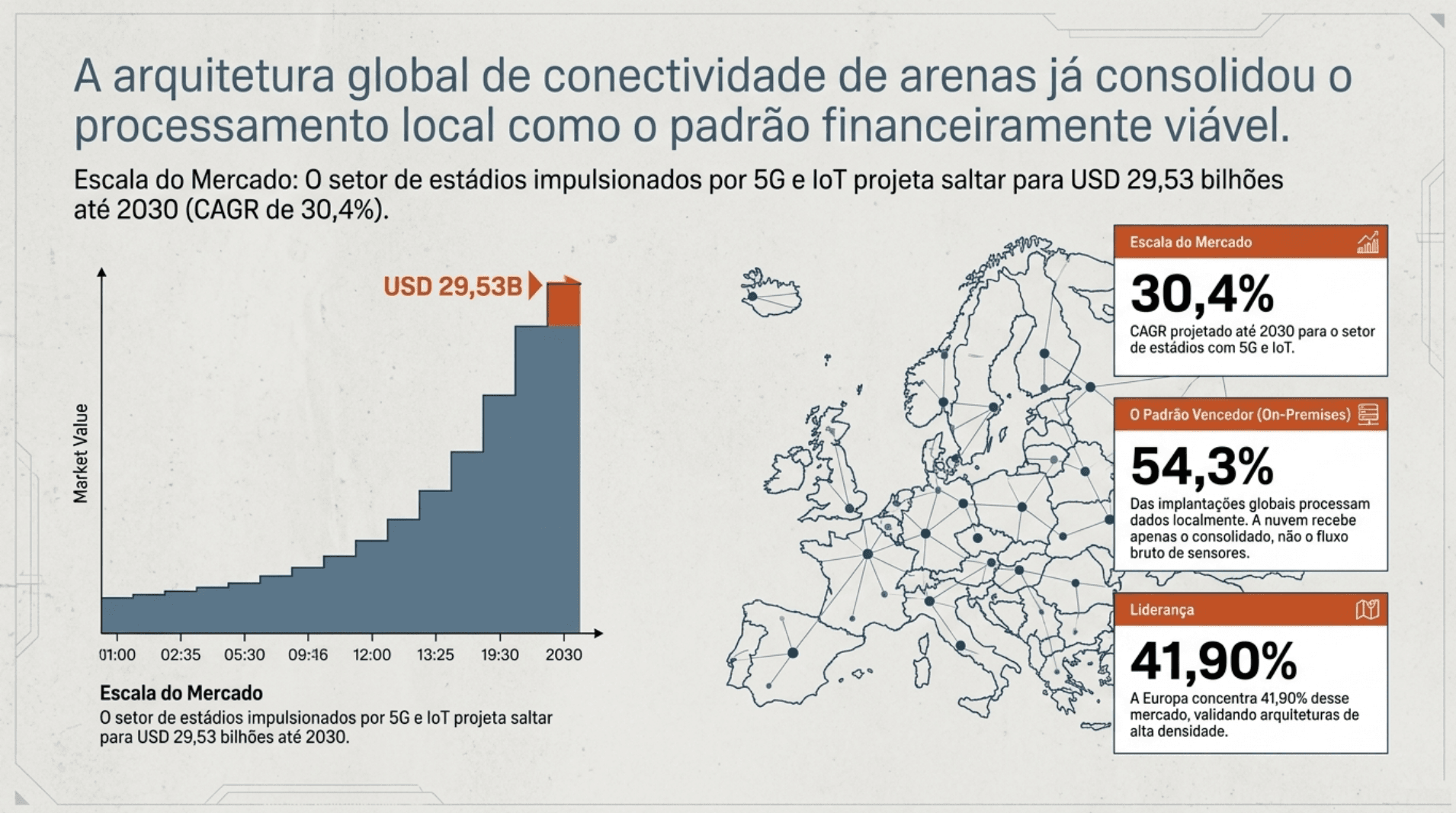
Evidence 1 — Scale. The global market for 5G- and IoT-powered stadiums was valued at USD 7.92 billion, projected to reach USD 29.53 billion by 2030 (30.4% CAGR). The broader smart-stadium segment is estimated at USD 12.36 billion, projected at USD 53.06 billion.
Source: The Business Research Company / ResearchAndMarkets, 5G-Powered Smart Stadiums Market Report 2026–2030; Fortune Business Insights
Evidence 2 — Architecture. 54.3% of global deployments run on-premises, with Europe holding 41.90% of the market. The winning architecture processes locally: the cloud receives the consolidated data, not the raw sensor stream.
Source: Straits Research / IMARC Group, Smart Stadiums Market Size & Growth Analysis
Evidence 3 — Traffic isolation in real operation. European operators such as BT Group and Orange Business apply network slicing in mass-audience arenas — the Orange Vélodrome being one example — to separate live broadcast and critical telemetry from public traffic.
Source: Orange Business / BT Group, technical cases on private 5G and network slicing in European arenas
Licensed private network with local processing in large arenas with continuous operation.
Autonomous crowd-flow automation and standardized models for monetizing venue telemetry.
Finally, what prevents scale: the upfront investment in radios and edge nodes, priced in hard currency, and the absence of a clear operator for the network once installed.
4Applicability in Brazil
Where the numbers work — and where they don’t
Two profiles concentrate the conditions to leave the experimental stage:
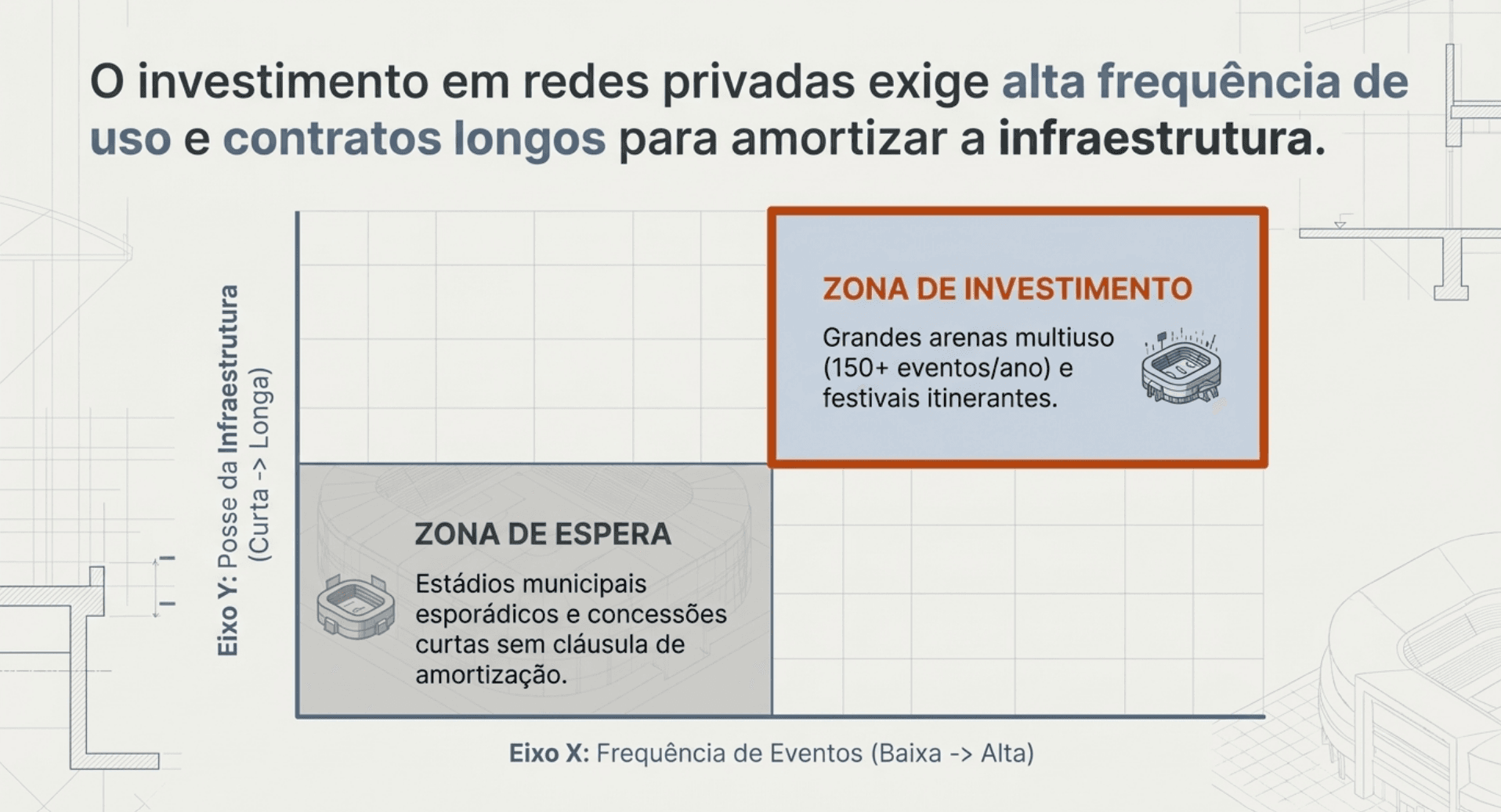
- Operators of large multi-purpose arenas with a full year-round calendar — football, concerts, conventions. Their own retail and ticketing operations, an in-house IT team, and a management contract long enough to amortize infrastructure. This is where the numbers work, because the network is used in 150 events a year, not 15.
- Large festival and touring-event producers. They set up temporary infrastructure several times a year and already contract connectivity for each edition. For them, the private network is a reusable mobile asset — an economic model distinct from the fixed stadium, and easier to justify.
These two profiles — starting by separating, in the current network map, critical traffic (security, turnstiles, energy, occupancy sensors) from spectator access, and by preparing the internal architecture for edge processing. The diagnosis comes before the radio.
Small municipal gyms and stadiums with sporadic use, because the network sits idle between events; and arenas under short concessions without a clause to amortize IT infrastructure, because the investment does not survive the end of the contract.
54TT’s intellectual signature
The real bottleneck of private 5G in Brazilian stadiums is not technology. It is business model and data governance.
Spectrum has already been allocated by Anatel, the equipment exists and vendors serve the country. What does not exist is an answer to two contractual questions: who operates the network once installed, and who owns the crowd-behavior data generated inside the stadium. Without that, the arena takes on the role of a telecom operator it was never structured for — and that is where most projects stall.
6Executive conclusion
In 60 seconds
- The hype overstatesfull Wi-Fi replacement, autonomous crowd management and automatic telemetry monetization.
- Real maturity lies inhybrid private networks with local processing in large arenas in Europe and North America, with more than half of deployments on-premises.
- Brazil facesan Experimental stage in entertainment — not for lack of spectrum or rules, but because of hard-currency investment, short concessions and no defined operator.
- Who should act nowoperators of multi-purpose arenas with a full calendar, and large festival producers — traffic diagnosis and edge architecture first.
- Who should watch and preparesmall municipal stadiums and arenas under short concessions with no provision for amortization.
- Signal to watchthe first structured offer of managed private network (network as a service) by a domestic integrator aimed at the entertainment sector.
Innovation Radar
Signals from the Brazilian science and technology ecosystem related or adjacent to the topic. They are signals, not recommendations.
Open, disaggregated radio access networks, with participation from research institutes and universities. Open networks are the most direct path to reducing dependence on imported equipment — today the main cost barrier in arenas.
Source: CPQD / Finep
Applied research in private mobile networks, 5G testbeds and equipment certification. The competence to design and validate high-density private networks already exists in a Brazilian institute.
Source: Inatel
Next-generation networks with Inatel, CPQD and universities, publicly funded. It already defines the latency and density requirements arenas will need in the next decade.
Source: Brasil 6G Program
Allocation of the 3,300–3,800 MHz and 24.25–27.90 GHz bands for private networks. Spectrum for private 5G in stadiums is already available; licensing is not the bottleneck.
Source: Anatel
Market Insight
For IT integrators, telecom operators, arena concessionaires and event-technology companies, the opportunity is not in reselling imported infrastructure. It lies in the layer the Brazilian market has not yet occupied: offering private network as a service to the entertainment sector — shifting the upfront investment from the arena to whoever has the scale to spread it across several venues — and the data-governance arrangements that turn venue telemetry into a tradable asset.
Public stadiums and concessionaires can use the technology-procurement instrument in Brazil’s Innovation Law to commission the development of a solution not yet available on the market, instead of buying a closed package.
Arena operators facing the same problem can split the cost of a pilot, since the network architecture is practically the same for all of them.
An arena in operation is, for a research group, a test environment hard to reproduce in a lab — which makes the partnership a real exchange of value, not an institutional favor.
Each of these paths serves a different kind of organization, and choosing the wrong one costs time before it costs money. It is a strategy decision, not a technology one.
4 Trade Tech exists to turn science into business decisions.
If this topic touches your operation, let’s talk. Schedule a conversation with 4TT about innovation projects, outsourced R&D and partnerships with the science and technology ecosystem.
[email protected] · +55 11 93244-4141 · linkedin.com/company/4tradetech
The series: Connected Arenas and Athletes
- Article 1 — Private 5G in stadiums: what Brazil is missing (this article)
- Article 2 — Sports micro-telemetry: where does Brazil stand?
- Article 3 — LGPD in sports: athlete biometrics and wearables
Connected Arenas and Athletes is a three-part series of the 4 Trade Tech newsletter, produced in editorial partnership with FBIoT (Brazilian IoT Forum). Originally published in Portuguese.
Sources
- The Business Research Company / ResearchAndMarkets — 5G-Powered Smart Stadiums Market Report 2026–2030 (USD 7.92bn in 2025 → USD 29.53bn by 2030, 30.4% CAGR).
- Fortune Business Insights — Smart Stadium Market Size, Share & Growth Analysis (2026–2034).
- Straits Research / IMARC Group — Smart Stadiums Market Size & Growth Analysis (54.3% on-premises; Europe 41.90%).
- Market Research Future — Smart Stadium Market Trends & Technological Drivers.
- Anatel — Resolutions No. 711 and No. 742, Private Limited Service (SLP): 3,300–3,800 MHz and 24.25–27.90 GHz bands.
- Orange Business / BT Group — technical cases on network slicing and private 5G in European arenas (Orange Vélodrome).
- HPE Aruba, Cisco and Qualcomm — technical documentation on connected-venue architecture.
- Briefing of the series “The Connected Athlete & Arena” (FBIoT/4TT).