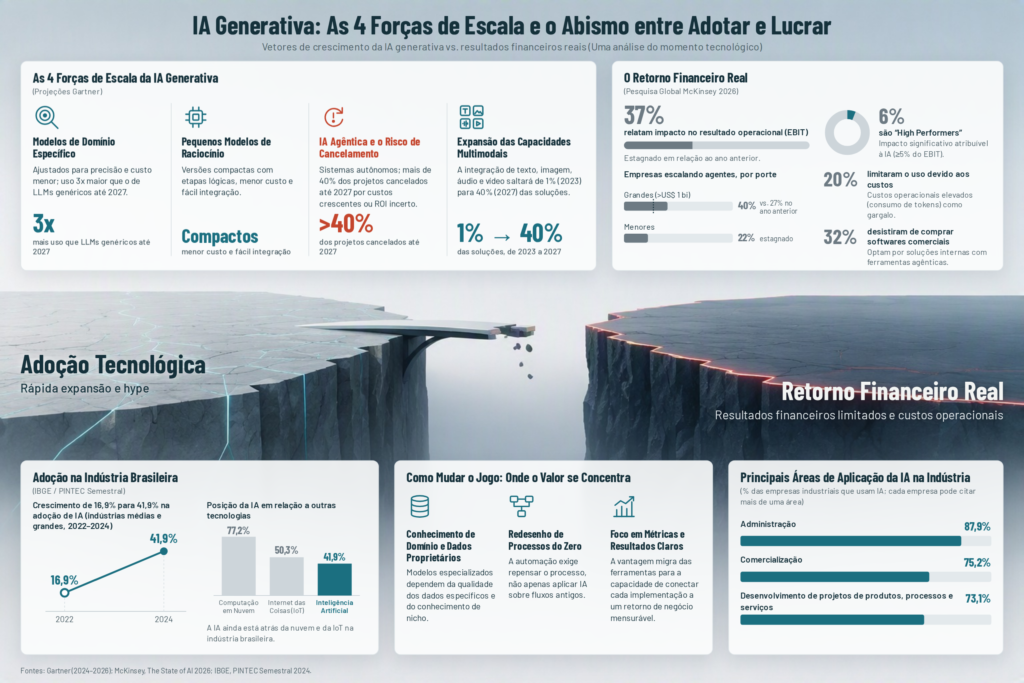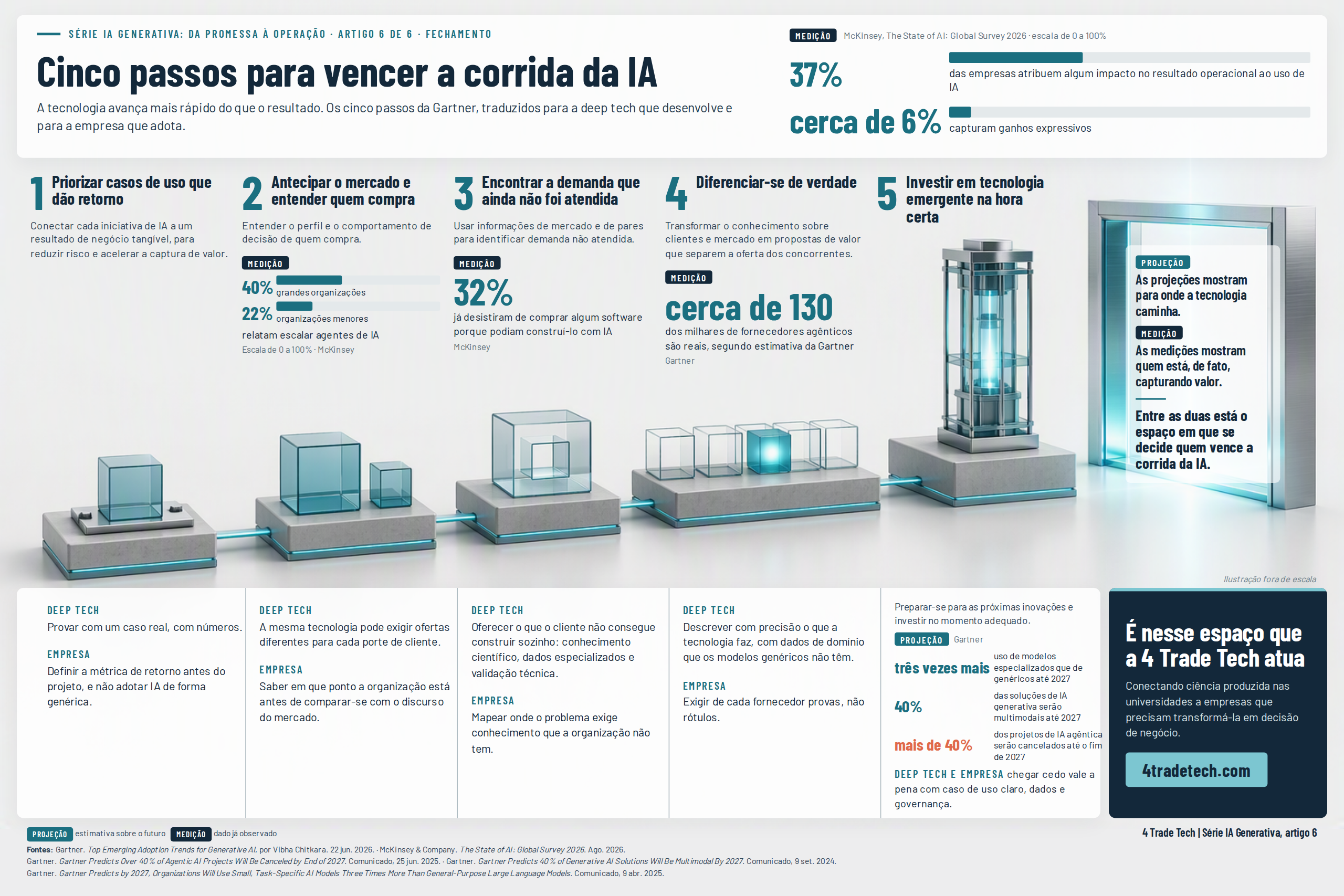
Across this series, one gap showed up in every topic: technology advances faster than results. Models specialise, agents multiply, AI reaches the factory and software development. Yet in McKinsey’s latest survey only 37% of companies attribute any impact on operating results to their use of AI, and just about 6% capture significant gains. That gap is what a generative AI strategy has to cross.

In the article that inspired this series, Gartner proposes five steps for those developing AI solutions. They were written for technology vendors, but they also serve buyers. Below, each step appears translated for both sides of open innovation: the deep tech that builds and the company that adopts.
1. Prioritise use cases that pay off
The first step of a generative AI strategy is the most concrete. Gartner recommends refining and implementing profitable use cases, connecting every AI initiative to a tangible business outcome, to reduce risk, accelerate value capture and maximise return.
For the deep tech: pick a problem where the technology is measurably better than the alternative and prove it with a real case, with numbers. For the company: start with bounded problems and a return metric defined before the project, not with a generic “adopt AI” initiative.
2. Anticipate the market and understand the buyer
The second step of a generative AI strategy is to anticipate market shifts and understand the profile and decision behaviour of buyers, in order to adjust product, packaging and commercial strategy.
The measurements show why this matters: large and small companies move at different speeds. According to McKinsey, 40% of large organisations report scaling AI agents, against 22% of smaller ones. For the deep tech: the same technology may require different offers for each customer size. For the company: it pays to know where the organisation actually stands before comparing itself to market talk.
3. Find the demand that has not been met
Gartner suggests using market and peer intelligence to identify unmet demand, validate opportunities and prioritise the AI investments that drive growth.
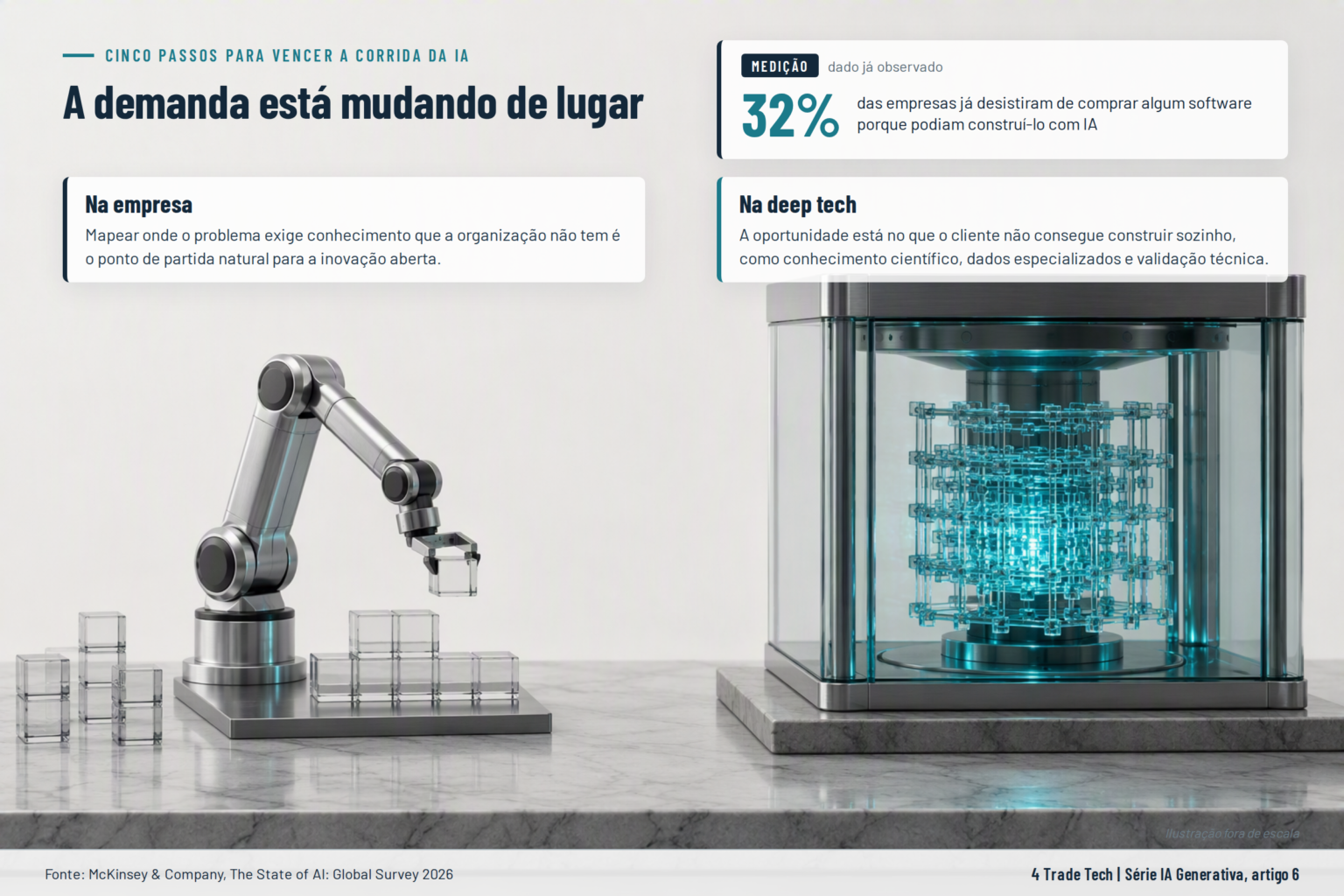
Demand is also shifting: 32% of the companies surveyed by McKinsey have already dropped a software purchase because they could build it with AI. For the deep tech: the opportunity lies in what the customer cannot build alone — scientific knowledge, specialised data and technical validation. For the company: mapping where the problem demands knowledge the organisation lacks is the natural starting point for open innovation.
4. Differentiate for real
The fourth step is turning knowledge about customers and markets into capabilities, messages and value propositions that clearly separate the offer from competitors.
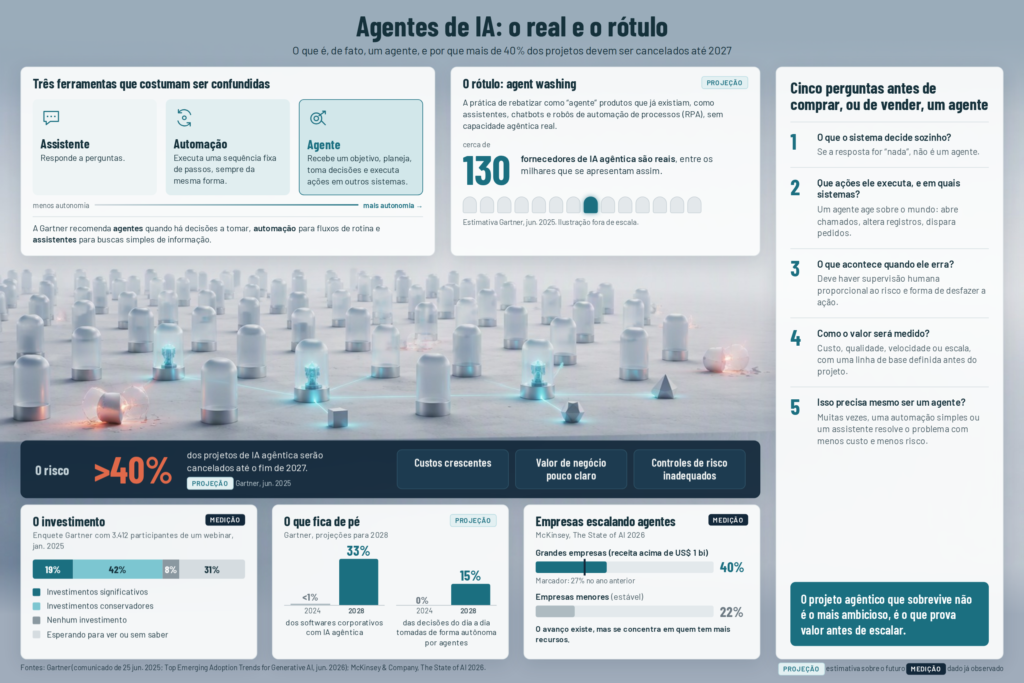
In a market where Gartner estimates only around 130 of the thousands of “agentic” vendors are real, differentiation starts with honesty. For the deep tech: describe precisely what the technology does, backed by domain data generic models do not have. For the company: demand proof from every vendor, not labels.
5. Invest in emerging technology at the right time
The last step is preparing for the next innovations and investing at the right moment, taking advantage of being early.
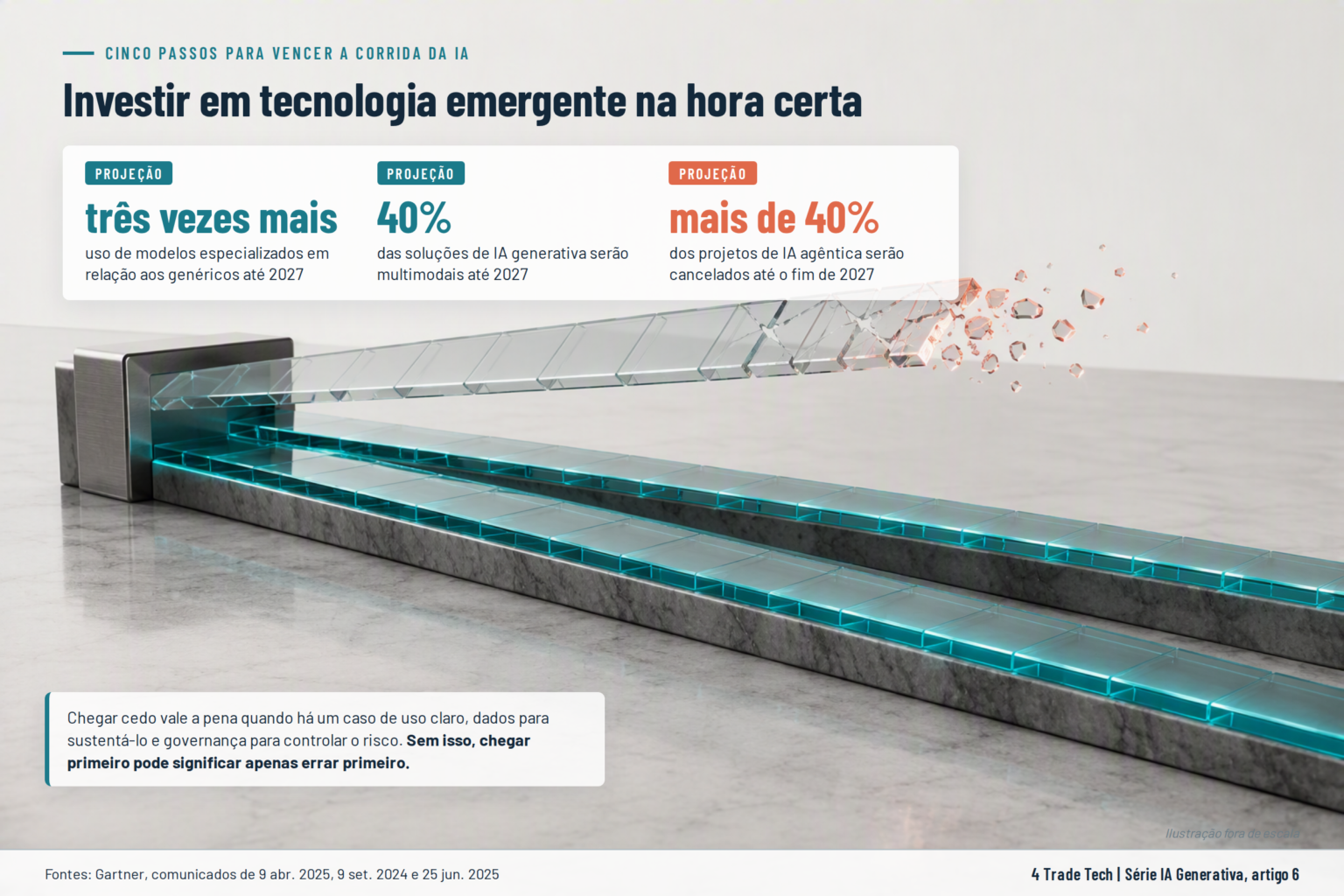
“The right moment” is the delicate part. Gartner projects that specialised models will be used three times more than generic ones by 2027, and that 40% of generative AI solutions will be multimodal in the same period. But it also forecasts that more than 40% of agentic AI projects will be cancelled by the end of 2027. For deep techs and companies alike: arriving early pays off when there is a clear use case, data to support it and governance to control risk. Without that, arriving first may just mean erring first.
What runs through the five steps of a generative AI strategy
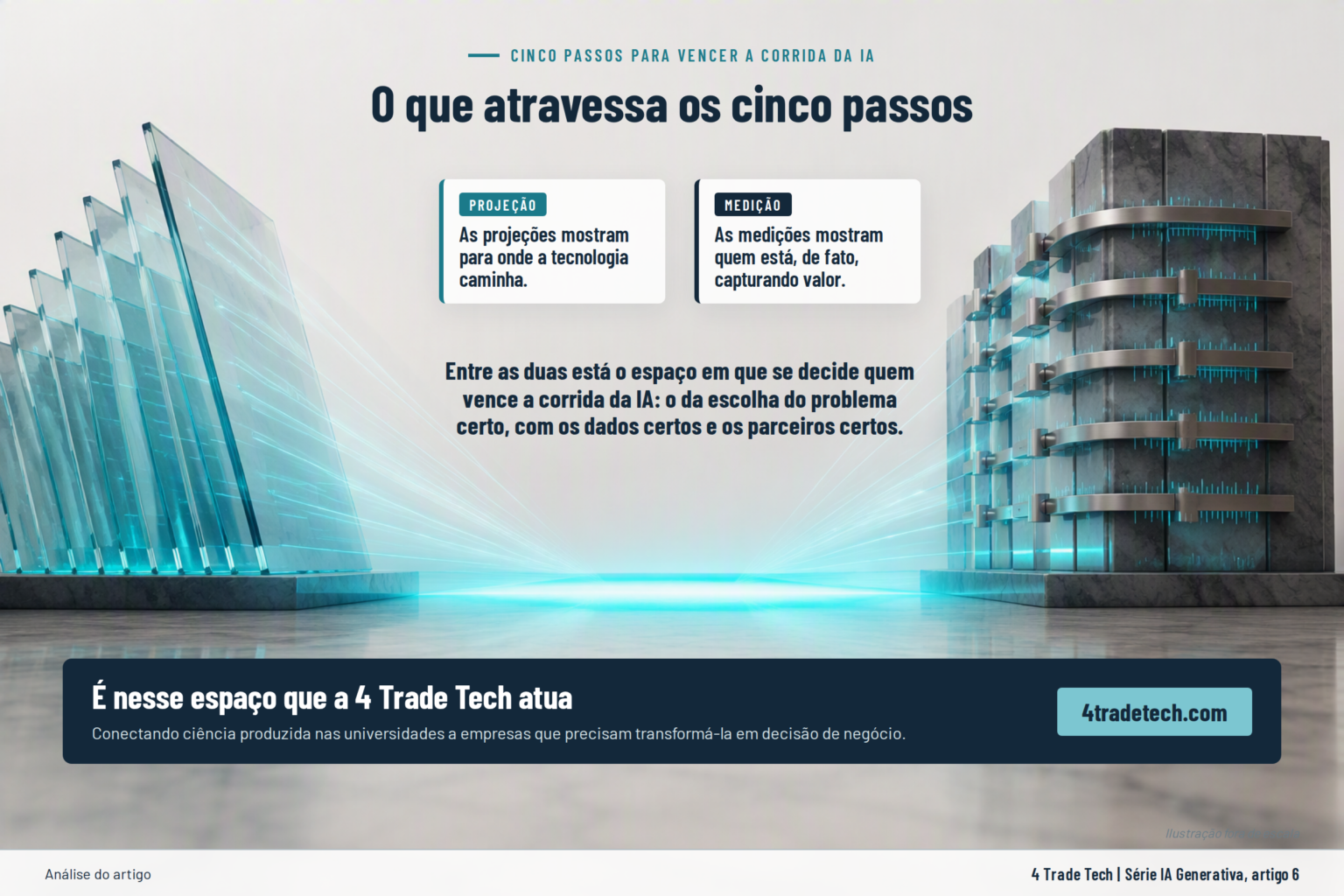
If one lesson runs through the series, it is separating projection from measurement. Projections show where technology is heading. Measurements show who is actually capturing value. Between the two lies the space where the AI race is decided: choosing the right problem, with the right data and the right partners.
That is the space 4 Trade Tech works in: connecting science produced in universities to companies that need to turn it into business decisions.
This is the last article in the series. To revisit the path, start with the first article, on the four scaling forces and the value gap, and follow through to the fifth, on building or buying software.
4 Trade Tech exists to turn science into business decisions.
Does your company want to move beyond experimentation and define a generative AI strategy with measurable return, or does your deep tech need to prove value to a corporate buyer? 4TT can help on both sides of that bridge.
[email protected] · +55 (11) 93244-4141 · linkedin.com/company/4tradetech
Sources
- Gartner · Top Emerging Adoption Trends for Generative AI, by Vibha Chitkara · 22 Jun. 2026.
- McKinsey & Company · The State of AI: Global Survey 2026 · Aug. 2026.
- Gartner · Gartner Predicts Over 40% of Agentic AI Projects Will Be Canceled by End of 2027 · press release, 25 Jun. 2025.
- Gartner · Gartner Predicts by 2027, Organizations Will Use Small, Task-Specific AI Models Three Times More Than General-Purpose Large Language Models · press release, 9 Apr. 2025.
- Gartner · Gartner Predicts 40% of Generative AI Solutions Will Be Multimodal By 2027 · press release, 9 Sep. 2024.