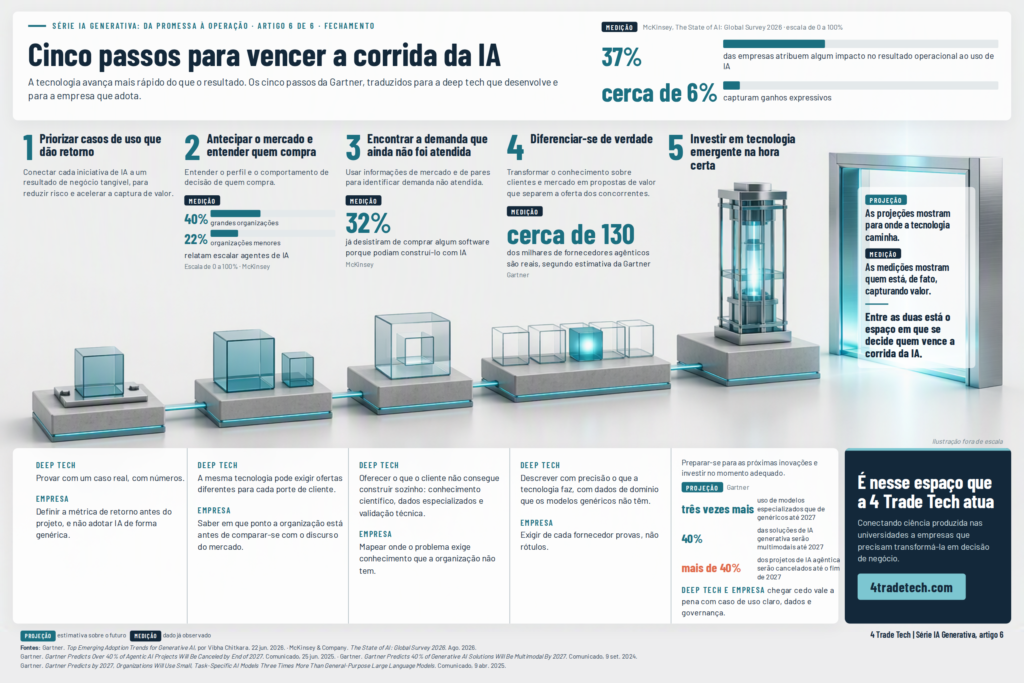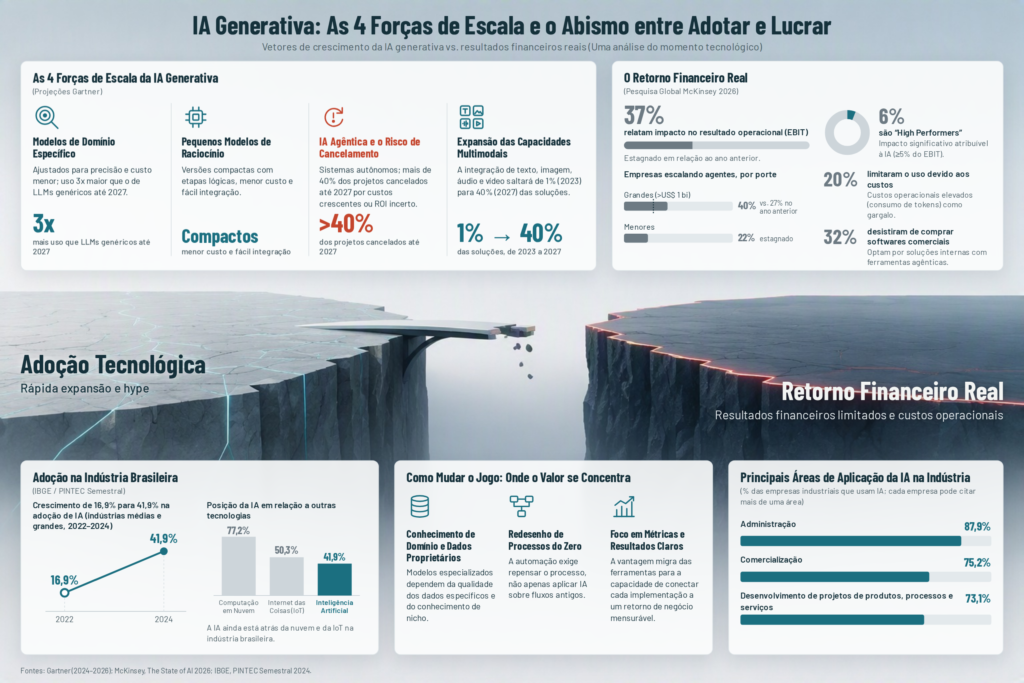
Few expressions have spread through the technology market as fast as “AI agent”. In no time it appeared in sales decks, product launches and strategic plans. The trouble is that not everything carrying the name does what the name promises. And Gartner itself, one of the firms projecting the fastest advance of agentic AI in the enterprise, is also among those warning most loudly about the excess.
What an AI agent actually is
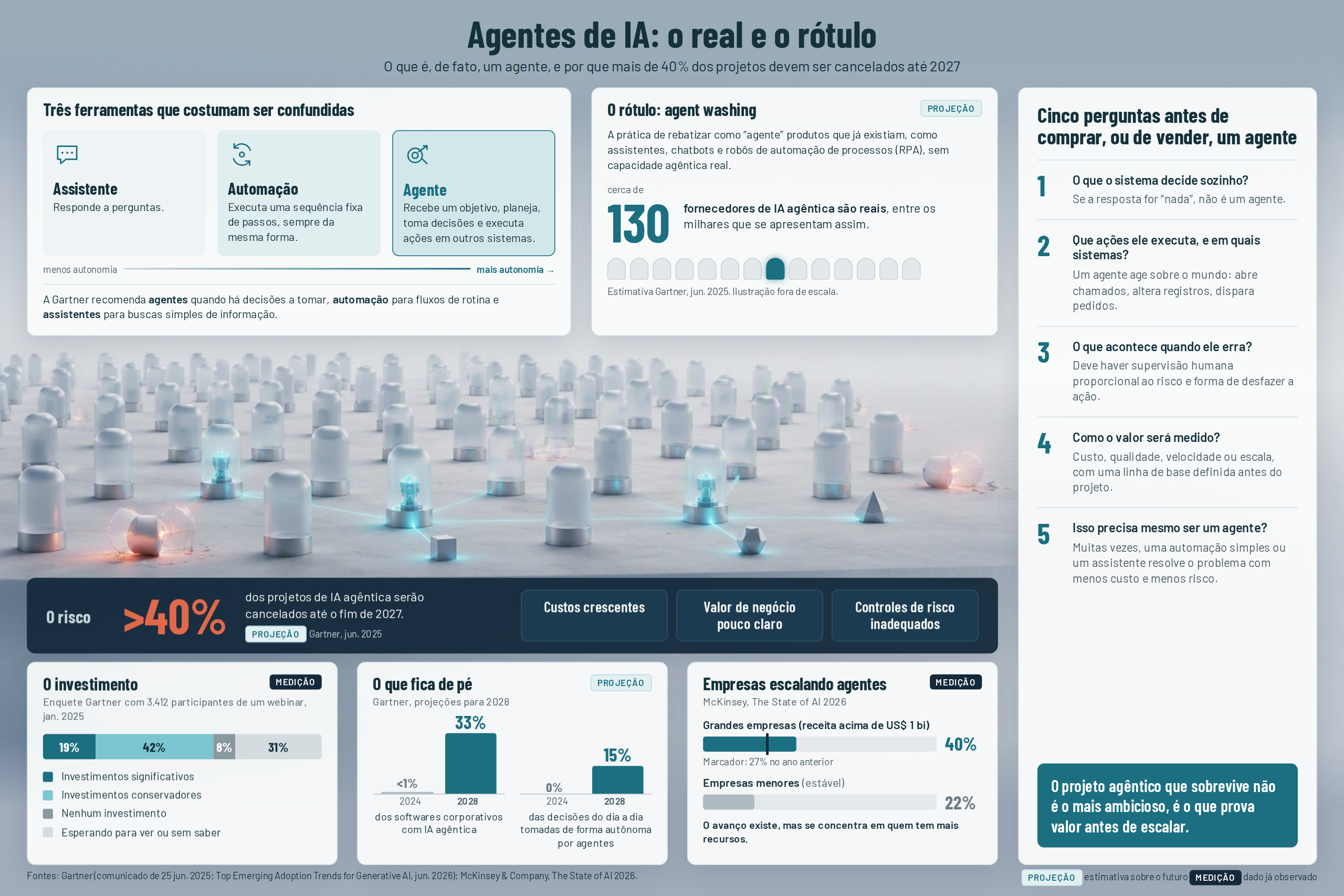
Before discussing agentic AI in the enterprise, it is worth separating three things that get confused. An assistant answers questions. An automation runs a fixed sequence of steps, always the same way. An agent receives a goal, plans how to reach it, makes decisions along the way and executes actions in other systems.
The distinction is not academic. Gartner recommends using each tool in its place: agents when there are decisions to make, automation for routine flows and assistants for simple information lookups. The aim, according to the firm, is to generate business value across four dimensions: cost, quality, speed and scale.
The label: agent washing
In June 2025, Gartner named a phenomenon many buyers had already noticed: agent washing, the practice of rebranding as “agents” products that already existed — assistants, chatbots and robotic process automation (RPA) — without real agentic capability. The firm’s estimate is blunt: of the thousands of vendors presenting themselves as agentic AI providers, only around 130 are real.
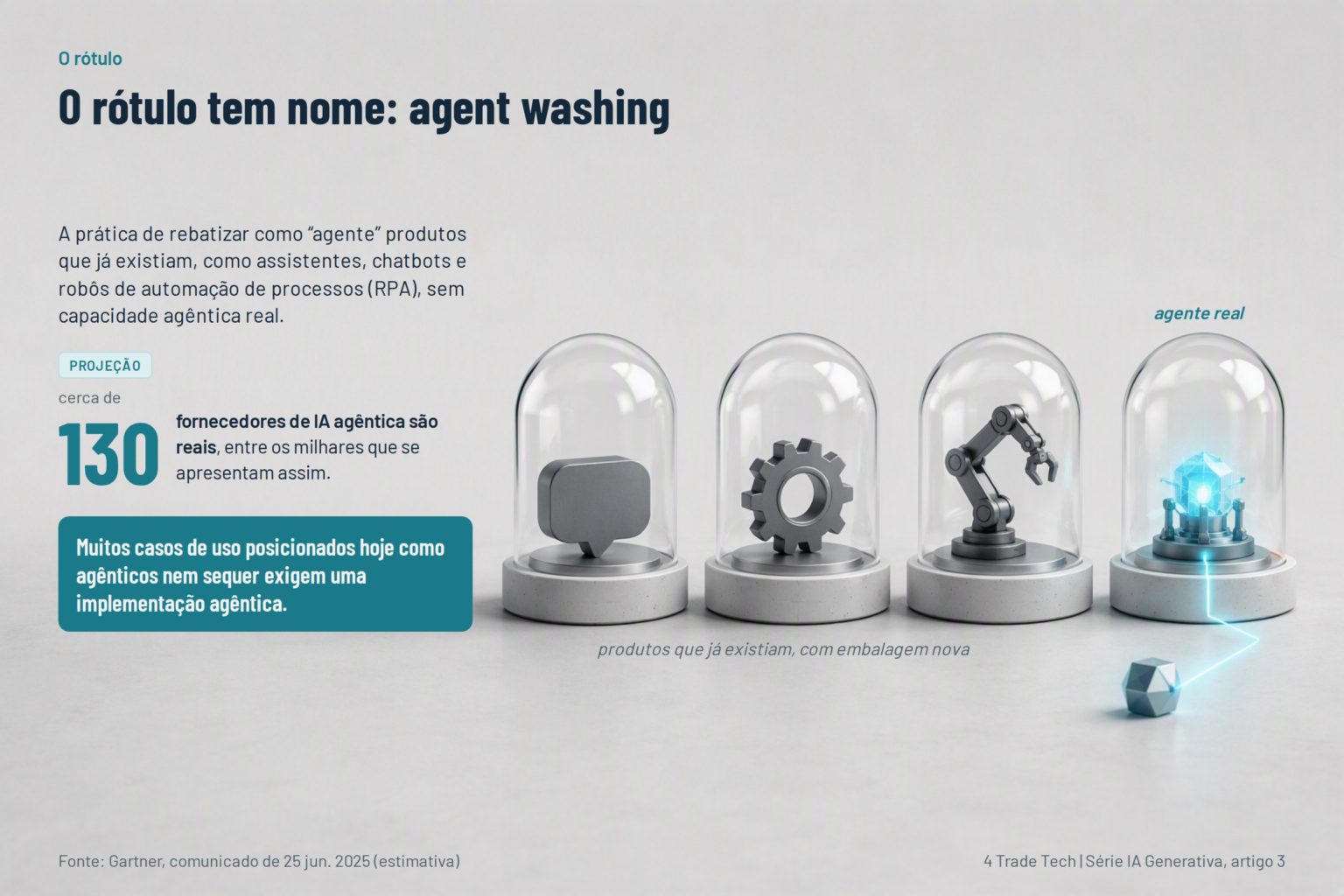
Anushree Verma, senior director analyst at Gartner, said most agentic AI projects are still early experiments or proofs of concept, driven largely by hype and often misapplied. According to her, many use cases positioned today as agentic do not even require an agentic implementation.
Why 40% of agentic AI projects in the enterprise will fail
In the same release, Gartner projected that more than 40% of agentic AI projects will be cancelled by the end of 2027. Three reasons are cited: escalating costs, unclear business value and inadequate risk controls.
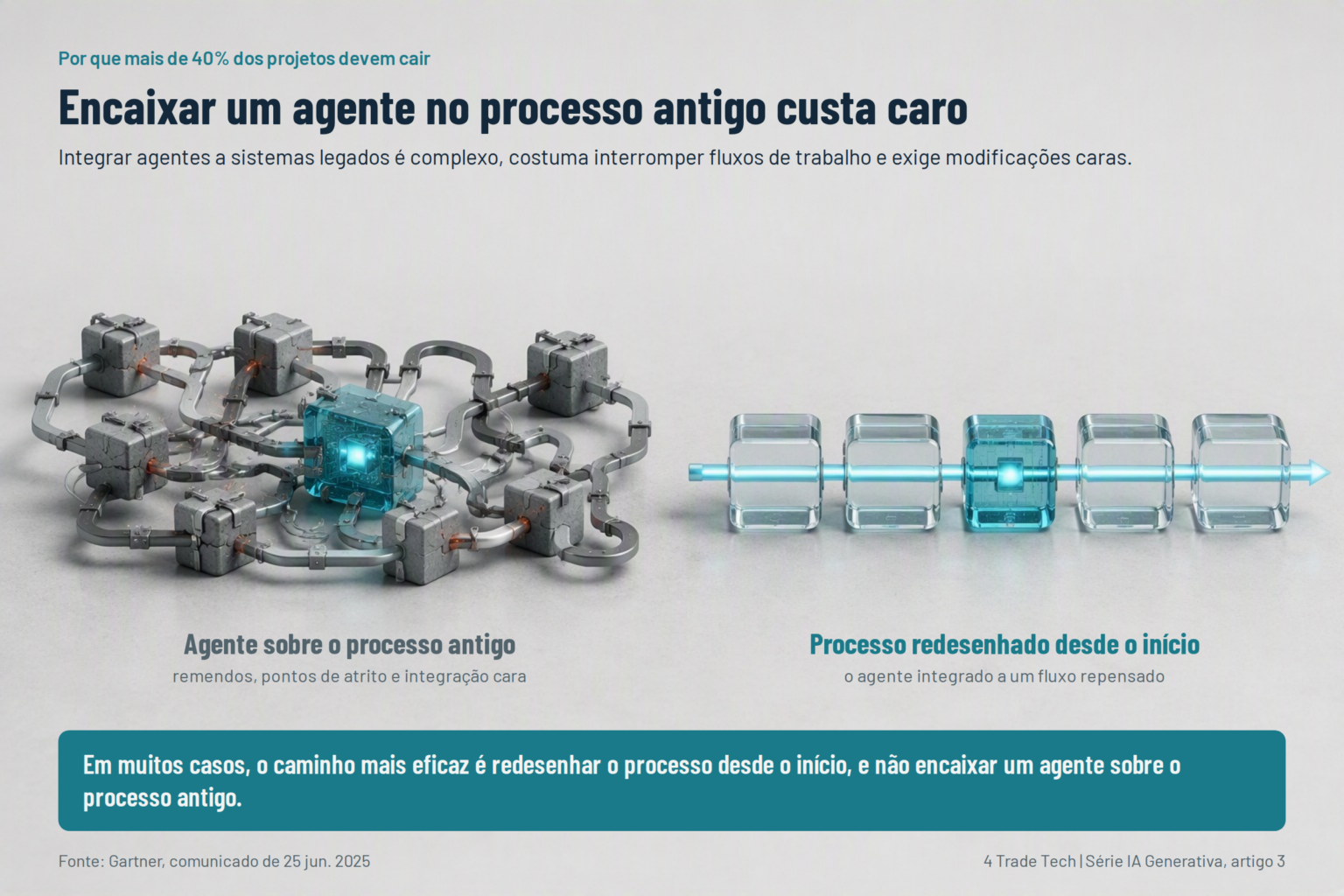
There is also a technical obstacle. Integrating agents with legacy systems is complex, tends to disrupt workflows and demands expensive modifications. For that reason, the firm suggests that in many cases the most effective route is to redesign the process from the start rather than bolt an agent onto the old one.
The investment picture helps explain the risk. In a Gartner poll of 3,412 webinar participants in January 2025:
- 19% said their organisations had made significant investments in agentic AI;
- 42% had made conservative investments;
- 8% had not invested;
- 31% were waiting to see or did not know.
Governance will weigh ever more heavily on agentic AI in the enterprise. In its March 2026 predictions, Gartner estimated that by 2030 half of all failures in AI agent deployment will stem from insufficient governance controls during operation and from integration problems between systems.
What holds up in agentic AI in the enterprise
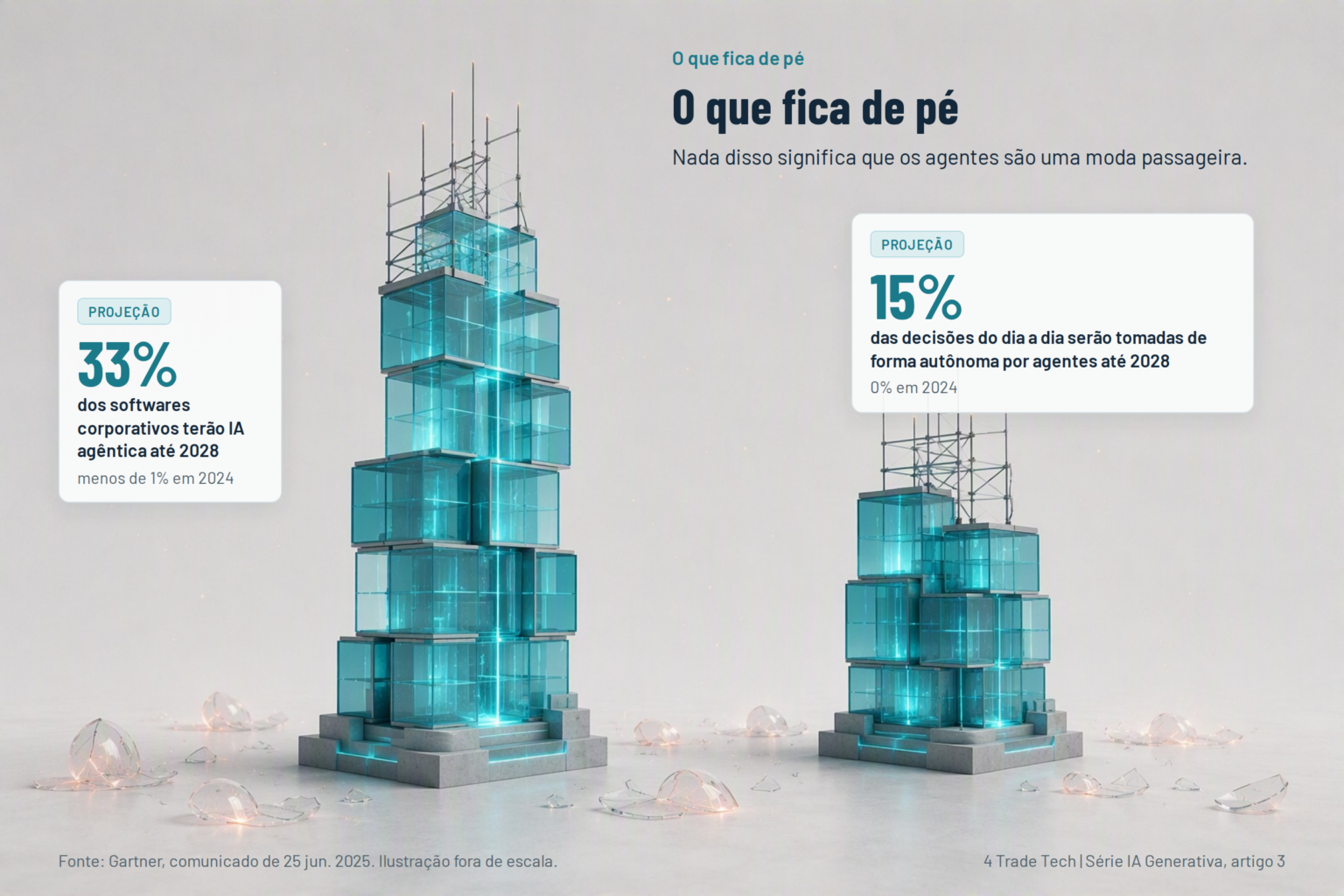
None of this means agents are a passing fad. The same Gartner that forecasts the cancellations projects that by 2028 33% of enterprise software will include agentic AI (less than 1% in 2024) and that 15% of day-to-day decisions will be made autonomously by agents (0% in 2024).
Measurements already show movement, but uneven. In McKinsey’s The State of AI 2026 survey, 40% of respondents at large companies (revenue above US$ 1 billion) report scaling AI agents, against 27% the year before. Among smaller companies the figure held steady at 22%. The advance is real, but concentrated among those with more resources to absorb cost and complexity.
Five questions before buying — or selling — an agent
To separate the real thing from the label in agentic AI in the enterprise, five questions help both buyers and builders:
- What does the system decide on its own? If the answer is “nothing”, it is not an agent.
- What actions does it execute, and in which systems? An agent acts on the world: it opens tickets, changes records, triggers orders.
- What happens when it gets things wrong? There must be human oversight proportional to the risk, and a way to undo the action.
- How will value be measured? Cost, quality, speed or scale, with a baseline defined before the project starts.
- Does this really need to be an agent? Often a simple automation or an assistant solves the problem at lower cost and lower risk.
What this means for deep techs and companies
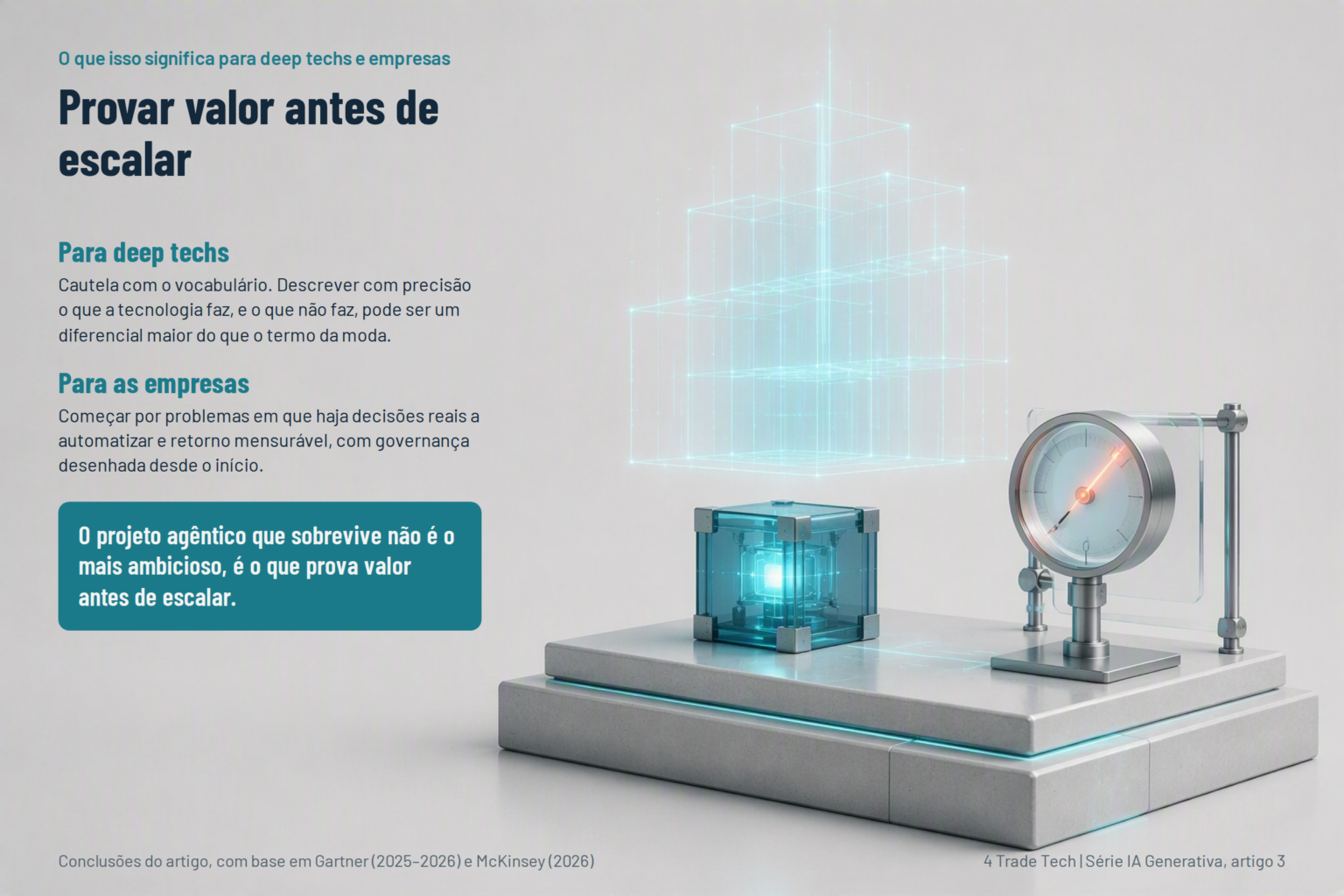
For a deep tech, this is a moment for caution with vocabulary. In a market where Gartner estimates only a small fraction of vendors are genuinely agentic, corporate buyers tend to distrust labels. Describing precisely what the technology does — and what it does not — may be a stronger differentiator than the buzzword.
For companies, the lesson is to start with problems where there are real decisions to automate and measurable returns, with governance designed from the outset. Those adopting agentic AI in the enterprise with that discipline find out early what works: the agentic project that survives is not the most ambitious one, but the one that proves value before scaling.
This is the third article in the series. In the previous one, we covered specialised AI models and the opportunity for university deep techs. Next, the series leaves the office for the factory floor: computer vision, multimodal AI and synthetic data.
4 Trade Tech exists to turn science into business decisions.
Is your company weighing an agentic AI project, or does your deep tech need to prove the agent is real? 4TT can help select use cases with measurable return and structure governance from the start.
[email protected] · +55 (11) 93244-4141 · linkedin.com/company/4tradetech
Sources
- Gartner · Gartner Predicts Over 40% of Agentic AI Projects Will Be Canceled by End of 2027 · press release, 25 Jun. 2025.
- Gartner · Gartner Announces Top Predictions for Data and Analytics in 2026 · press release, 11 Mar. 2026.
- McKinsey & Company · The State of AI: Global Survey 2026 · Aug. 2026.
- Gartner · Top Emerging Adoption Trends for Generative AI, by Vibha Chitkara · 22 Jun. 2026.