- Experimental
- Pilots
- Scale
- Consolidation
Experimental, with one caveat: load monitoring through positioning wearables is widespread among elite Brazilian clubs. The layer this edition deals with is a different one — physiological biometrics with edge inference and privacy-by-design architecture. There, no public data on structured adoption exists in the country. The distance between the two layers is exactly the risk: more is already being collected than anyone knows how to govern.
Brazil’s data protection law (LGPD) in sports has stopped being a legal-seminar topic and become an architecture decision. A sensor strapped to a professional athlete’s chest measures heart rate, variability, core temperature, mechanical load. Abroad, those numbers no longer travel raw to the cloud: the device processes the signal on the body itself and sends the coaching staff only an index — accumulated fatigue, heat-stress risk, load capacity. The change looks technical. It is not.
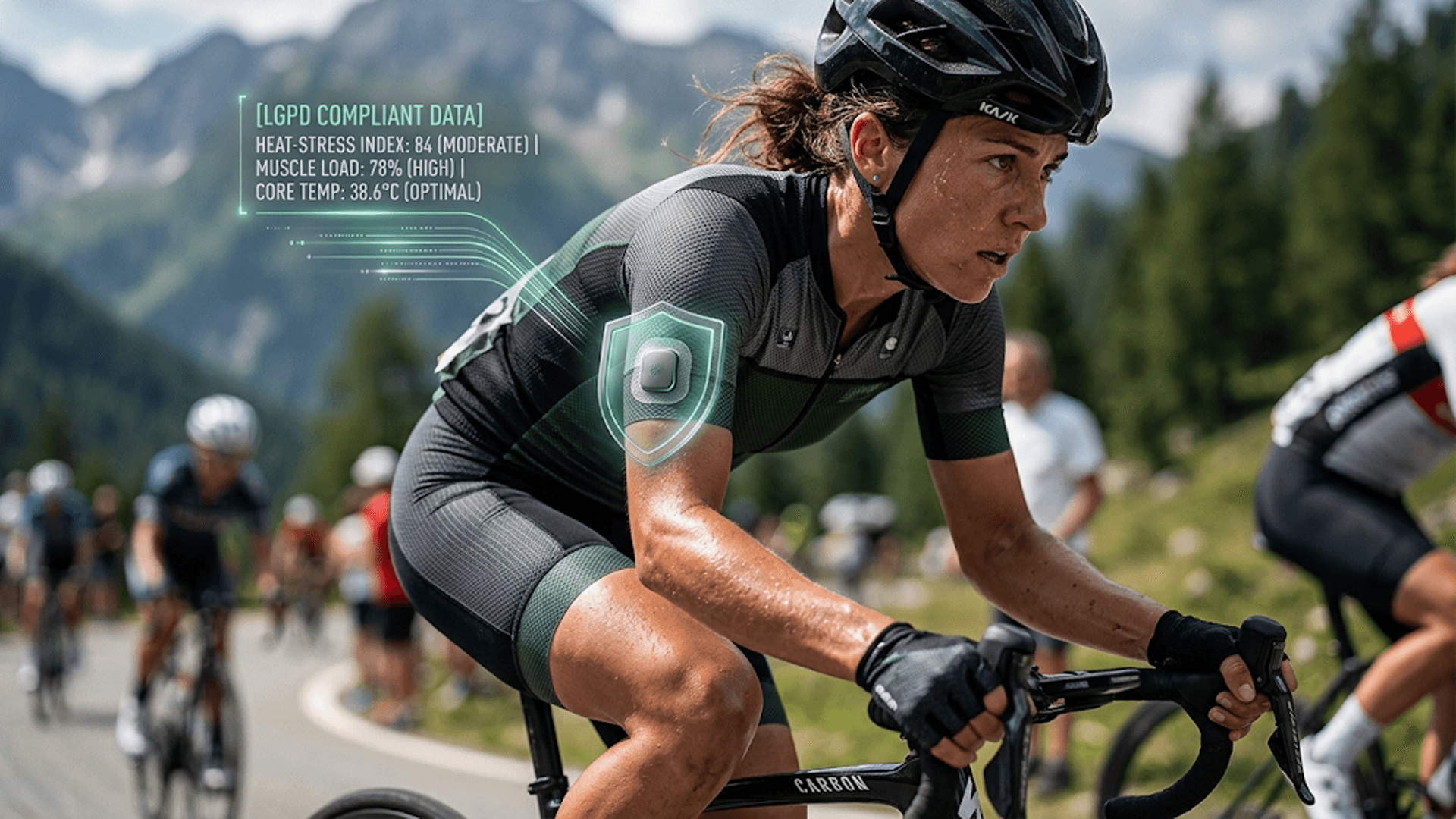
The architecture changed because data ownership changed. In the American leagues, a player’s raw physiological data belongs to the player, by collective agreement, and cannot circulate freely within the club. In Brazil, in turn, the LGPD reaches the same conclusion by another route — and ahead of any sports collective agreement. This edition therefore looks at what that means in practice for anyone already using wearables in training, which is most of the country’s elite clubs.
This is the third and final article in the series. The previous ones covered the private network that sustains the connected arena and the micro-telemetry of sports equipment.
1Context and urgency
Why LGPD in sports moved from legal to performance
First, three technical fronts matured together: more precise optical photoplethysmography sensors, continuous biosensors for metabolic markers, and microcontrollers capable of running inference inside the wearable without a permanent connection. The sum makes possible something that used to require a laboratory — continuous physiological reading during real activity.
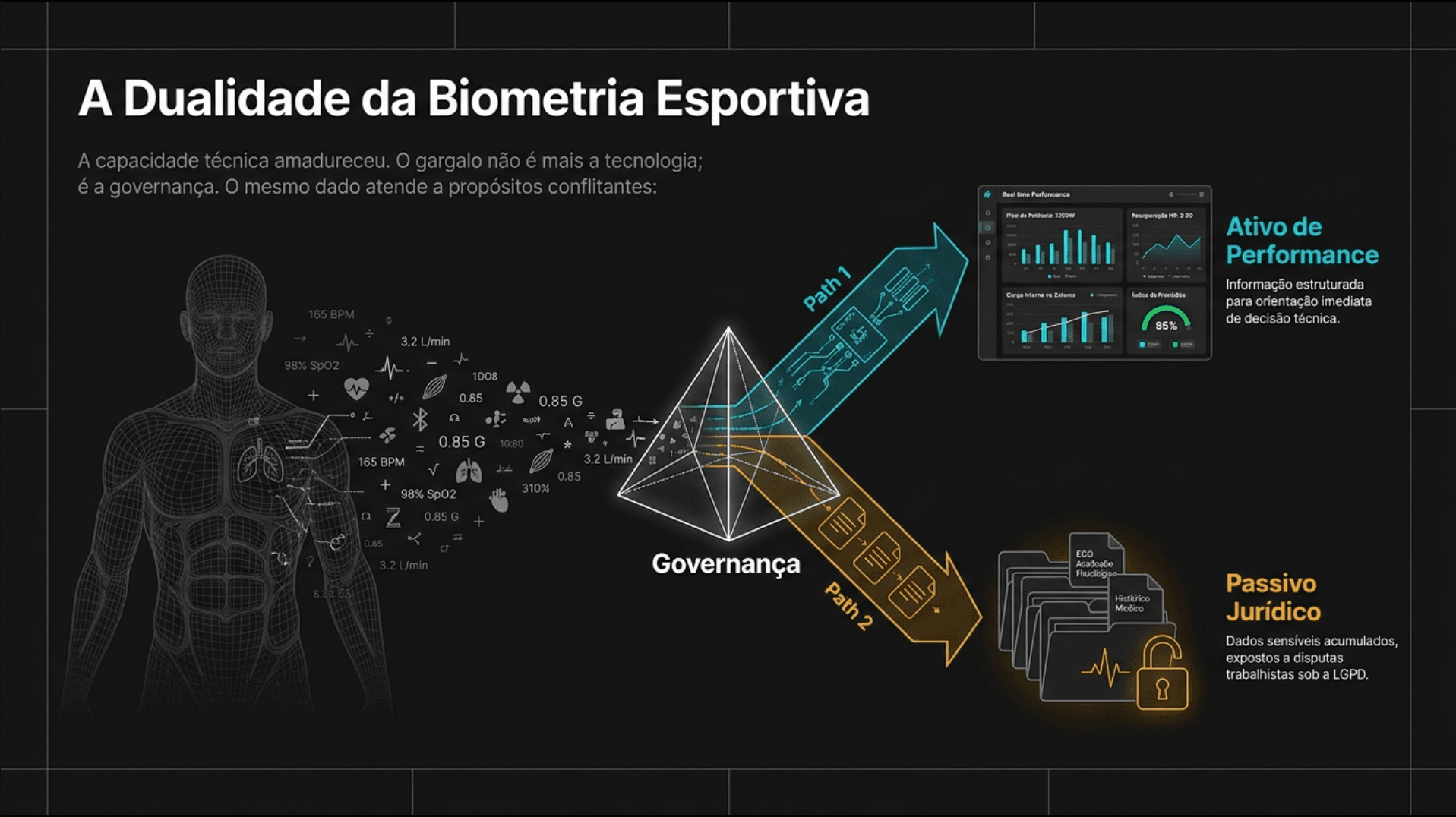
However, what gives the topic urgency is not the ability to measure, but what happens to the data afterwards. An athlete’s physiological data is, at the same time, performance information that guides technical decisions and health information the law protects. When those two uses coexist in the same flow, each reading potentially becomes evidence in a labor dispute, an input for contract negotiation and a commercial asset. That is why, therefore, the discussion has left the performance department and reached legal.
 2Market noise
Three inflated capabilities
What edge models calculate is the probability of accumulated fatigue and mechanical overload. Imminent muscle rupture during a match is not a diagnosis a wearable delivers — and selling it that way transfers to the device a responsibility that belongs to the medical department.
Continuous transdermal measurement of metabolic markers still faces calibration challenges under heavy sweating. It works with rigorous local filtering and recalibration; it is not, however, a lab reading strapped to the arm.
No vendor delivers LGPD compliance along with the hardware. Edge processing reduces the exposure surface, but the legal basis, consent and the impact assessment are obligations of whoever collects — not of the manufacturer.
3What is really happening
Wearable biometrics and privacy architecture have converged
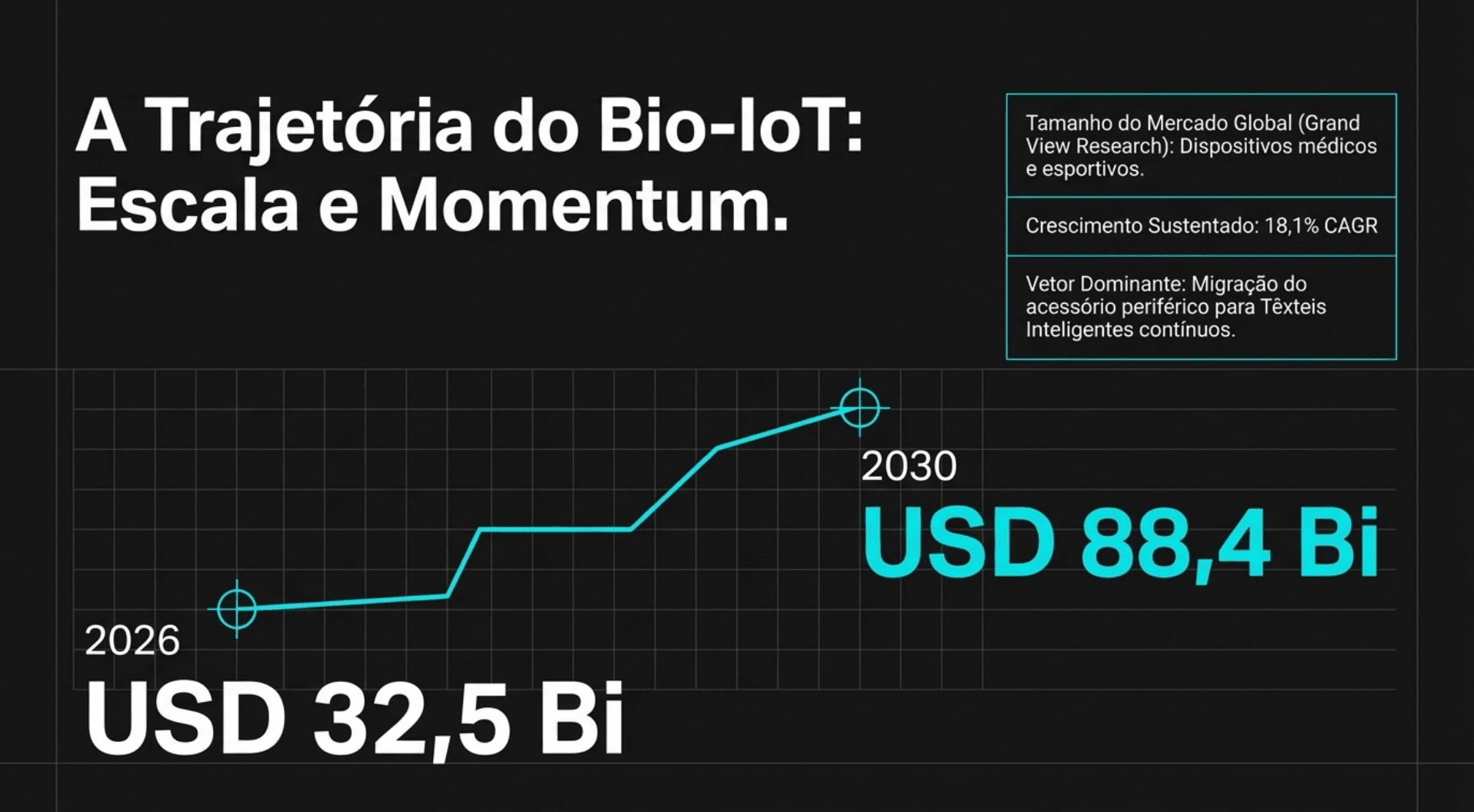
Evidence 1 — Sector scale. The global market for medical and sports wearables with biosensors is valued at USD 32.5 billion, projected to reach USD 88.4 billion by 2030 (18.1% CAGR); continuous biosensors and smart textiles are the fastest-growing segment.
Source: Grand View Research, Wearable Medical Devices Market Size, Share & Trends Analysis Report (2026–2030)
Evidence 2 — Ownership defined by contract. Collective bargaining agreements of the NFL and NBA players’ associations establish that raw physiological data is the player’s property and bar its use in salary negotiations. Consequently, on-device processing became the technical answer to a contractual requirement: the coach receives the index, not the medical record.
Source: NFLPA and NBPA, Collective Bargaining Agreements — wearable technology rules
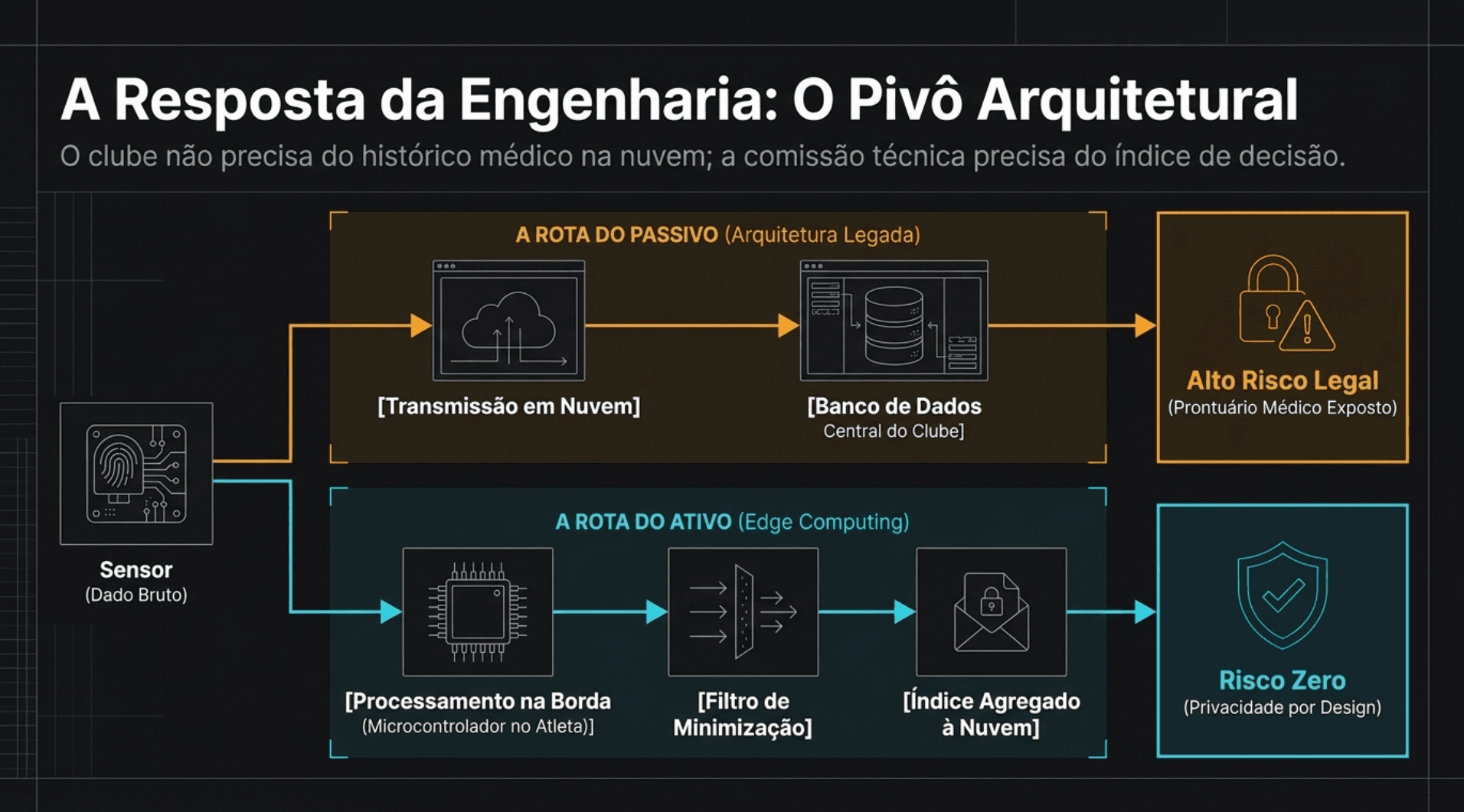
Evidence 3 — Architecture standards. Encryption at rest and in transit on the wearable node, and federated learning — in which the model learns from several athletes’ data without centralizing biometrics — already have normative references, including the IEEE P3652.1 guide on federated learning architecture.
Source: IEEE Standards Association, IEEE P3652.1
On-device processing with aggregated indices sent out, in leagues with defined contractual governance.
Stable continuous metabolic biosensors in competition and federated learning at scale across organizations.
Finally, what prevents scale: the cost of wearables with embedded inference and, above all, the absence of a legal structure in the organization that collects.
4Applicability in Brazil
Who has the exposure — and who has the opportunity
In Brazil, two profiles concentrate both the conditions and the exposure to address the topic now:
- Football clubs and Olympic federations with structured medical and performance departments. They already use wearables in training routines, have employment or contractual ties with athletes and hold an accumulated data history. The exposure, therefore, already exists; what is missing is the architecture that limits it.
- Sportstech startups and performance-software developers. They build the product clubs will contract. For them, treating privacy architecture as an engineering requirement — not a contract clause — is an immediate commercial differentiator, because the buyer has started asking.
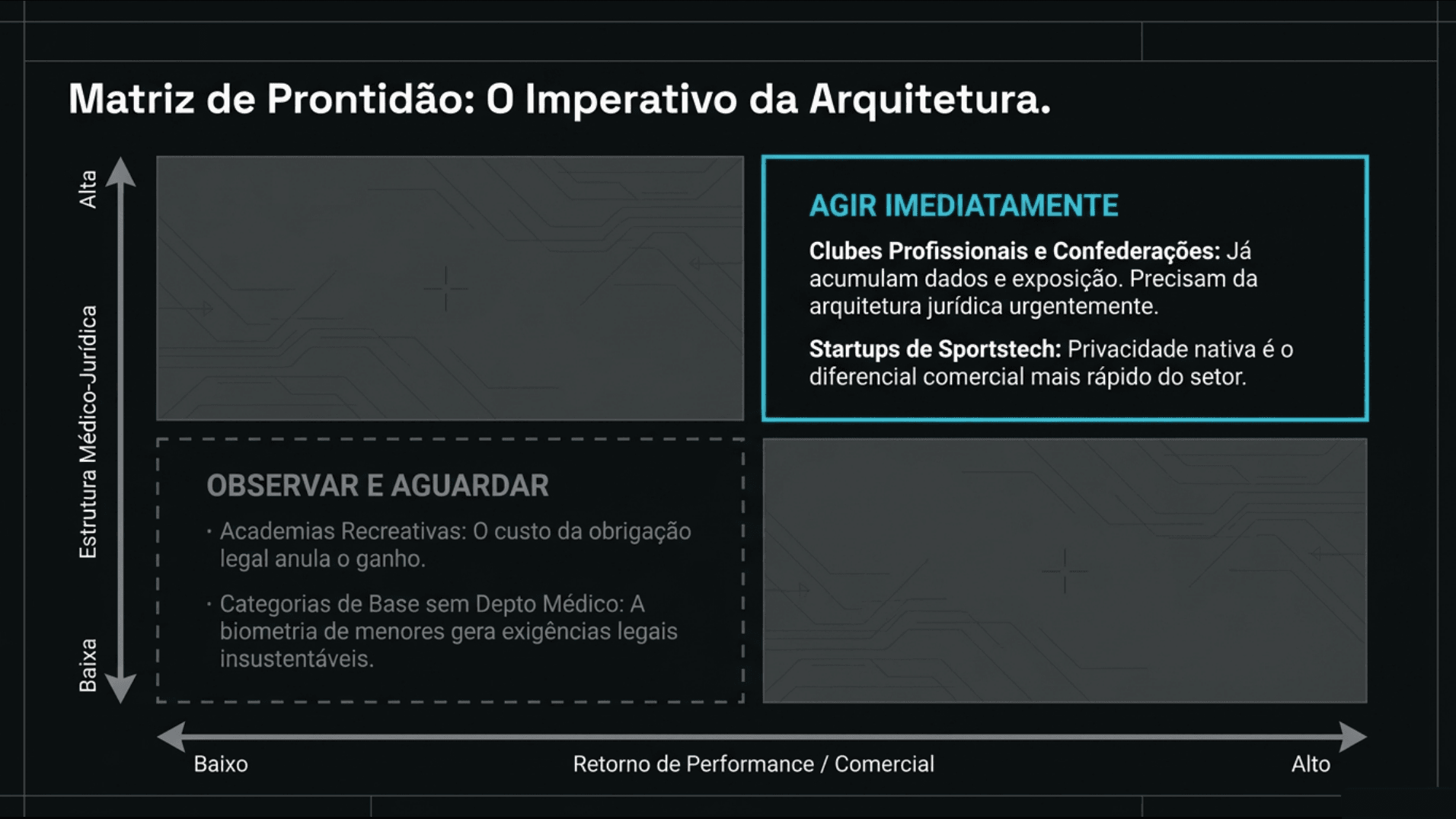
These two profiles — starting with the data protection impact assessment and the definition of the legal basis for processing, which determine which architecture to buy. Doing it in the reverse order means switching systems later.
Gyms and recreational centers without a high-performance routine, because they take on the obligation of handling sensitive data without a matching gain; and, likewise, youth categories without their own medical department, because biometrics of minors adds a legal layer the structure cannot support.
54TT’s intellectual signature
The real bottleneck of LGPD in sports is not technology. It is data governance.
Measuring lactate or heart-rate variability is a solved problem. The hard part, however, is answering who the data subject is, who the controller is, what the legal basis for processing is, and what happens to the history when the athlete is transferred. Organizations that buy the sensor before answering that are not acquiring a performance tool — they are building a liability with an expiry date, which falls due at the first contract dispute or inspection.
6Executive conclusion
In 60 seconds
- The hype overstatesreal-time injury prediction, infallible metabolic biosensors and compliance that comes built into the product.
- Real maturity lies inprocessing on the wearable itself with aggregated indices sent out, in leagues where data ownership is already defined in collective agreements.
- Brazil facesan Experimental stage in this layer, with an aggravating factor — physiological data is already collected routinely without the corresponding legal structure under the LGPD.
- Who should act nowclubs and federations with structured medical departments, and sportstech startups — impact assessment and legal basis first, hardware later.
- Who should watch and preparerecreational gyms, amateur sport and youth categories without their own medical structure.
- Signal to watcha position by the ANPD (Brazil’s data protection authority) on biometrics and wearables in employment relationships — professional sport will be reached by that reading before any sector-specific rule.
Innovation Radar
Signals from the Brazilian science and technology ecosystem related or adjacent to the topic. They are signals, not recommendations.
Fabrics with functions beyond clothing, including embedded electronics. The physiological wearable is migrating from accessory to fabric; in addition, the country has installed competence in the textile chain — the hardest link to import.
Source: SENAI CETIQT
Federal institute in Campinas working on embedded hardware and critical-systems software. Inference inside the device is an embedded-engineering problem, not a sports-science one — and that competence is national and available.
Source: CTI Renato Archer
Research on training load, recovery and physiological response to effort. The clinical validation of the index the algorithm delivers to the coach has to come from here; without it, the number on the screen is precision without meaning.
Source: EEFE-USP; CEPE/UNIFESP
Biometric and health data are sensitive personal data (art. 5, II). In other words, LGPD in sports is not a future rule: the requirements of legal basis, consent and impact assessment already apply to every club using wearables today.
Source: Planalto; ANPD
Market Insight
There is a useful inversion of reading here. The LGPD is usually presented to sports organizations as cost and risk. For those who develop technology, however, it is a product specification — and one of the clearest in the Brazilian market. A wearable or platform born with edge processing, data minimization and a consent trail is not merely compliant: it is solving, for the buying club, the problem it does not yet know how to describe. That is the layer nobody in the domestic market has occupied.
For private companies, the practical path is rarely to develop their own sensor — it is to build the software, embedded and governance layer on top of hardware already available, and validate the result with those who have the scientific authority to attest it:
With an exercise-physiology research group, to clinically validate the index delivered to the coach.
Development alongside a technology institute, to bring inference inside the wearable.
Structured with innovation funding, with impact assessment and legal basis defined before the first sensor.
In short, what defines the return is not the sensor chosen: it is the validation that accompanies the number.
Bio-IoT in sports, in one picture
The infographic below gathers the edition’s argument: the risk of collection without governance, the market myths, privacy architecture and who should act. The graphic is in Portuguese, as originally published.
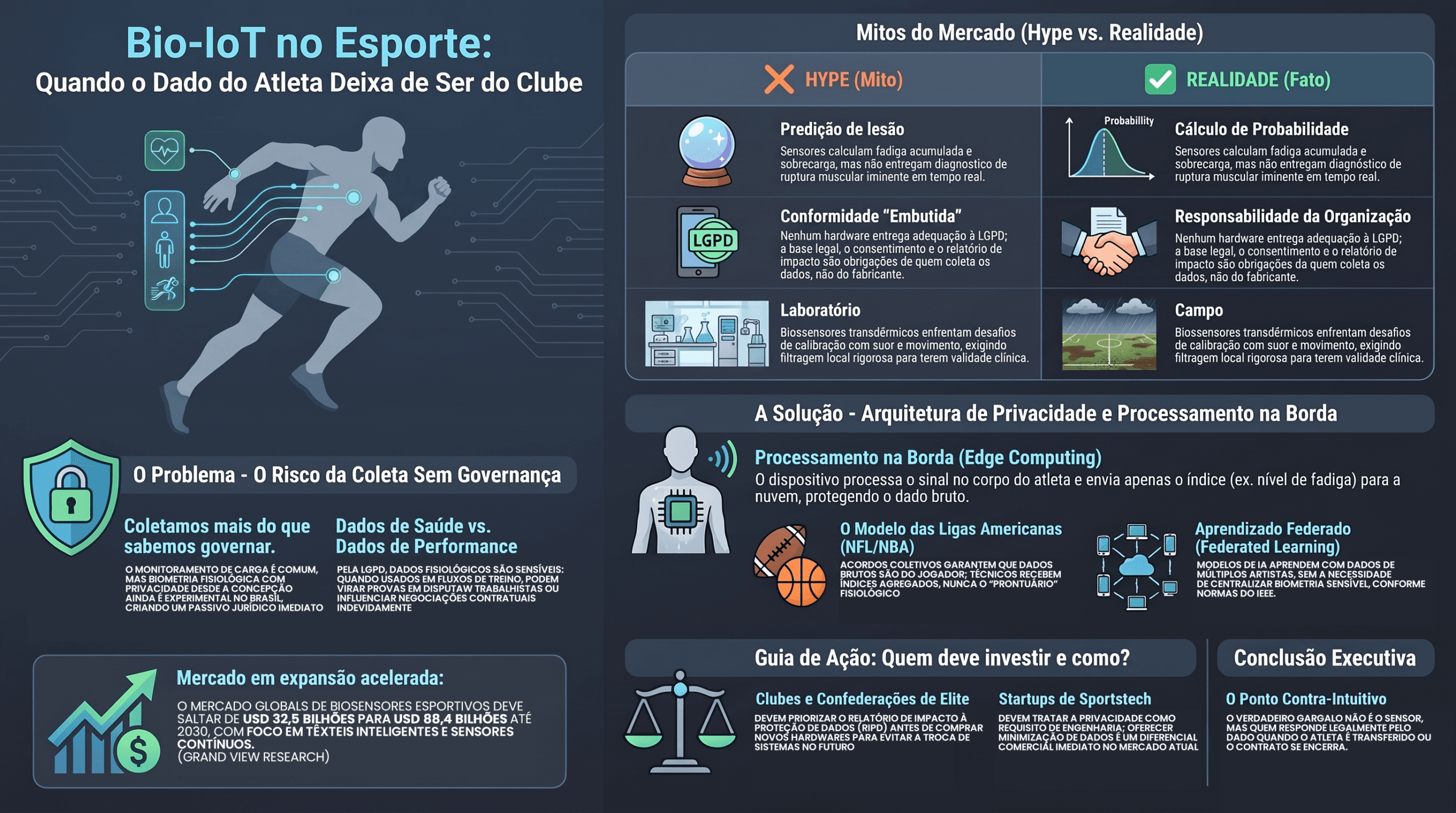
Click the image to enlarge.
4 Trade Tech exists to turn science into business decisions.
If this topic touches your operation, let’s talk. Schedule a conversation with 4TT about innovation projects, outsourced R&D and partnerships with the science and technology ecosystem.
[email protected] · +55 11 93244-4141 · linkedin.com/company/4tradetech
The complete series: Connected Arenas and Athletes
- Article 1 — Private 5G in stadiums: what Brazil is missing
- Article 2 — Sports micro-telemetry: where does Brazil stand?
- Article 3 — LGPD in sports: athlete biometrics and wearables (this article)
Connected Arenas and Athletes was a three-part series of the 4 Trade Tech newsletter, produced in editorial partnership with FBIoT (Brazilian IoT Forum). Originally published in Portuguese.
Sources
- Grand View Research — Wearable Medical Devices Market Size, Share & Trends Analysis Report (2026–2030): USD 32.5bn → USD 88.4bn by 2030, 18.1% CAGR.
- MarketsandMarkets — Continuous Glucose & Biosensors Monitoring Market, Global Forecast.
- Law No. 13,709/2018 (LGPD) — biometric and health data as sensitive personal data (art. 5, II); legal basis, consent and impact assessment.
- ANPD — guidance on the processing of sensitive personal data and biometrics.
- NFLPA and NBPA — Collective Bargaining Agreements, wearable technology rules.
- IEEE Standards Association — IEEE P3652.1, Guide for Architectural Framework and Application of Federated Learning.
- Briefing of the series “The Connected Athlete & Arena” (FBIoT/4TT).