- Experimental
- Pilots
- Scale
- Consolidation
Experimental: there is no consolidated data on equipment micro-telemetry integrated into live broadcasts in the country. The partial exception is motorsport, where vehicle telemetry has been standard for decades — but it serves teams and race control, with limited entry into the broadcast graphics feed. The data does not yet exist, and that in itself is a signal of the real stage.
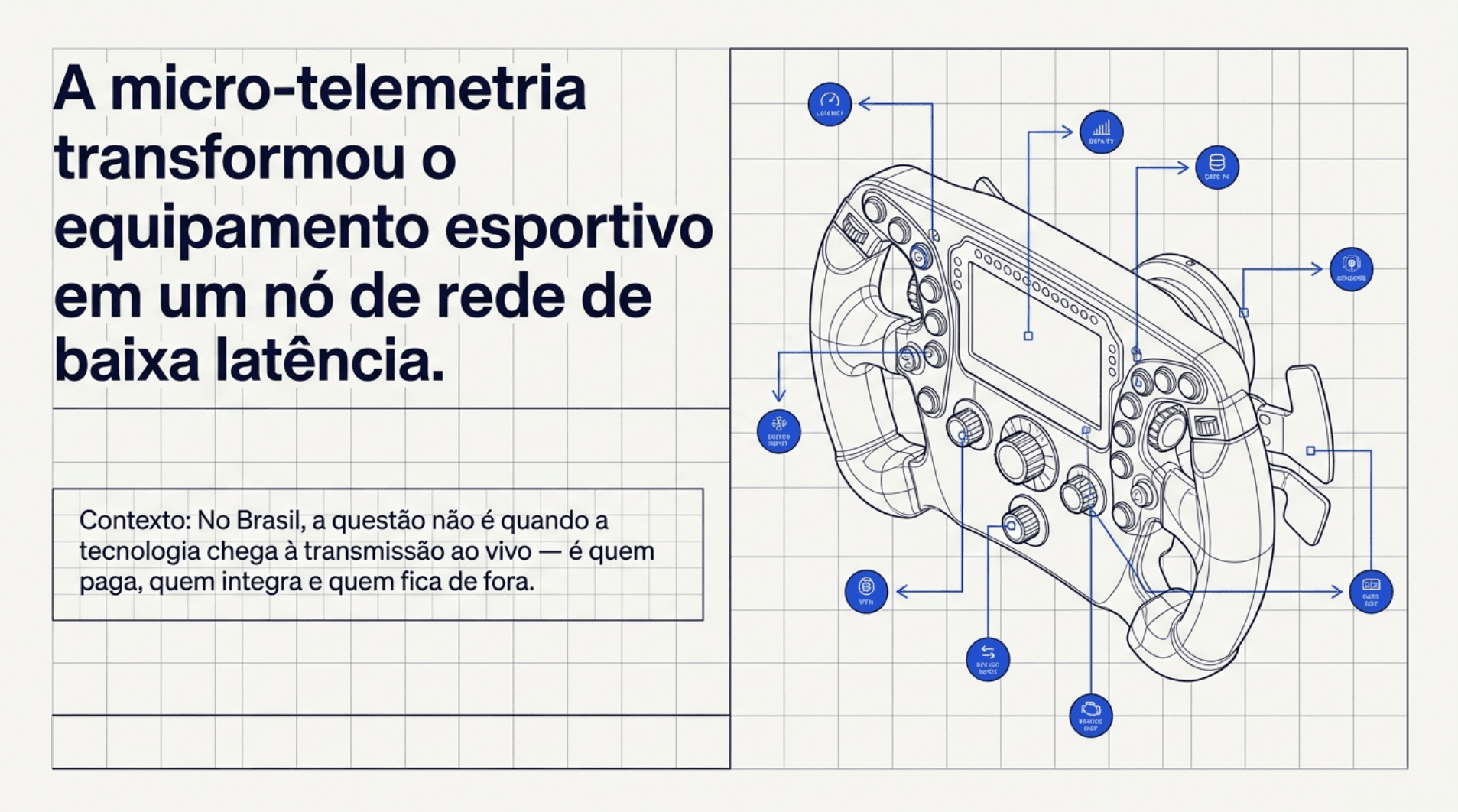
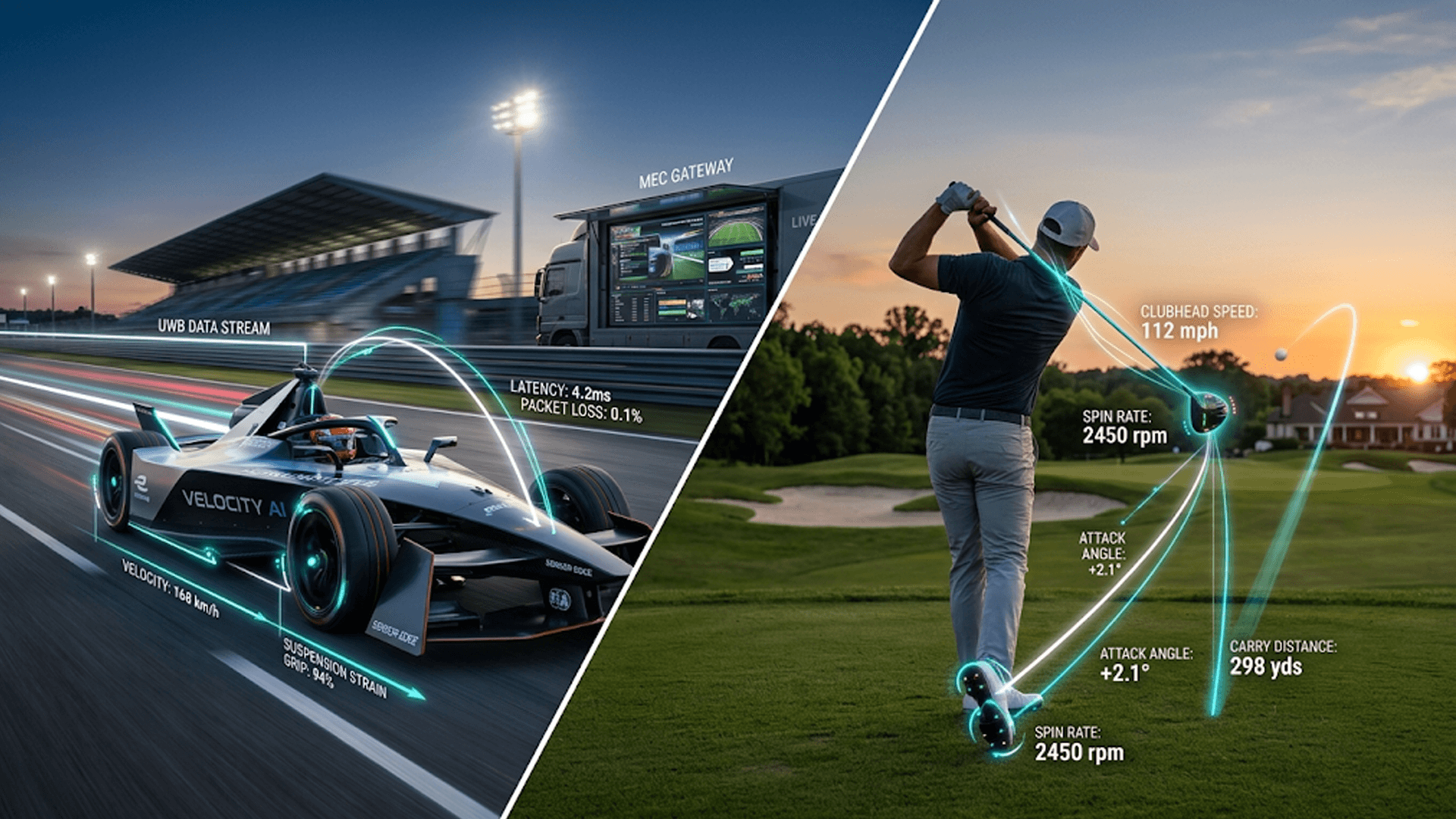
Sports micro-telemetry has already reached live broadcasting. Clubs that report swing speed, chassis that transmit axle vibration, balls that describe their own trajectory in three dimensions before touching the ground: at major international events, sports equipment has become a network node — and the data it generates reaches the broadcast graphic in less than a tenth of a second.
In Brazil, however, the conversation still revolves around an imprecise question: when does this get here? The useful question is a different one: it gets here for whom, paid by whom, and integrated into which production chain. This edition therefore separates what real-time micro-telemetry already delivers abroad, what remains a promise even there, and what a Brazilian sports or media organization needs to have in place before signing any hardware contract.
This is the second article in the series. The first, Private 5G in stadiums: what Brazil is missing, covered the network that sustains all of this.
1Context and urgency
Three vectors matured at the same time
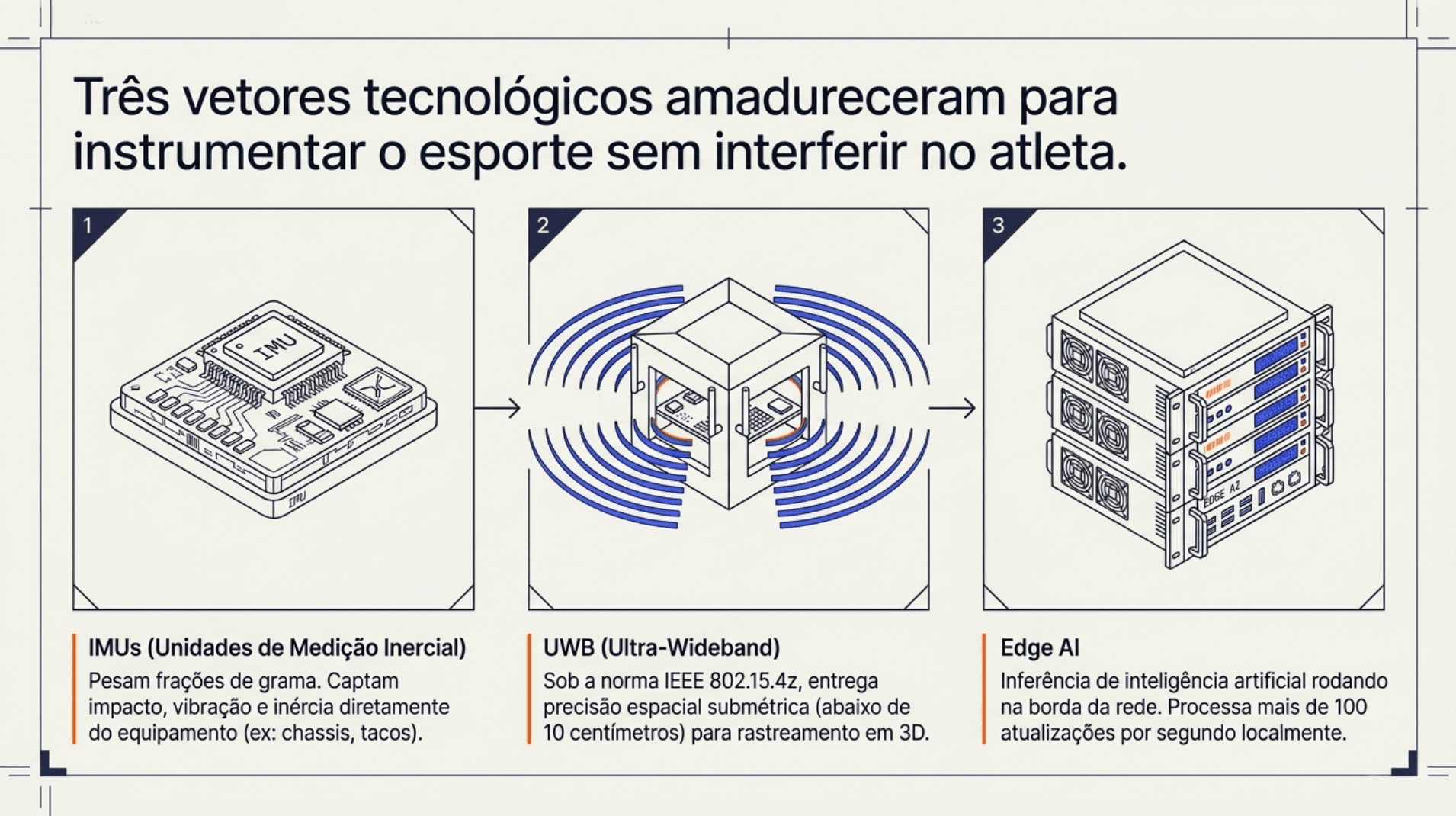
First, three technical vectors matured simultaneously: inertial measurement units (IMUs) weighing a fraction of a gram, ultra-wideband (UWB) position tags with sub-10-centimeter precision, and inference models that run at the network edge without depending on the cloud to respond. Together, they make it possible to instrument the object of the sport — club, ball, car, saddle — without interfering with the athlete.
The movement was born in high-precision individual sports and motor categories. According to this series’ briefing, the 2025–2026 Ryder Cup deployments feature complete on-course sensor arrays feeding 3D graphic overlays; similarly, comparable architectures are expanding into Formula E and equestrian sports. However, what gives the topic urgency is not the technology itself, but what it moves: the value of broadcast rights has come to depend on second screens, real-time betting and immersive graphics — products that only exist with live data.
2Market noise
Three capabilities inflated by sales material
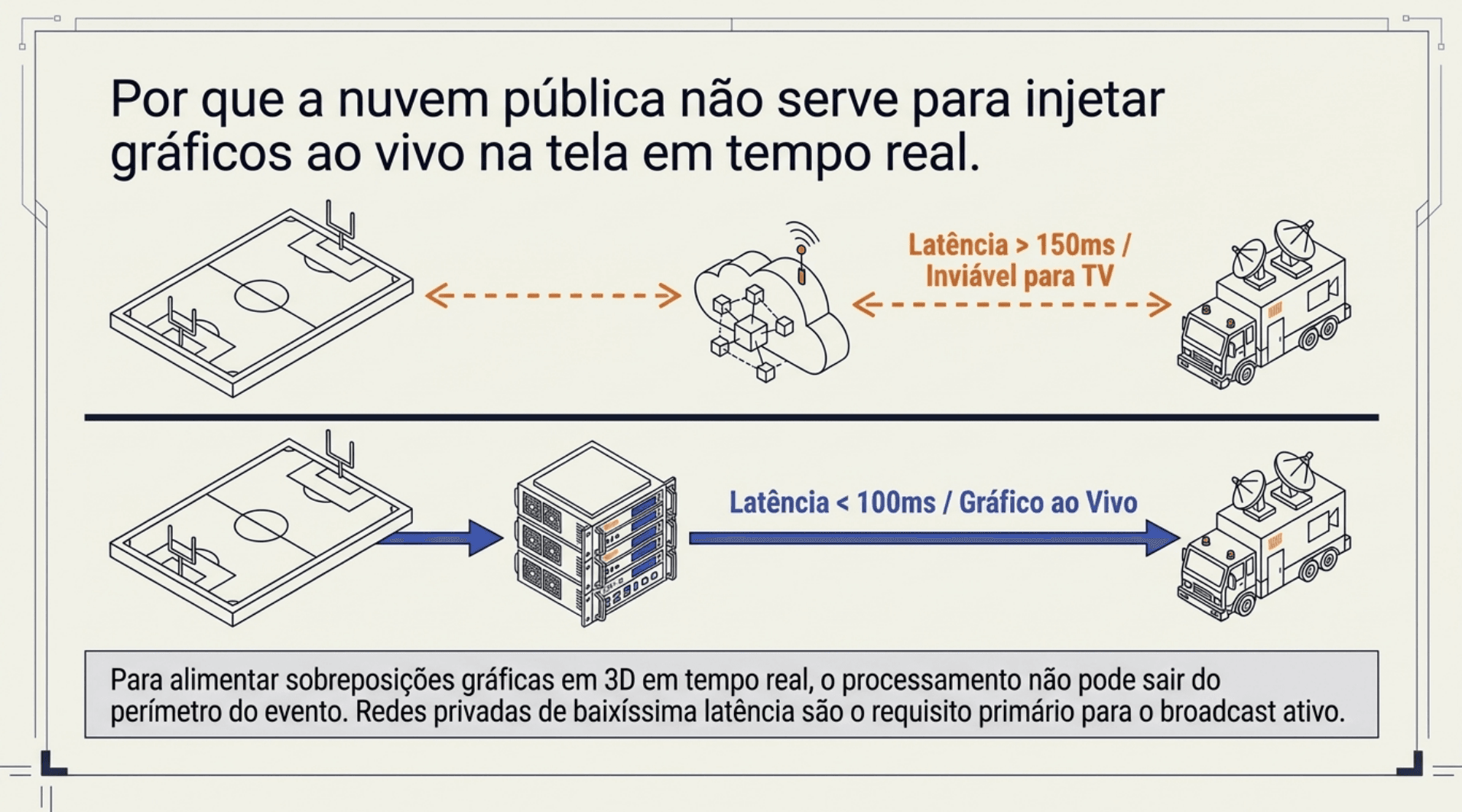
In practice, data density and the sub-100-millisecond latency requirement demand edge gateways at the venue. The public cloud receives only consolidated data — not the raw signal.
The state of the art combines kinetic or thermal energy harvesting with micro-batteries operating in transmission bursts. It works for specific disciplines; it is not, however, a generic solution for any sport.
Clean data does not enter the graphic on its own. Between sensor and screen lies a layer of data engineering and media production that each event must build — and that is precisely where most of the cost hides.
None of these promises is entirely false. All of them, however, depend on conditions that rarely appear in the sales material.
3What is really happening
From passive to active telemetry
The transition from passive telemetry (post-event analysis) to active telemetry (data injected live) is supported by verifiable evidence:
Evidence 1 — Sector scale. The global sports analytics and telemetry market is valued at USD 4.31 billion, projected to reach USD 12.6 billion by 2030 (23.8% CAGR). Hardware — IMUs and UWB tags — accounts for more than 48% of that revenue.
Source: MarketsandMarkets, Sports Analytics Market — Global Forecast to 2030
Evidence 2 — Inference at the edge. The Edge AI market in IoT devices is estimated at USD 20.4 billion, projected above USD 60 billion by 2030 (24.1% CAGR). Real-time inference in arenas is cited as the main driver outside manufacturing.
Source: Grand View Research, Edge AI Market Size, Share & Trends Analysis Report (2026–2030)
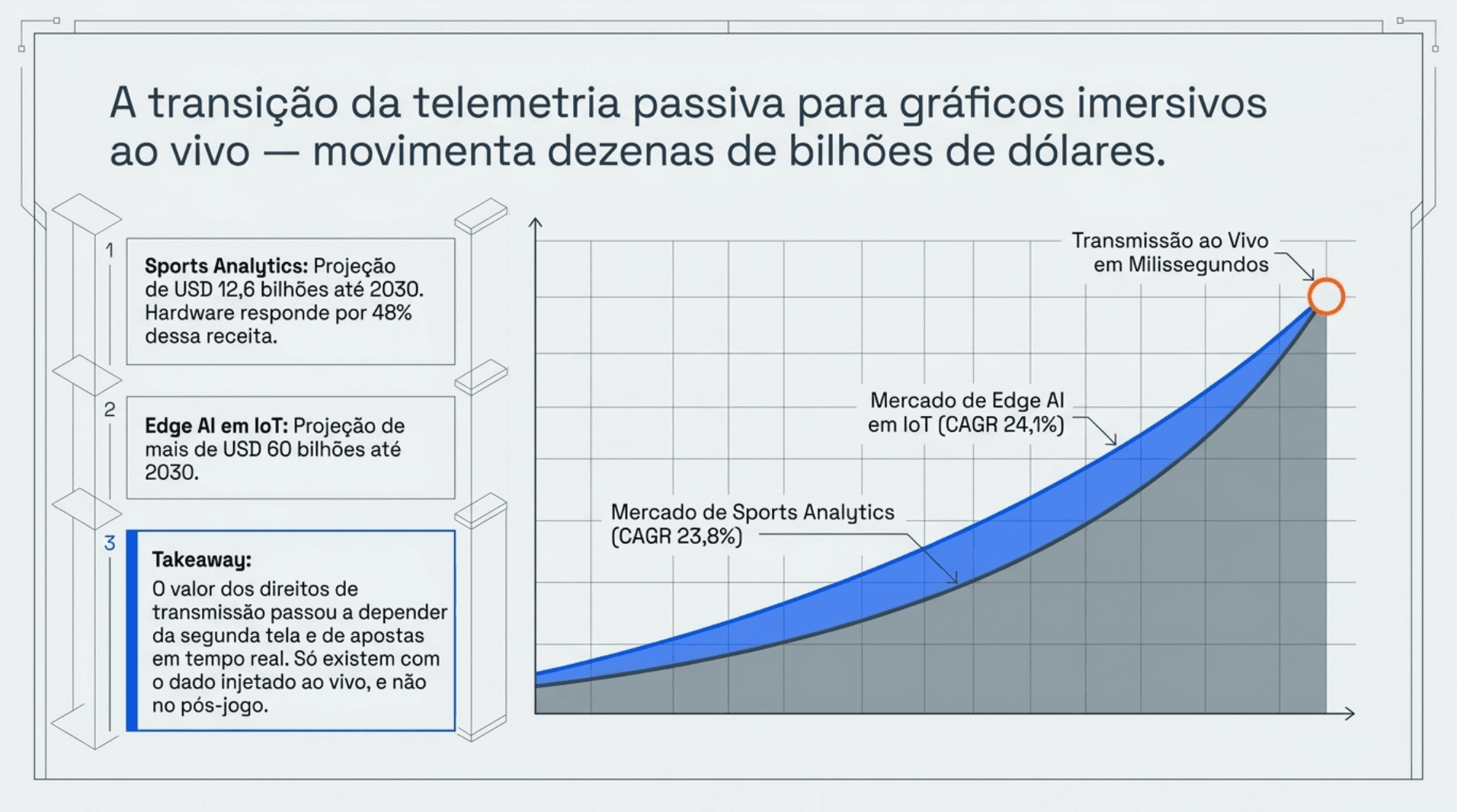
Evidence 3 — Consolidated technical standard. Under IEEE 802.15.4z and the FiRa Consortium specifications, UWB nodes deliver spatial precision below 10 centimeters. In addition, commercial local-positioning platforms already document more than 100 updates per second processed at the edge, feeding live graphics.
Source: IEEE Standards Association; FiRa Consortium; Kinexon Sports & Media
Equipment instrumentation at elite events, with local processing and latency below 100 ms.
Energy autonomy for any discipline and standardization of data formats across vendors.
Finally, what prevents scale: the cost of sensors certified for impact and thermal variation, the absence of edge infrastructure at most venues, and a media production chain designed for studio graphics, not for data injected into the stream.
4Applicability in Brazil
Where sports micro-telemetry has the conditions to start
In Brazil, two sectors concentrate the minimum conditions to leave the experimental stage:
- Elite national motorsport (promoters of categories such as Stock Car and Copa Truck and their rights partners). Organizations with their own broadcast production or a strong technical partner, fixed circuits with some cabling infrastructure and an established culture of vehicle telemetry. What is missing, therefore, is the layer of equipment micro-telemetry connected to the graphic — not the habit of measuring.
- Mid-to-large sports broadcast producers and rights holders with their own technical broadcast operation and an interest in second-screen products. IT capable of operating a private network at the venue and a graphics team open to external real-time data.
These two profiles — starting with edge infrastructure at the venue and standardized data protocols (MQTT/JSON) for integration with video rendering, not with buying sensors.
Federations of individual disciplines (equestrian, golf, sailing) without broadcast audiences at scale, because the cost per event does not close without rights revenue; and, likewise, amateur leagues and arenas without a private network, because a sensor without an edge produces an archive nobody can use live.
54TT’s intellectual signature
The real bottleneck of sports micro-telemetry is not technology. It is integration and business model.
Collecting gigabytes of inertial data is a solved problem. What stalls, however, is deciding who owns the data — organizer, rights holder, team or athlete — and who pays for the engineering that turns physical noise into a single clean metric on the TV graphic in milliseconds. Without that agreement, the most precise sensor in the world becomes a hardware cost with no revenue on the other side.
6Executive conclusion
In 60 seconds
- The hype overstatesinvisible, self-powered sensors, straight to the cloud and plug-and-play with the broadcast.
- Real maturity lies inelite individual sports and motor categories abroad, with local edge and integration built to measure for each event.
- Brazil facesan Experimental stage — imported hardware in hard currency, no edge at venues and a media chain not prepared for live data.
- Who should act nowmotorsport promoters and producers/rights holders — infrastructure and data standards first, sensors later.
- Who should watch and preparefederations of individual disciplines, grassroots leagues and arenas without a private network.
- Signal to watchthe first partnership between a Brazilian rights holder and a UWB/Edge AI vendor at a large event.
Innovation Radar
Signals from the science and technology ecosystem related or adjacent to the topic. They are signals, not recommendations — they describe what exists and why it matters.
Research in automatic athlete tracking and kinematic movement analysis. In other words, the competence in fusing and validating movement data — exactly the engineering layer the market lacks — already exists in a Brazilian university.
Source: FEF/Unicamp
Athlete load monitoring with wearable sensors. It shows that inertial data collection in the field already happens in the country; what does not yet exist, however, is the bridge between that data and the broadcast.
Source: NAR-SP
Research in private networks, edge architectures and latency requirements for critical applications. It is the infrastructure circuits and arenas need before any sensor — and it is being developed at a Brazilian institute.
Source: CPQD / Brasil 6G Program
Enhanced physical and MAC layers for UWB, with burst modulation and sub-meter precision. Consequently, the technical standard for sports micro-telemetry is already settled; the Brazilian gap is integration, not standards.
Source: IEEE Standards Association; FiRa Consortium
Market Insight
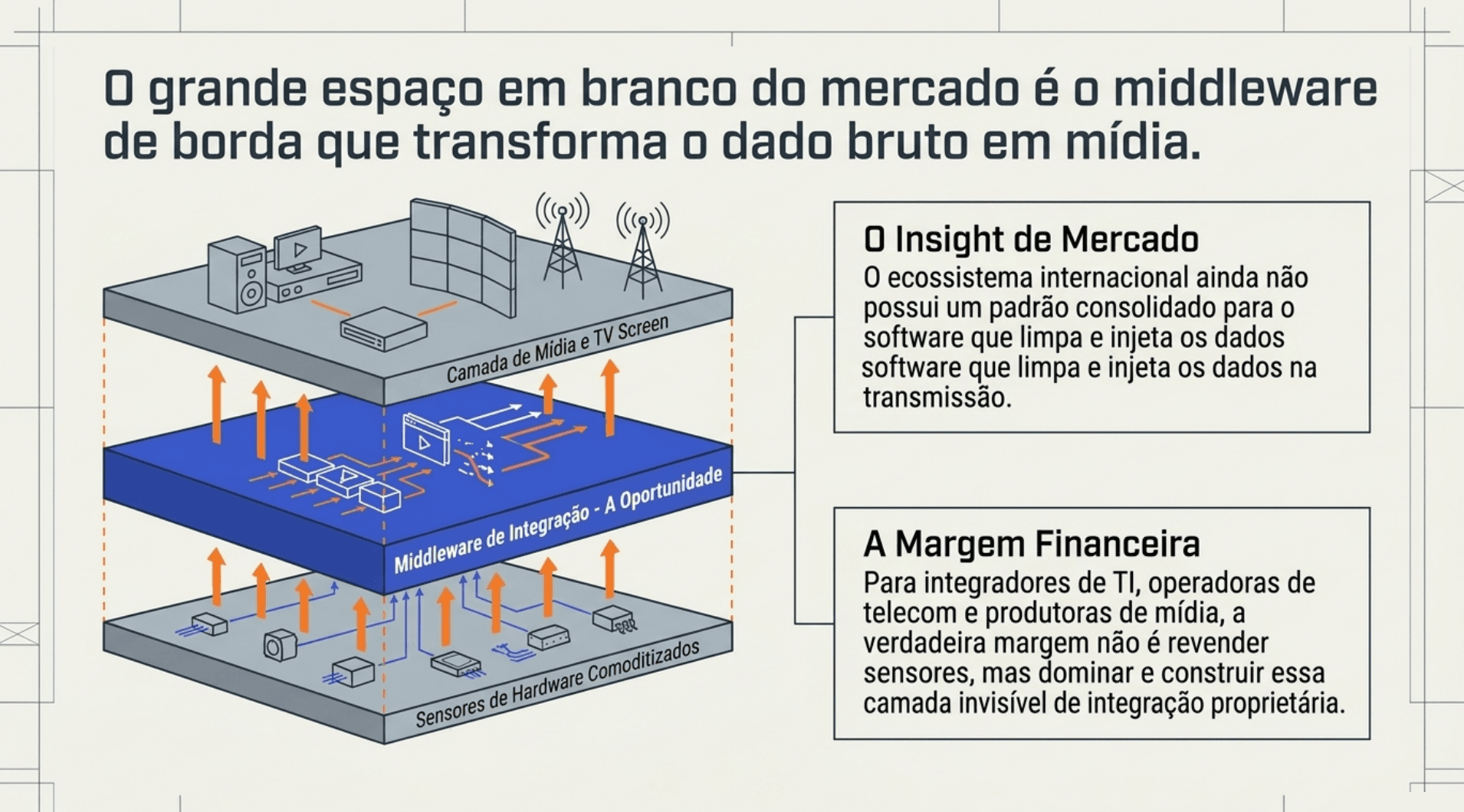
For media producers, event promoters, IT integrators and operators, the opportunity is not in importing sensors. It lies, rather, in occupying the layer the international market has not yet standardized: the edge middleware that turns raw data into a graphic-ready metric, and the data-ownership arrangements that make that flow commercially viable.
In addition, there are ways to get there without taking on all the R&D risk internally:
Biomechanics labs and network groups, through programs such as Embrapii and FAPESP PIPE, with non-repayable funding for proofs of concept at venues.
Private edge network in partnership with an operator, splitting the upfront investment and testing real latency at the circuit or arena.
Structuring a startup out of groups that already master movement-data engineering — the university deep-tech model 4TT supports.
In short, each of these paths serves different company profiles — and choosing the right one is a strategy decision, not a technology one.
4 Trade Tech exists to turn science into business decisions.
If this topic touches your operation, let’s talk. Schedule a conversation with 4TT about innovation projects, outsourced R&D and partnerships with the science and technology ecosystem.
[email protected] · +55 11 93244-4141 · linkedin.com/company/4tradetech
The series: Connected Arenas and Athletes
- Article 1 — Private 5G in stadiums: what Brazil is missing
- Article 2 — Sports micro-telemetry: where does Brazil stand? (this article)
- Article 3 — LGPD in sports: athlete biometrics and wearables
Connected Arenas and Athletes is a three-part series of the 4 Trade Tech newsletter, produced in editorial partnership with FBIoT (Brazilian IoT Forum). Originally published in Portuguese.
Sources
- MarketsandMarkets — Sports Analytics Market, Global Forecast to 2030 (USD 4.31bn → USD 12.6bn; 23.8% CAGR; hardware 48%).
- Grand View Research — Edge AI Market Size, Share & Trends Analysis Report 2026–2030 (USD 20.4bn → USD 60bn; 24.1% CAGR).
- FiRa Consortium — Technical Specifications for Ultra-Wideband (UWB): sub-meter precision (<10 cm) for RTLS under IEEE 802.15.4z.
- IEEE Standards Association — IEEE 802.15.4z, Enhanced UWB Physical and MAC Layers.
- Kinexon Sports & Media — Real-Time Location & Micro-Telemetry Platform: >100 Hz on private networks and integration with broadcast overlays.
- Briefing of the series “The Connected Athlete & Arena” (FBIoT/4TT): Ryder Cup 2025–2026, Formula E and equestrian sports.