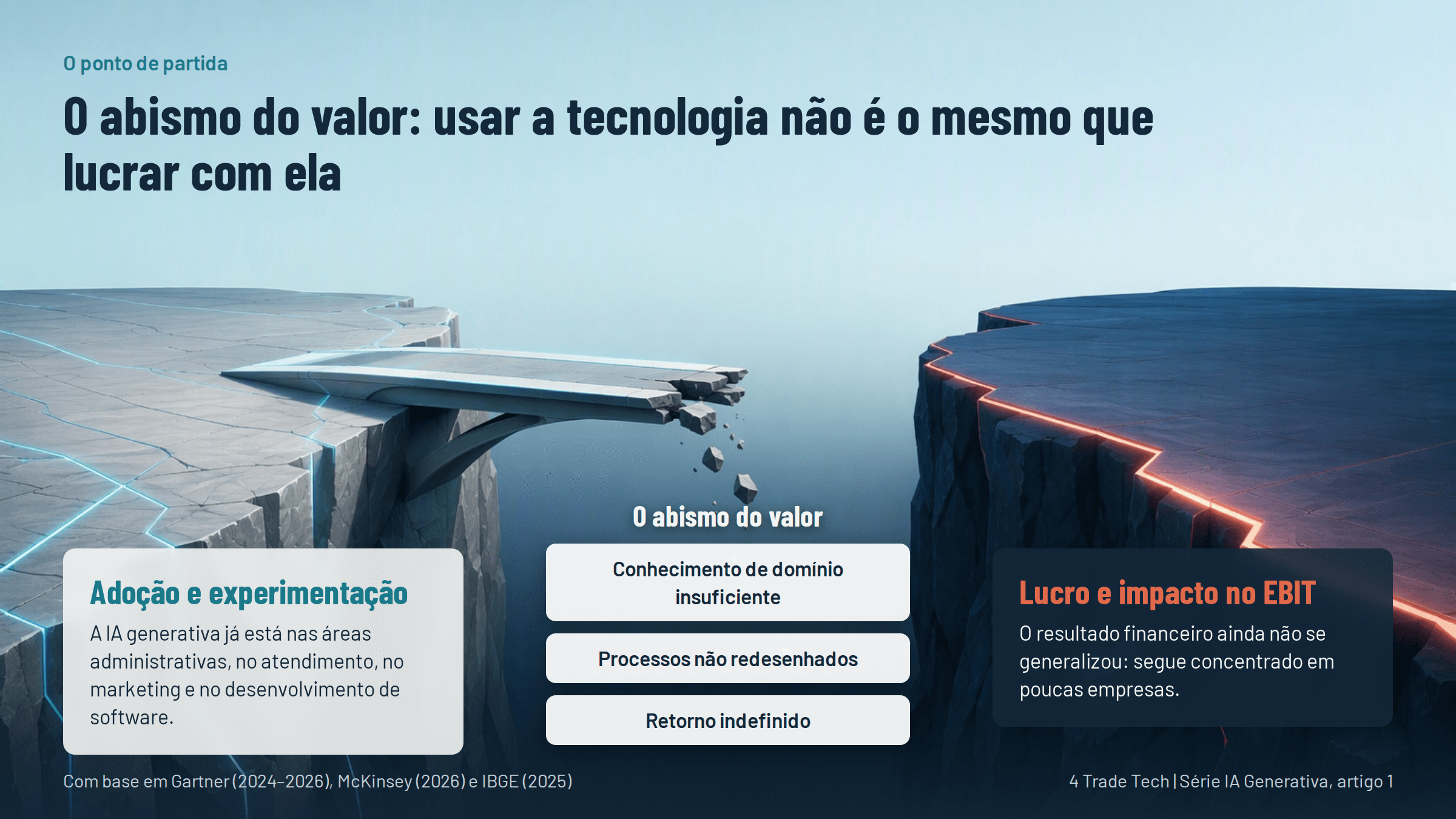
Generative AI trends are no longer a novelty inside companies. It is already present in administrative functions, customer service, marketing and software development. What has not yet become widespread is the financial return. This gap between using the technology and extracting value from it is the starting point of this series.
Generative AI trends on Gartner’s map: four drivers of scale
In June 2026, Gartner published an analysis of emerging adoption trends for generative AI, aimed at product leaders in companies that build AI-enabled solutions. Its thesis is straightforward: over the next two years, four drivers should allow the technology to move beyond experimentation and reach scale.
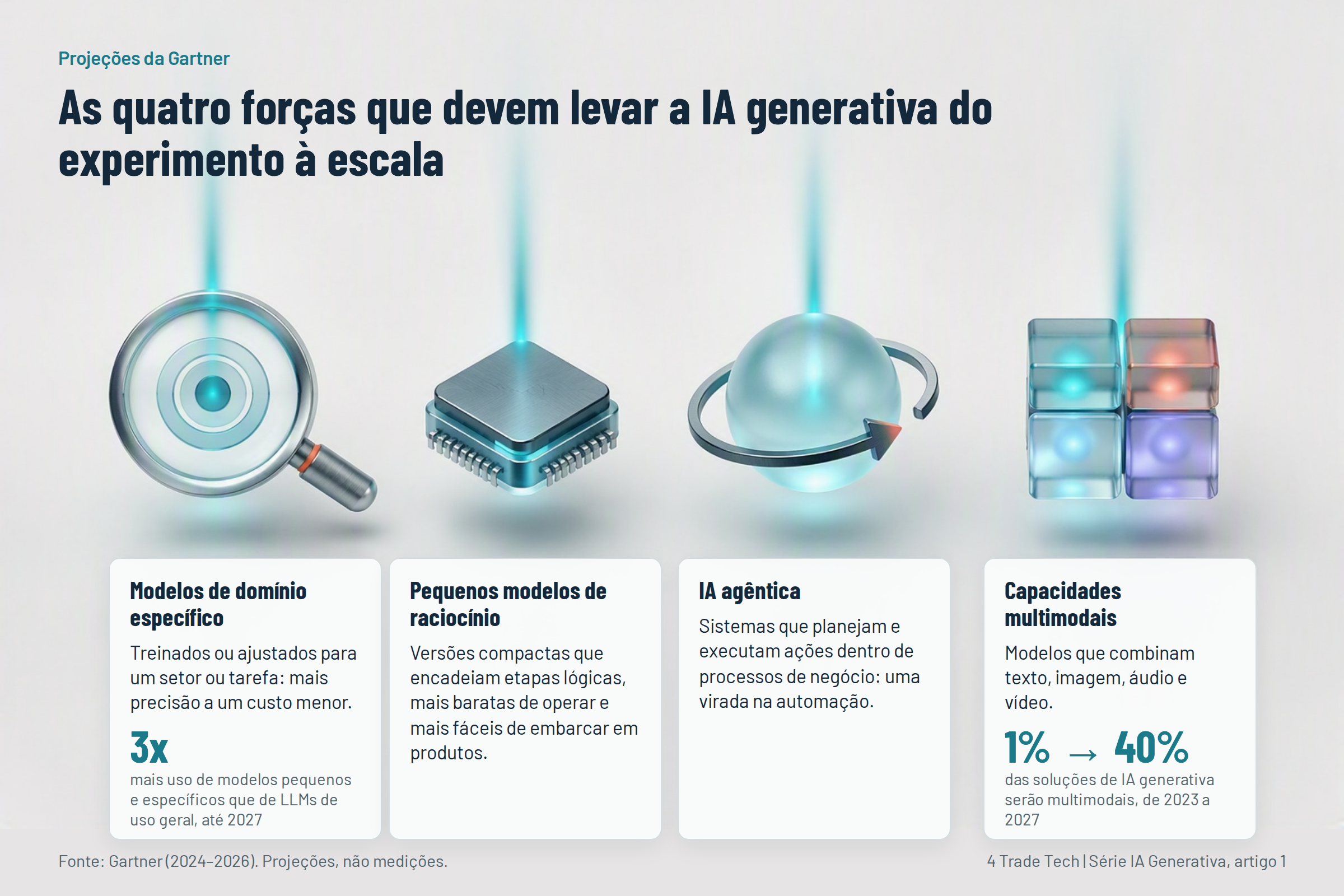
1. Domain-specific models. These are models trained or tuned for a particular industry or task. According to the firm, they deliver greater accuracy and efficiency at a lower cost than general-purpose models. In a press release from April 2025, Gartner predicted that by 2027 organisations will use small, task-specific models at least three times more than general-purpose large language models.
2. Small reasoning models. These are compact models that can chain logical steps together, are cheaper to run and are easier to embed in products.
3. Agentic AI. These are systems that do not just answer, but plan and carry out actions within business processes. Gartner sees them as a turning point in process automation, enabling more autonomous workflows.
4. Multimodal capabilities. These are models that combine text, images, audio and video. Gartner predicts that 40% of generative AI solutions will be multimodal by 2027, up from 1% in 2023.
The article also points to two further developments. The first is AI simulation and synthetic data, which matter in regulated industries and manufacturing. The second is the progressive automation of the entire software development life cycle.
A word of caution: all of the above are predictions, not measurements. They show where the technology supply is heading, not how much value it already generates.
What the measurements show about generative AI trends
To measure value, the most recent reference is McKinsey’s annual global survey, The State of AI, published in August 2026. The numbers show adoption advancing unevenly and returns failing to keep pace.
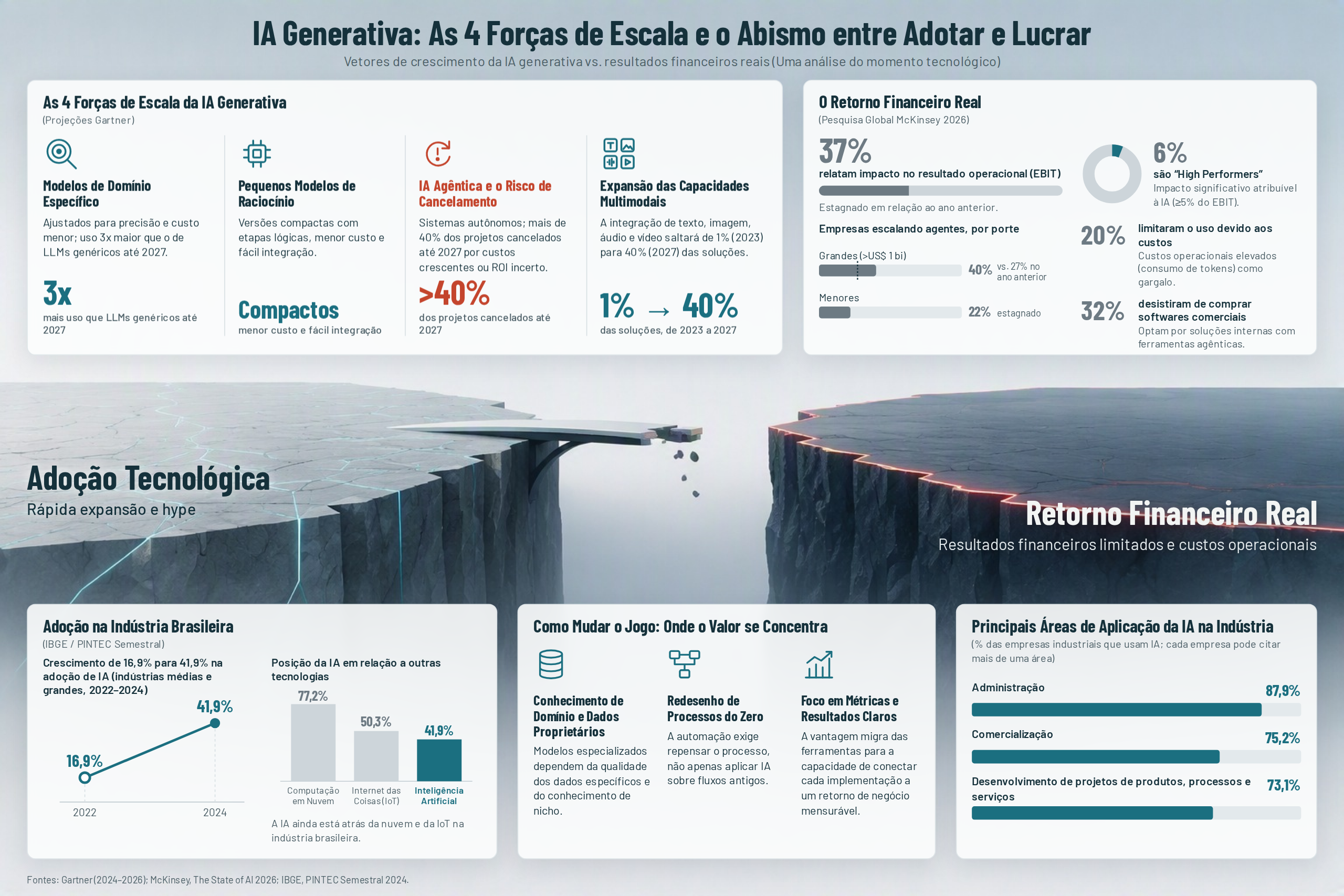
Financial results have stalled. Only 37% of respondents attribute any EBIT impact to their use of AI, practically the same level as the previous year. The group of high performers, who attribute at least 5% of EBIT to AI and describe its impact as significant, remains at about 6%.
Agents are advancing, but in large companies. Among organisations with annual revenues above US$1 billion, 40% say they are scaling AI agents, up from 27% the year before. Among smaller organisations, the figure held steady at 22%.
Cost is already a constraint. About 20% of respondents report that AI-related operating costs, including token consumption, constrained their use of the technology.
The software market is starting to shift. Nearly a third (32%) say their organisation has decided against buying a software product or feature because it could be built in-house with agentic coding tools.
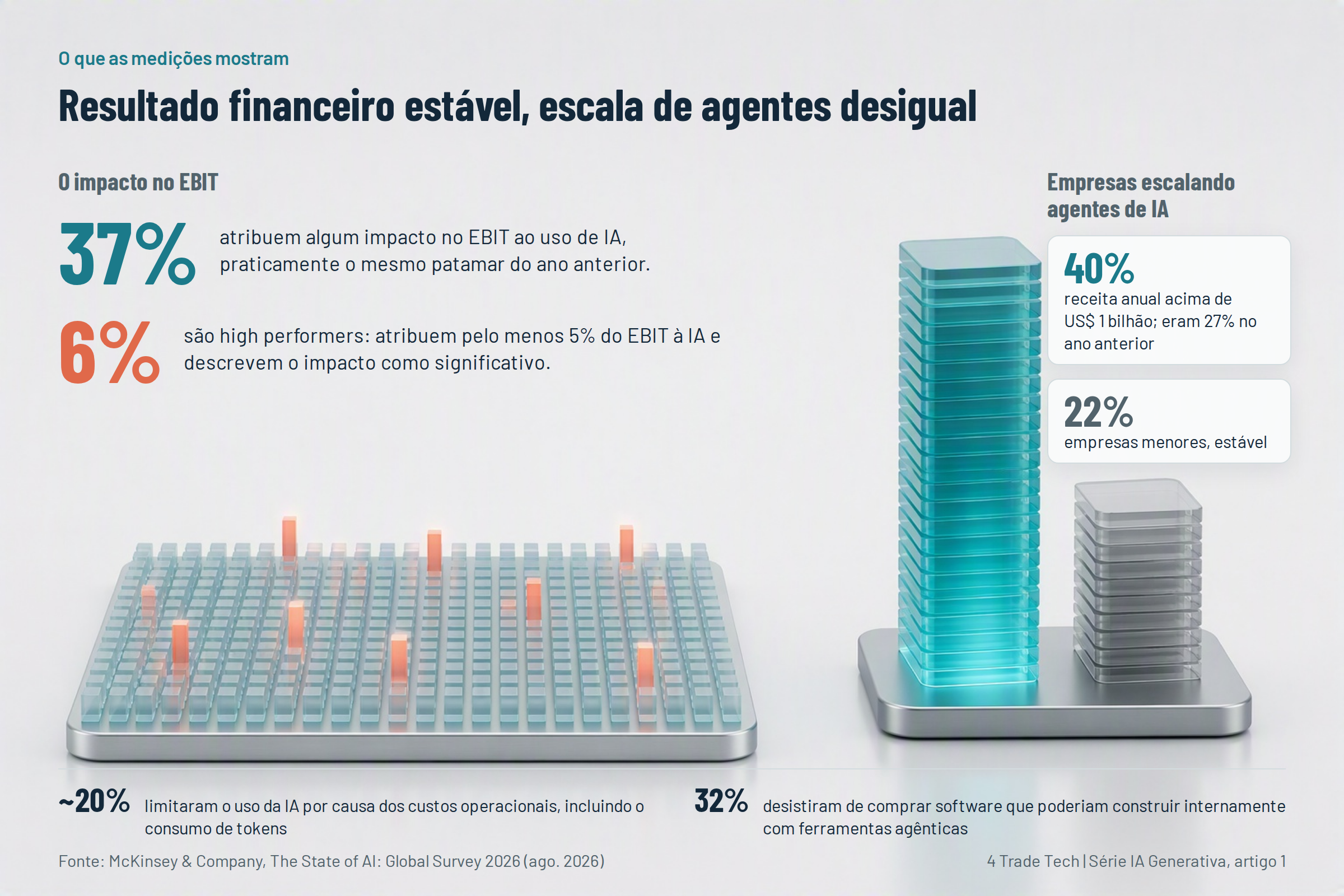
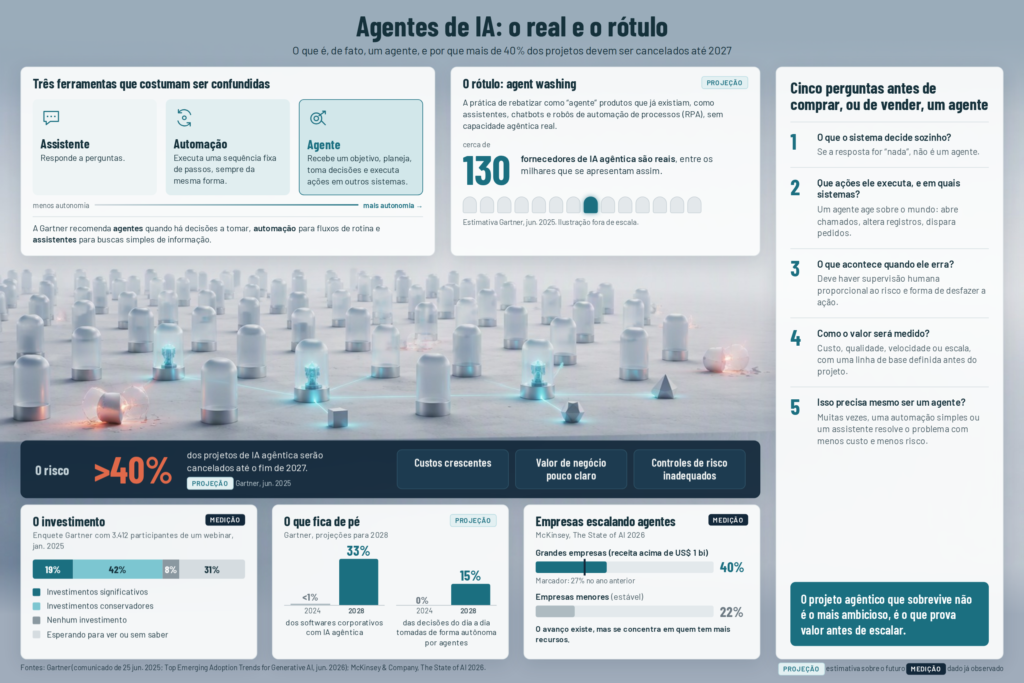
The picture is one of a widely available technology whose value is concentrated in a few hands. Gartner acknowledges the same risk on the supply side: in June 2025, it predicted that over 40% of agentic AI projects will be cancelled by the end of 2027, due to escalating costs, unclear business value or inadequate risk controls.
And in Brazil?
The most robust official data comes from PINTEC Semestral, a survey by IBGE, Brazil’s national statistics institute, in partnership with ABDI and UFRJ, released in September 2025. Among extractive and manufacturing companies with 100 or more employees, the use of artificial intelligence rose from 16.9% in 2022 to 41.9% in 2024. It was the fastest-growing advanced digital technology over the period.
The same survey shows where that use is concentrated. The functions with the highest use of AI were:
- Administration: 87.9% of companies using AI;
- Sales and marketing: 75.2%;
- Design and development of products, processes and services: 73.1%.
Compared with other technologies, AI still trails cloud computing (77.2%) and the Internet of Things (50.3%).
Two caveats are needed. First, the IBGE survey covers only medium and large industrial companies, not the economy as a whole. Second, it measures use, not returns. The growth is significant, but it does not allow us to claim that Brazilian industry is capturing value at the same rate.
Why the gap exists
When the same technology is available to everyone, it stops being a source of advantage on its own. The trends identified by Gartner help explain where value tends to concentrate:
- Domain knowledge. Specialised models are only as good as the data and niche knowledge that feed them.
- Process redesign. AI agents deliver little when they are bolted onto old workflows. Gartner itself recommends, in many cases, rethinking the process from the ground up.
- Use cases with clear returns. The first step the firm suggests to vendors is to connect each implementation to a measurable business outcome.
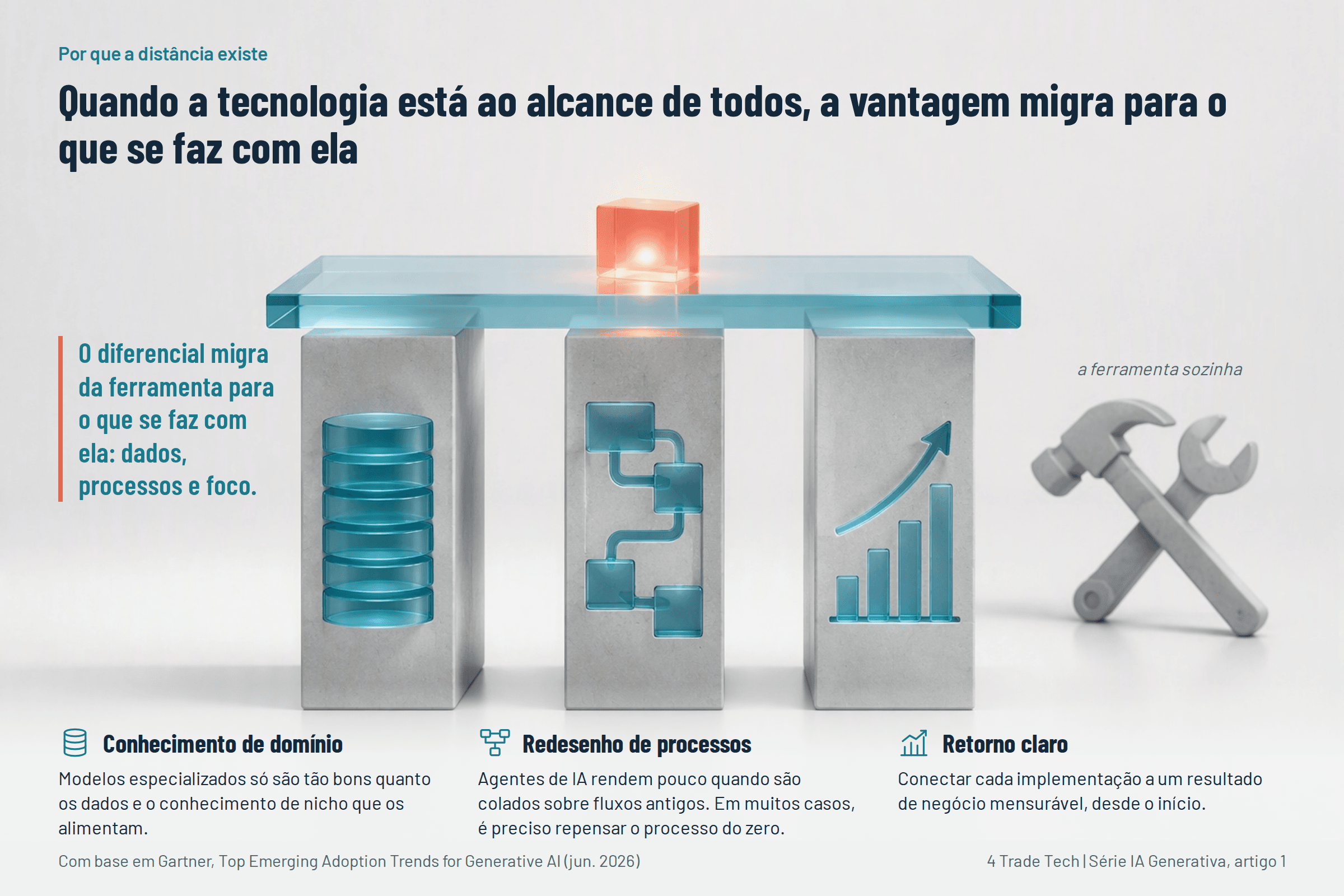
In other words, the differentiator shifts from the tool to what is done with it: data, processes and focus.
What generative AI trends mean for innovators
For university-born deep techs, the landscape is favourable, but it demands clarity. The trend towards specialised models values exactly what laboratories produce: deep knowledge of a problem and, often, proprietary data. The challenge is to translate that technical asset into a value proposition that a corporate buyer recognises. It is also essential to avoid selling as an “agent” or as “generative AI” something that does not hold up under scrutiny.
For established companiesfacing these generative AI trends, the question is no longer “whether” to adopt, but “where” and “with whom”. The numbers suggest caution with broad promises and attention to well-defined use cases, with return metrics set from the outset. Open innovation with specialised startups is one way to access domain knowledge without building it from scratch.
The generative AI trends coming up in this series
In the next articles, we will explore each of these generative AI trends in depth:
- domain-specific models and the opportunity for deep techs;
- agentic AI and the phenomenon of agent washing;
- multimodal AI and synthetic data on the factory floor;
- the impact of automation on the software market itself;
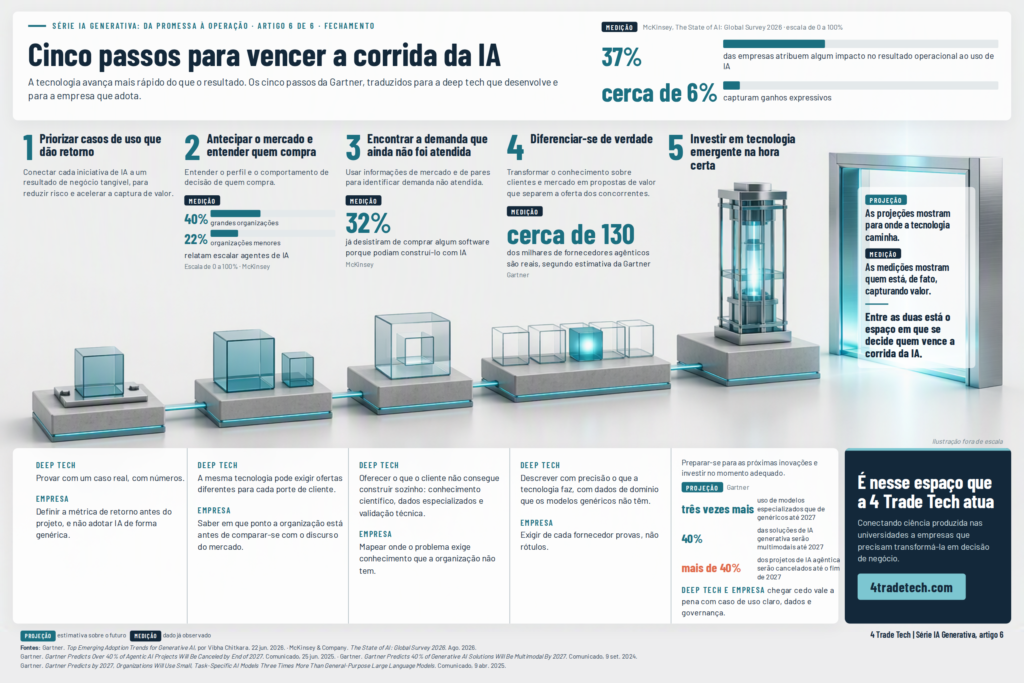
- and, to close the series, five steps to turn generative AI into results.
In each of these generative AI trends, we will separate what is prediction from what is already measurement.
4 Trade Tech exists to turn science into business decisions.
Is your company trying to find where generative AI can deliver real returns, or does your deep tech need to turn technology into a value proposition the market recognises? 4TT can help prioritise use cases and structure the link between research, capital and corporate strategy.
[email protected] · +55 (11) 93244-4141 · linkedin.com/company/4tradetech
Sources
- Gartner · Top Emerging Adoption Trends for Generative AI, by Vibha Chitkara, 22 June 2026.
- Gartner · Gartner Predicts by 2027, Organizations Will Use Small, Task-Specific AI Models Three Times More Than General-Purpose Large Language Models, press release, 9 April 2025.
- Gartner · Gartner Predicts 40% of Generative AI Solutions Will Be Multimodal By 2027, press release, 9 September 2024.
- Gartner · Gartner Predicts Over 40% of Agentic AI Projects Will Be Canceled by End of 2027, press release, 25 June 2025.
- McKinsey & Company · The State of AI: Global Survey 2026, August 2026.
- IBGE · De 2022 a 2024, percentual de empresas industriais utilizando Inteligência artificial subiu de 16,9% para 41,9% (From 2022 to 2024, the share of industrial companies using artificial intelligence rose from 16.9% to 41.9%), PINTEC Semestral, IBGE News Agency, 24 September 2025.