In the early years of generative AI, the race looked like a race for size. Ever larger models, trained on ever more data, able to answer almost anything. Gartner’s latest projections point elsewhere: inside companies, the fastest growth is expected from specialised AI models — the ones that know a great deal about one thing rather than a little about everything.
For anyone building technology out of academic research, this shift is more than a technical curiosity. It moves value towards an asset that laboratories have been producing for decades: deep knowledge of a specific problem.
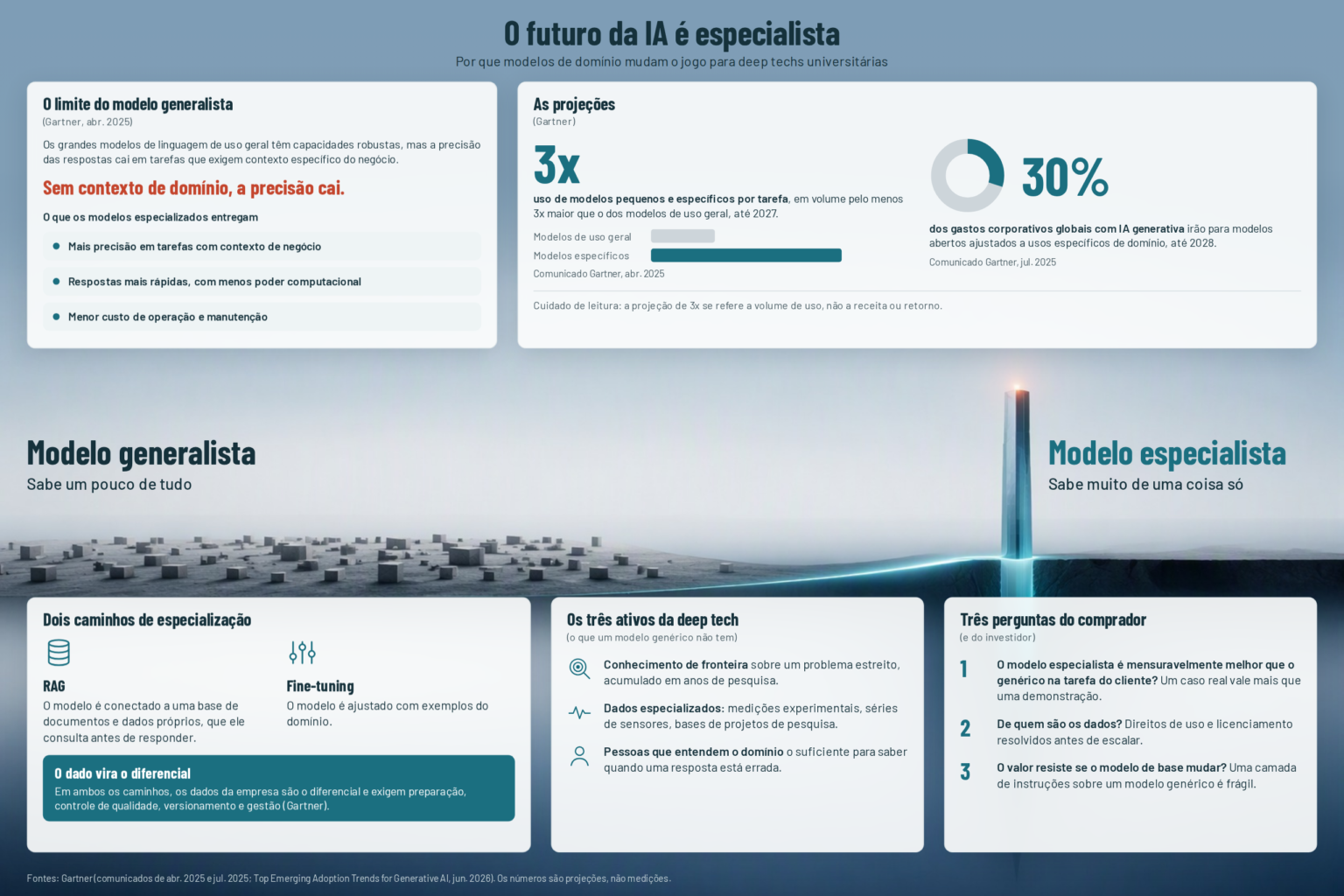
Where specialised AI models beat the generalist
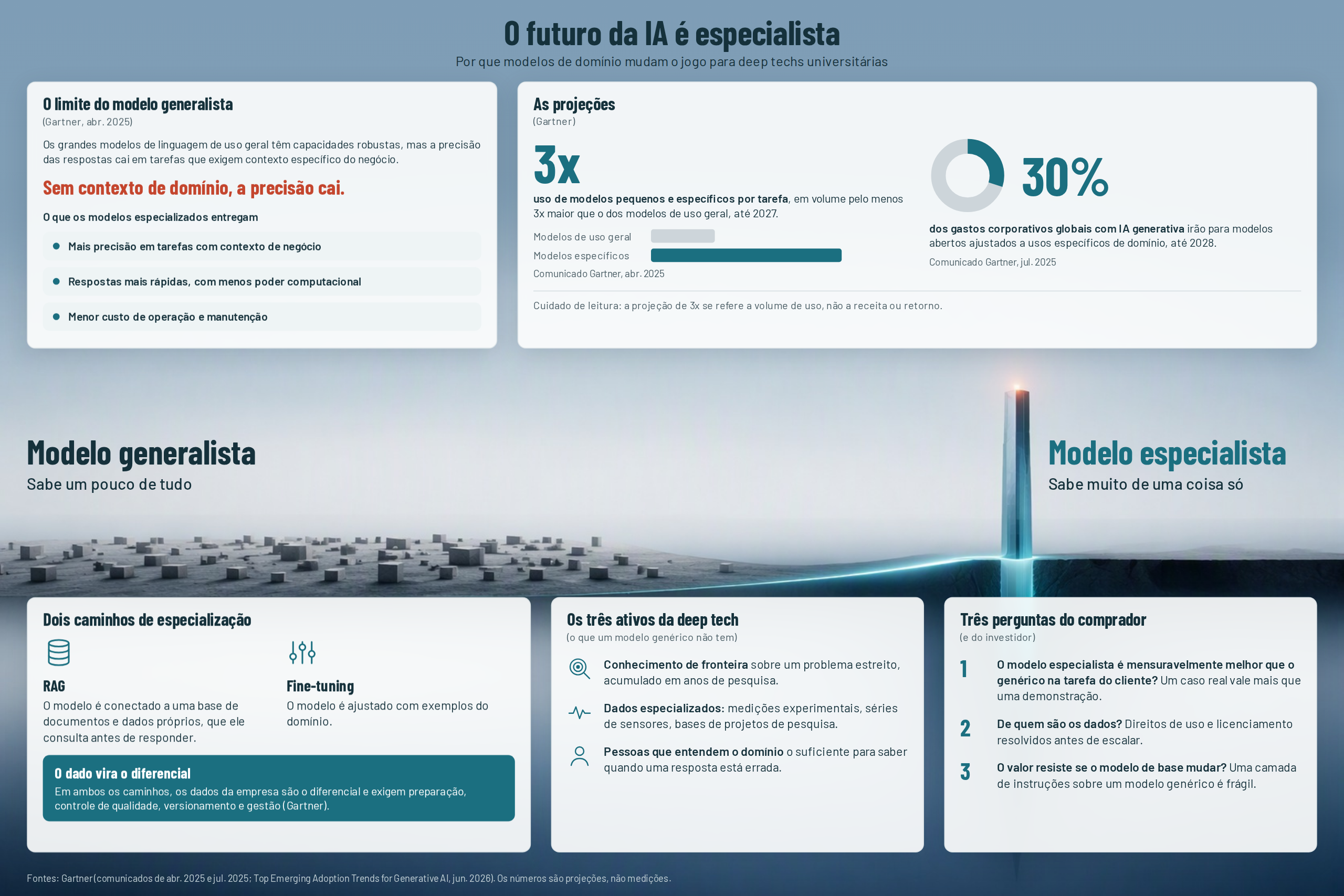
In an April 2025 press release, Gartner put the problem plainly: general-purpose large language models have robust capabilities, but the accuracy of their answers drops on tasks that require specific business context.

Gartner projects that by 2027 organisations will use small, task-specific models at least three times more than general-purpose ones. According to Sumit Agarwal, VP analyst at Gartner, the variety of tasks in business workflows and the need for greater accuracy are pushing towards models tuned to functions or to the data of a domain. These models answer faster and use less computing power, which cuts operating and maintenance costs.
In its June 2026 piece on adoption trends, Gartner reinforces the same reading: domain-specialised models deliver more accuracy and efficiency at lower cost. The path it describes leads to task-level knowledge agents and to systems combining several models.
Data becomes the differentiator
In practice, companies build specialised AI models along two main paths. The first connects the model to a base of proprietary documents and data that it consults before answering — the technique known as RAG. The second tunes it with examples from the domain, or fine-tuning. In both cases, Gartner notes that company data becomes the differentiator, and therefore demands preparation, quality control, versioning and governance.
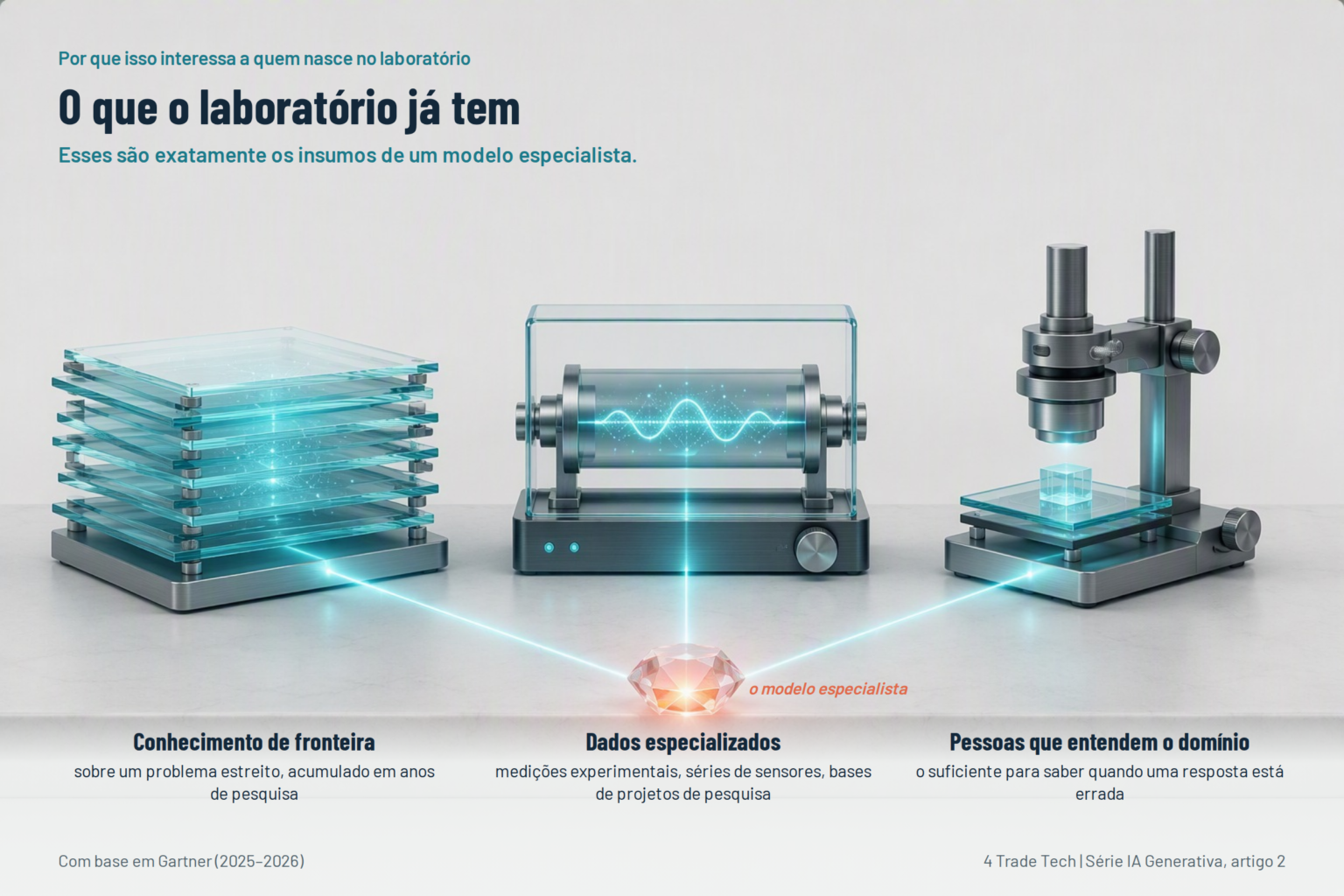
Two projections complete the picture. In July 2025, Gartner estimated that by 2028, 30% of global corporate spending on generative AI will go to open models tuned to domain-specific uses. And in the April release, Agarwal predicted that companies will begin to monetise their own models, offering access to customers and even to competitors — a shift from protecting data to a more open use of knowledge.
Why this matters to those born in the lab
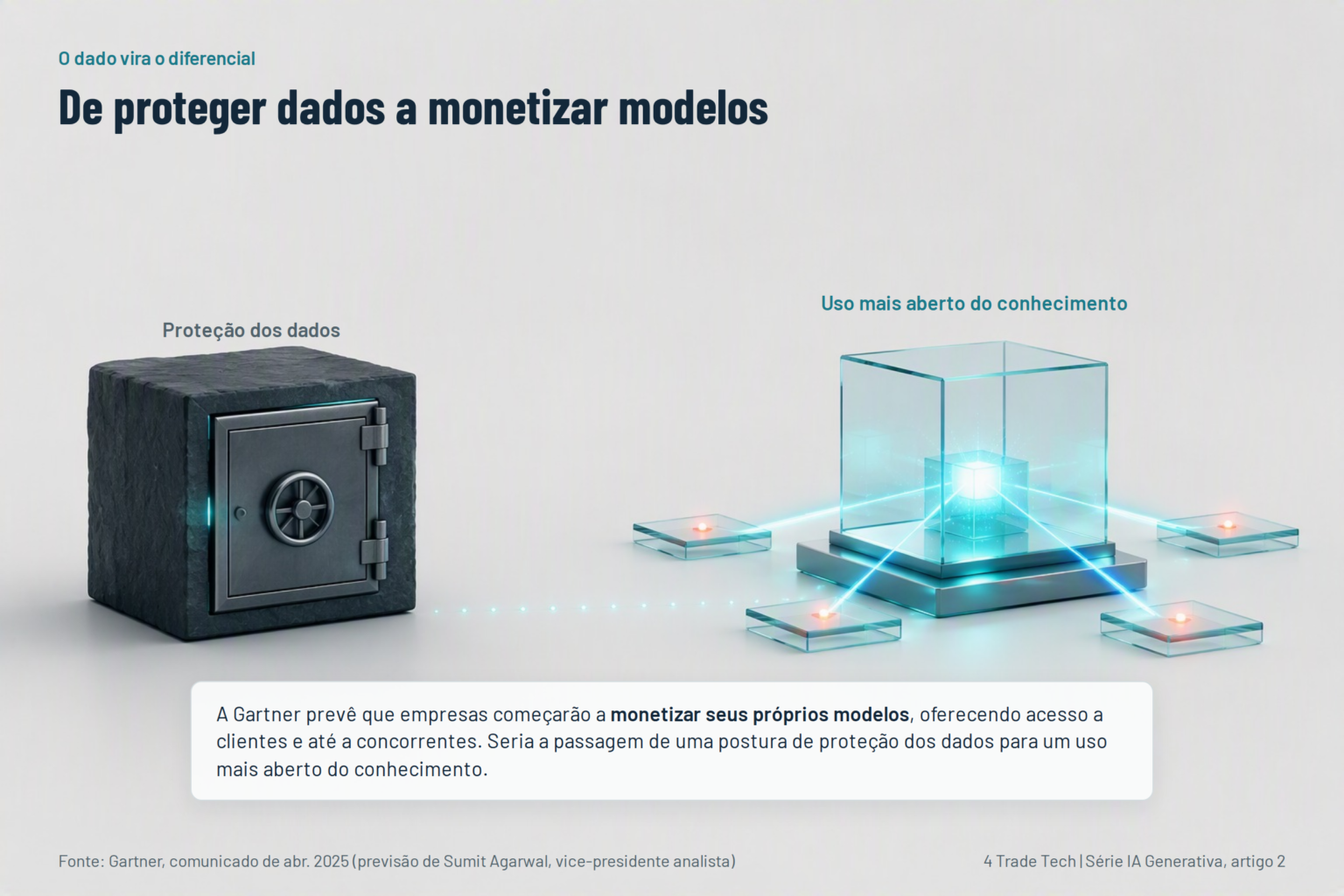
A university deep tech usually starts with three assets a generic model does not have:
- frontier knowledge of a narrow problem, accumulated over years of research;
- specialised data, such as experimental measurements, sensor series or databases built in research projects;
- people who understand the domain well enough to know when an answer is wrong.
Gartner takes the idea to its limit in one of its March 2026 predictions: by 2030, a new generation of companies valued at over US$ 1 billion would emerge, with recurring revenue of US$ 2 million per employee. According to the firm, these companies would solve specific, underserved problems with proprietary AI. It is a projection, and a bold one, but it signals where value is seen: in the well-defined problem, not in the generic model.
What specialised AI models demand
Gartner makes three recommendations to companies adopting domain-specific models:
- start with cases where business context is crucial, or where generic models have not reached the expected quality or speed;
- combine models and work stages when a single model cannot handle the task;
- invest in data and in people, preparing data for model tuning and training not only technical teams but also risk, compliance, procurement and business specialists.
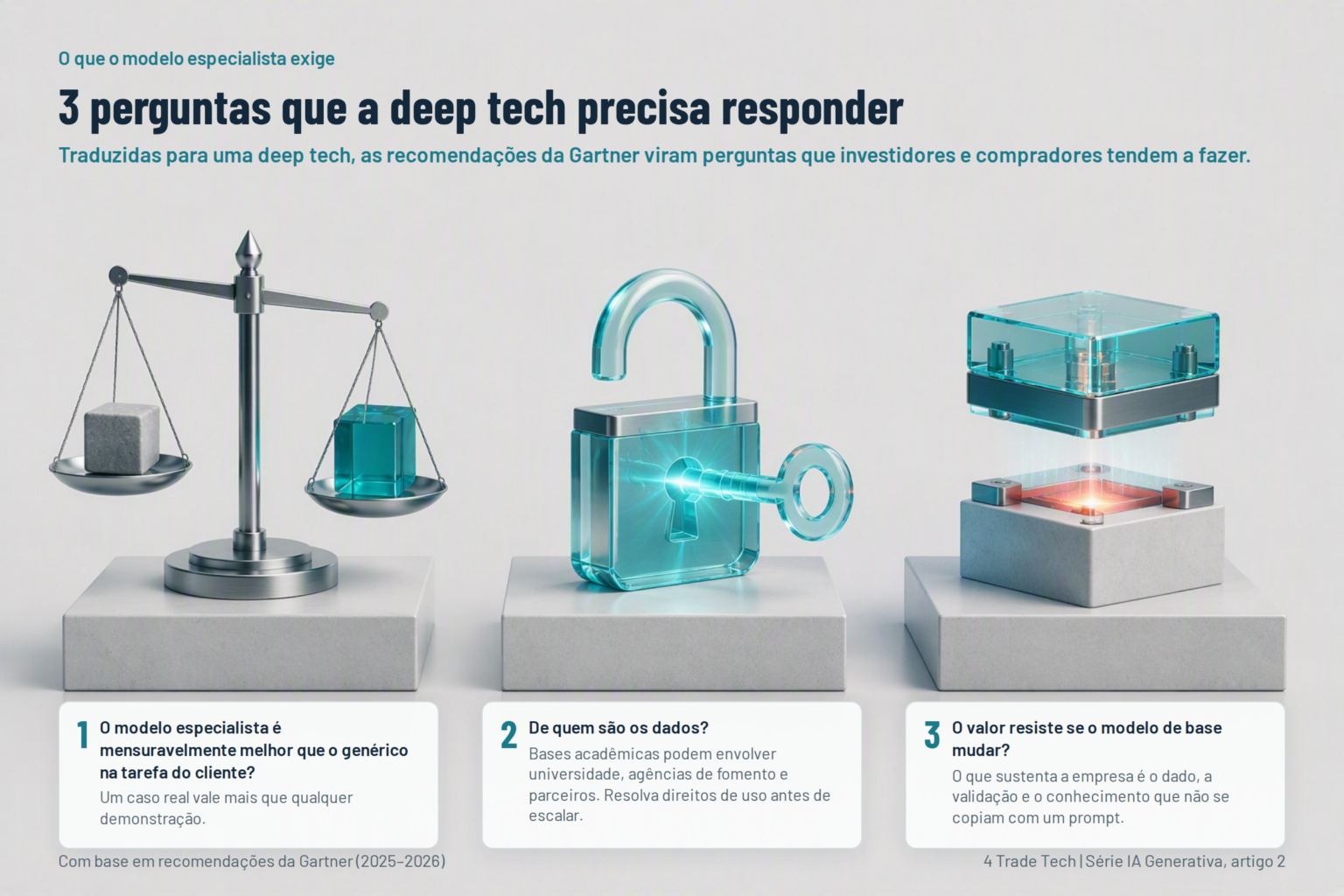
Translated for a deep tech, those recommendations become three questions investors and buyers tend to ask:
- Is the specialist model measurably better than the generic one at the client’s task? A comparison on a real case is worth more than any demo.
- Who owns the data? Databases built in academic projects may involve the university, funding agencies and partners. Settling usage and licensing rights before scaling avoids trouble in the first investment round.
- Does the value survive a change of base model? A solution that is merely a layer of instructions on top of a generic model is fragile. What sustains the company is the data, the validation and the knowledge that cannot be copied with a prompt.
And for established companies
For those buying or integrating AI, the message is complementary. Internal data, often treated as a by-product of operations, becomes raw material for competitive advantage. And where the generic model disappointed, the way out may lie with a startup that already masters the problem and has built specialised AI models for it. That is where open innovation stops being rhetoric and becomes a shortcut.
A note on reading these numbers
The figures in this article are Gartner projections, not measurements. The three-times forecast refers to volume of use, not revenue or return. What the projections support is a direction: in corporate use, specialised AI models tend to beat generalist ones. Turning that direction into a business still depends on proving results, case by case.
This is the second article in the series. In the first, we mapped the four scaling forces of generative AI and the gap between adoption and return. Next, we look at the vector that concentrates the most expectation — and the most noise: agentic AI.
4 Trade Tech exists to turn science into business decisions.
Does your deep tech hold data and domain knowledge that could become a specialist model? 4TT can help assess the asset, settle data rights and structure the value proposition for investors and buyers.
[email protected] · +55 (11) 93244-4141 · linkedin.com/company/4tradetech
Sources
- Gartner · Gartner Predicts by 2027, Organizations Will Use Small, Task-Specific AI Models Three Times More Than General-Purpose Large Language Models · press release, 9 Apr. 2025.
- Gartner · Gartner Identifies the Top Strategic Trends in Software Engineering for 2025 and Beyond · press release, 1 Jul. 2025.
- Gartner · Gartner Announces Top Predictions for Data and Analytics in 2026 · press release, 11 Mar. 2026.
- Gartner · Top Emerging Adoption Trends for Generative AI, by Vibha Chitkara · 22 Jun. 2026.