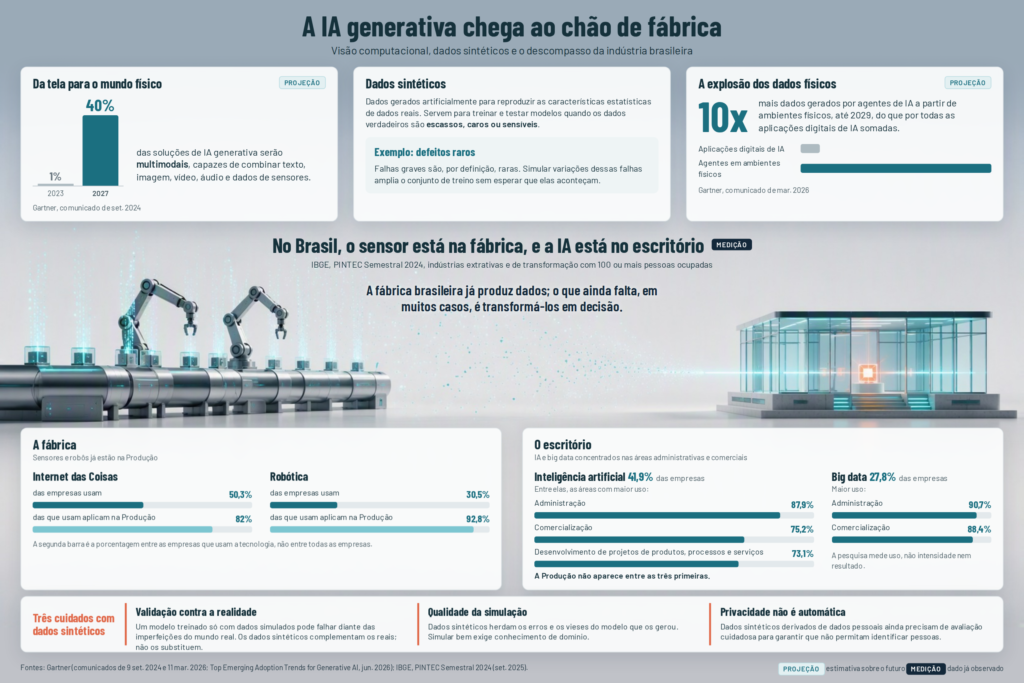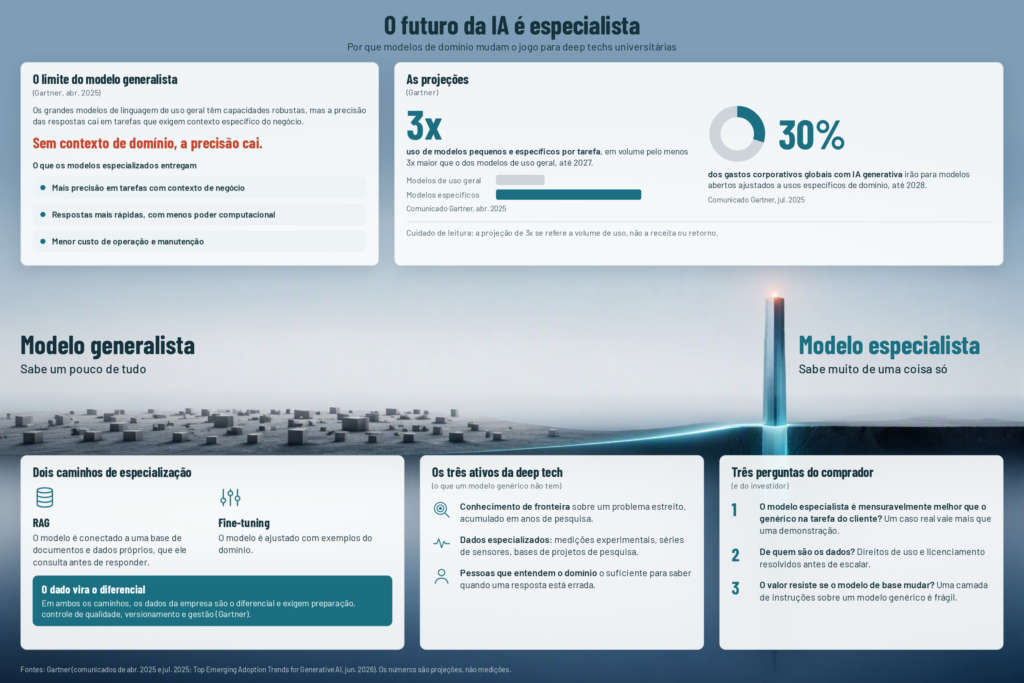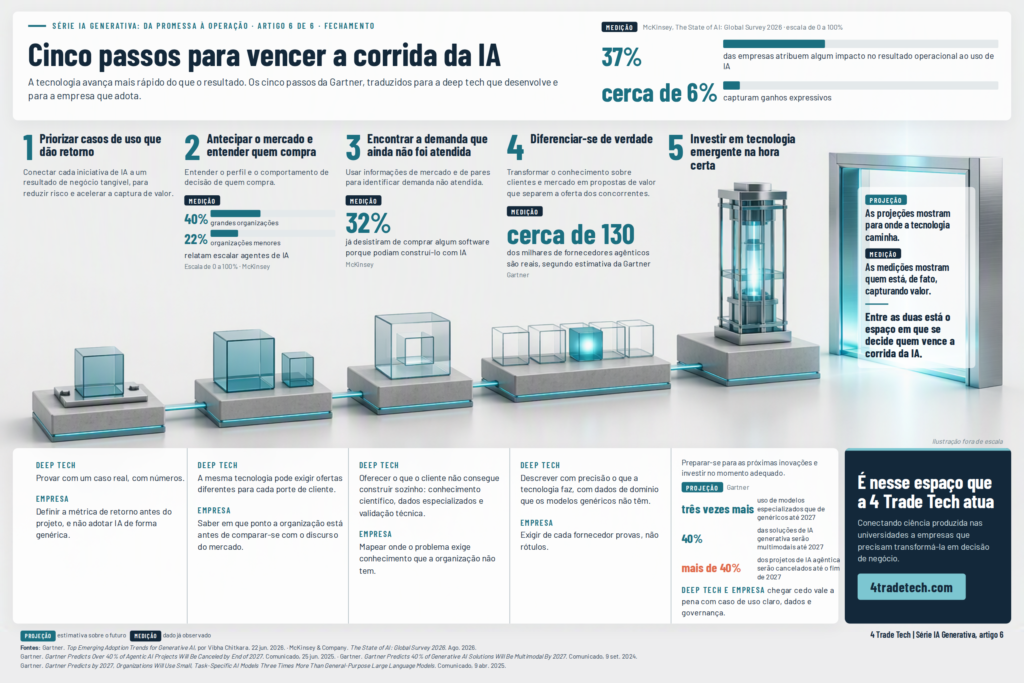
For decades, the question “build or buy?” had an almost automatic answer for most companies: buy. Developing software in-house was expensive, slow and demanded teams few could assemble. AI in software development is changing that calculation, and the first measurements already show the effect.
What the measurements already show
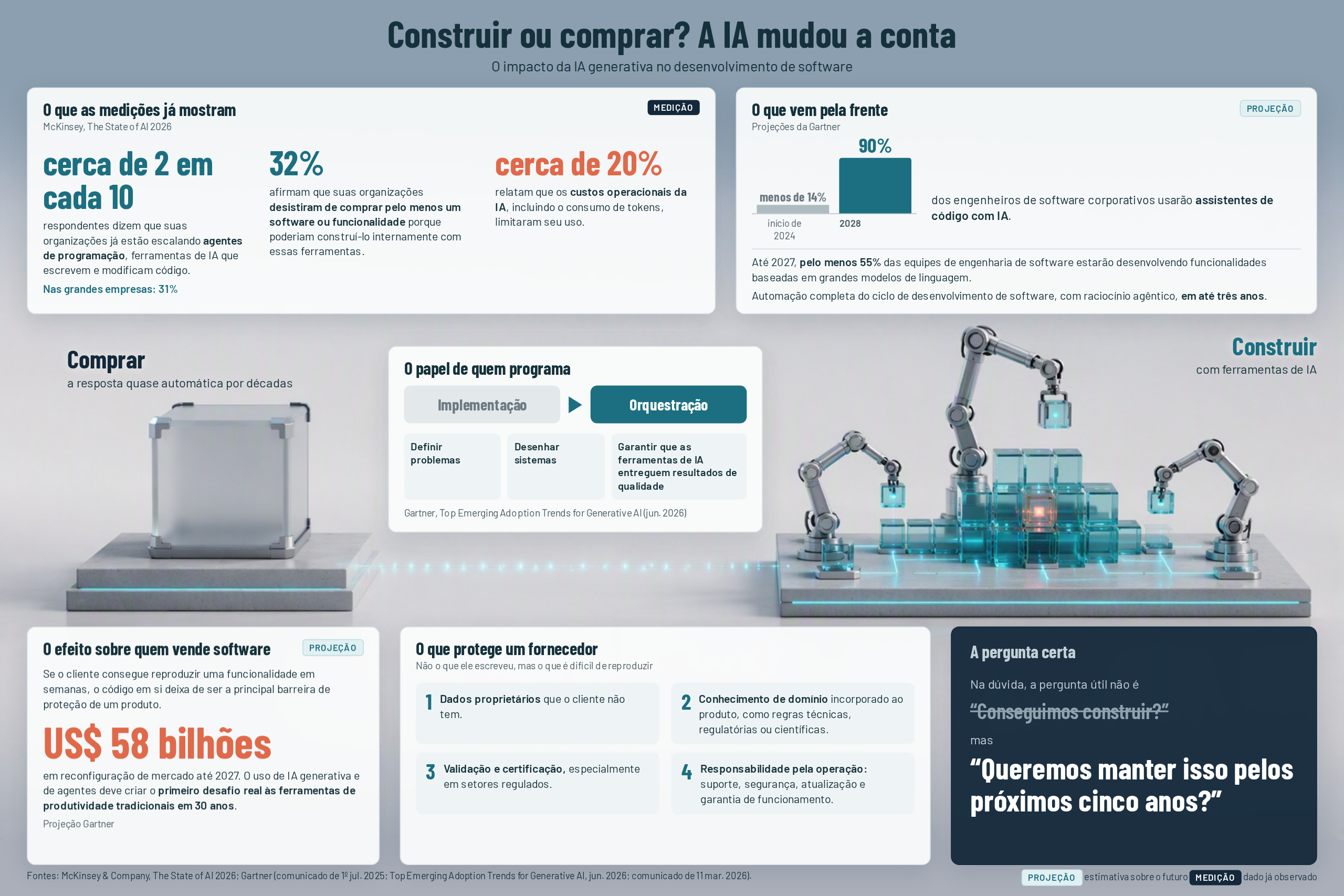
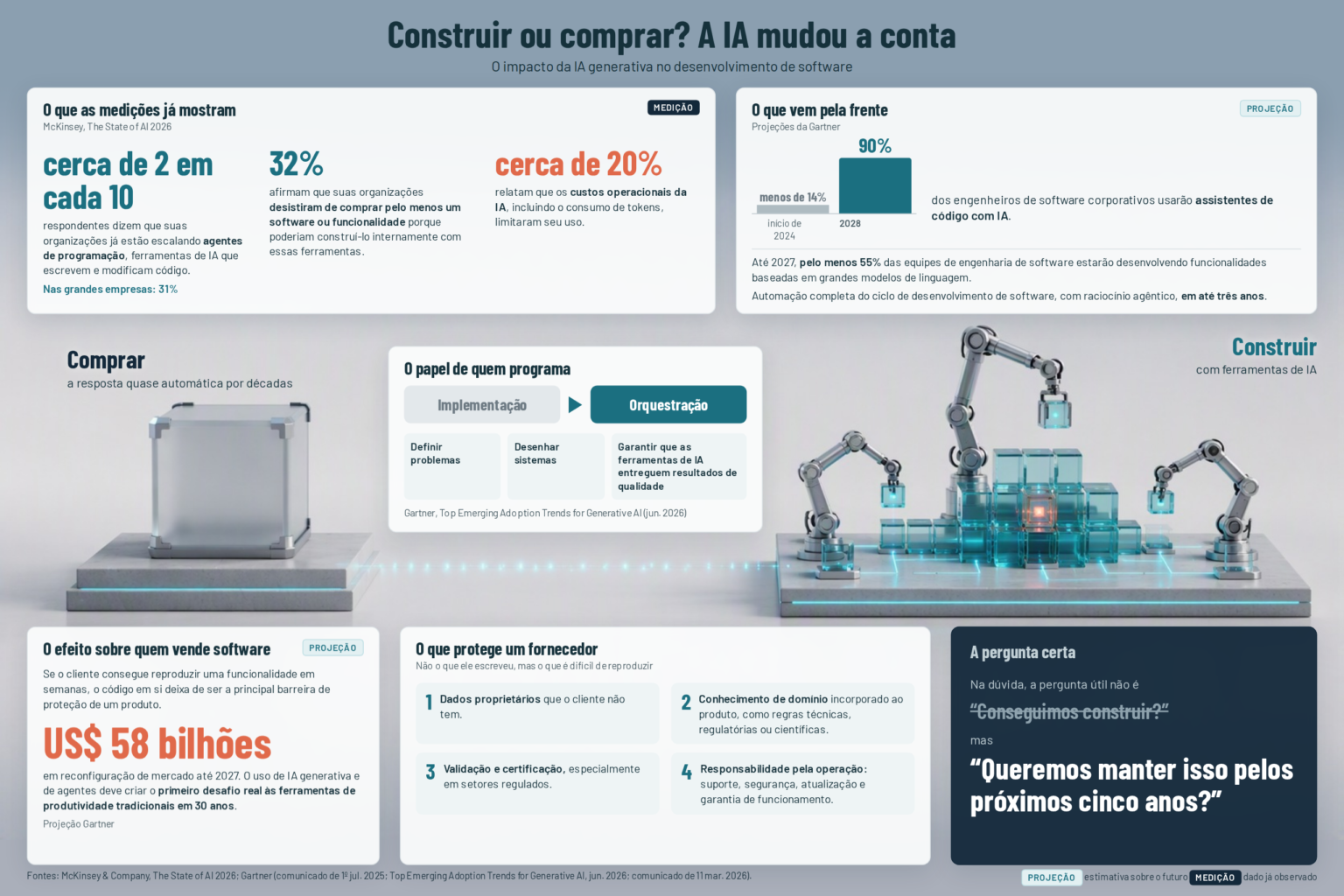
In McKinsey’s The State of AI 2026 survey, two findings deserve the attention of anyone selling software:
- about two in ten respondents say their organisations are already scaling coding agents — AI tools that write and modify code. At large companies the share rises to 31%;
- 32% say their organisations dropped the purchase of at least one piece of software or feature because they could build it in-house with these tools.
It is a quiet but structural shift: AI in software development has changed who is able to build what. When nearly a third of companies have already walked away from a purchase because they can build it, the software market competes not only with other vendors but with its own customers.
What lies ahead for AI in software development
Gartner’s projections suggest the movement will accelerate. In July 2025, the firm estimated that by 2028 90% of enterprise software engineers will use AI code assistants, against less than 14% in early 2024. The same analysis forecasts that by 2027 at least 55% of software engineering teams will be building features based on large language models.
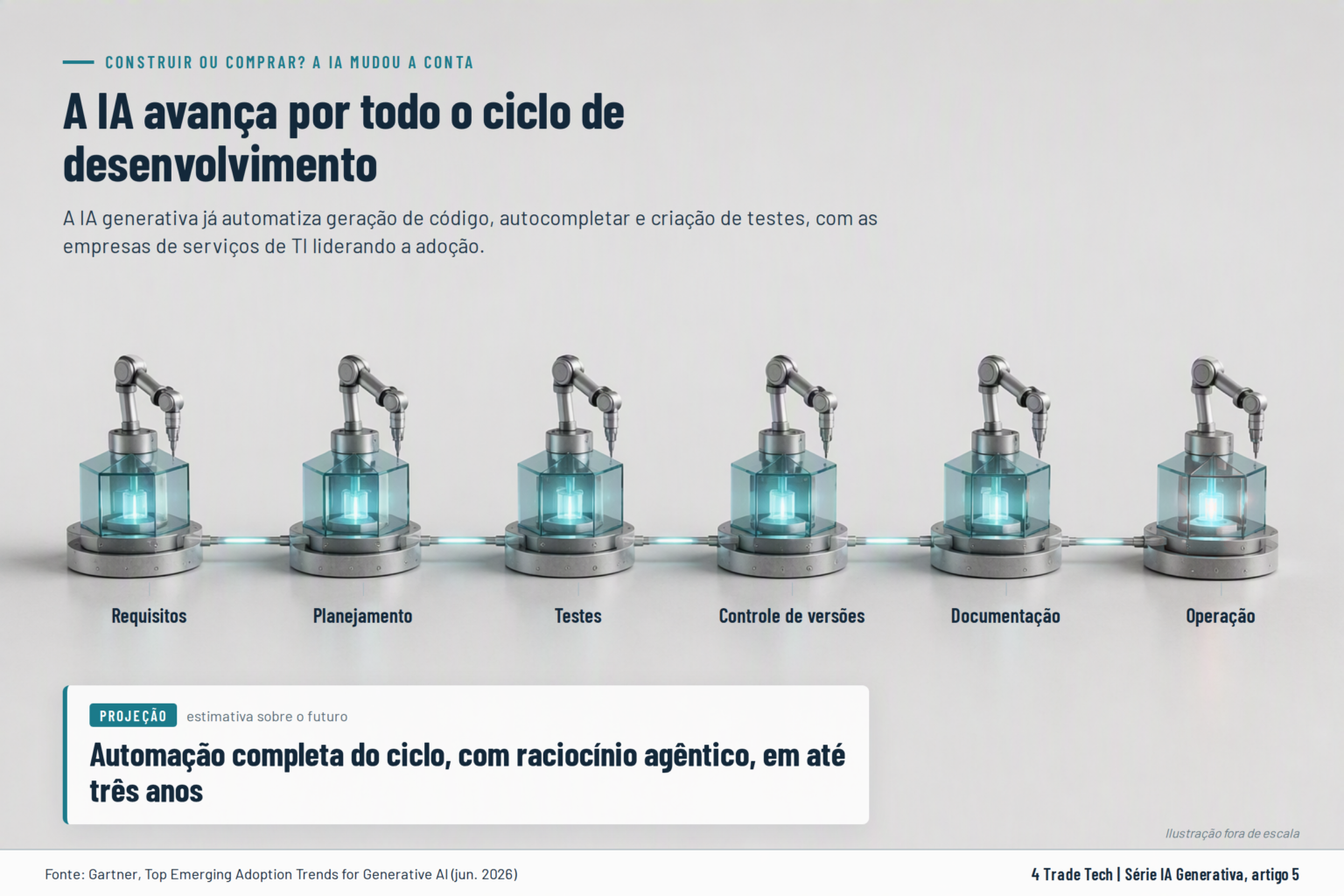
In its June 2026 piece on adoption trends, Gartner describes how generative AI already automates code generation, autocompletion and test creation, with IT services firms leading adoption. Code assistants are the largest segment today, but usage extends to requirements gathering, planning, testing, version control, documentation and operations. The firm expects full automation of the software development cycle, with agentic reasoning, within three years.
That changes the role of the programmer. According to Gartner, the developer’s work should shift from implementation to orchestration: defining problems, designing systems and ensuring AI tools deliver quality results.
The effect of AI in software development on those who sell it
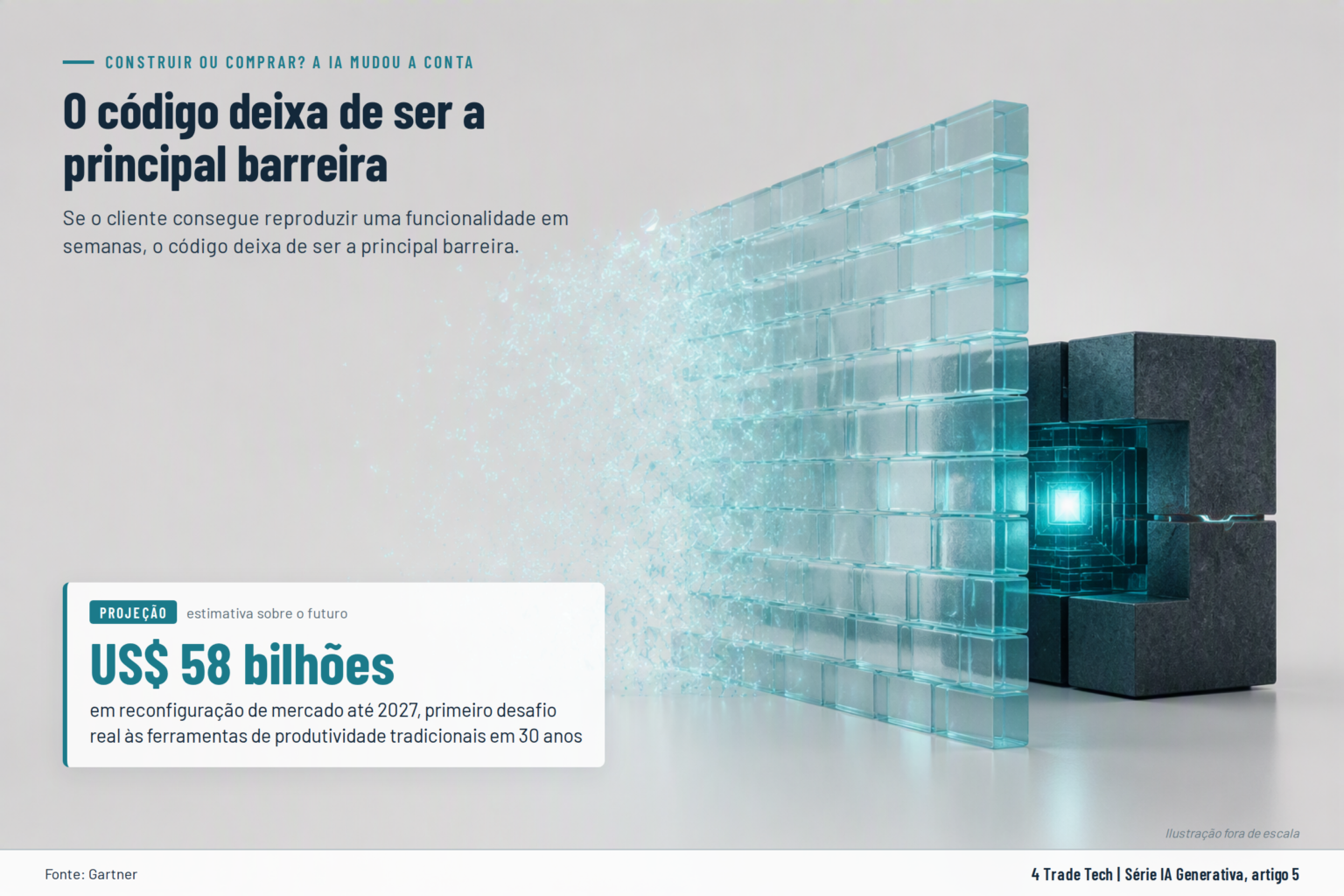
If the customer can reproduce a feature in weeks, the code itself stops being a product’s main protective barrier. Gartner points to the scale of the shock in one specific area: by 2027, the use of generative AI and agents should create the first real challenge to traditional productivity tools in 30 years, driving a US$ 58 billion market reshuffle.
What tends to protect a vendor in this landscape of AI in software development is not what it wrote, but what is hard to reproduce:
- proprietary data the customer does not have;
- domain knowledge embedded in the product, such as technical, regulatory or scientific rules;
- validation and certification, especially in regulated sectors;
- responsibility for operations: support, security, updates and guaranteed functioning.
The cost that does not show up in the prototype
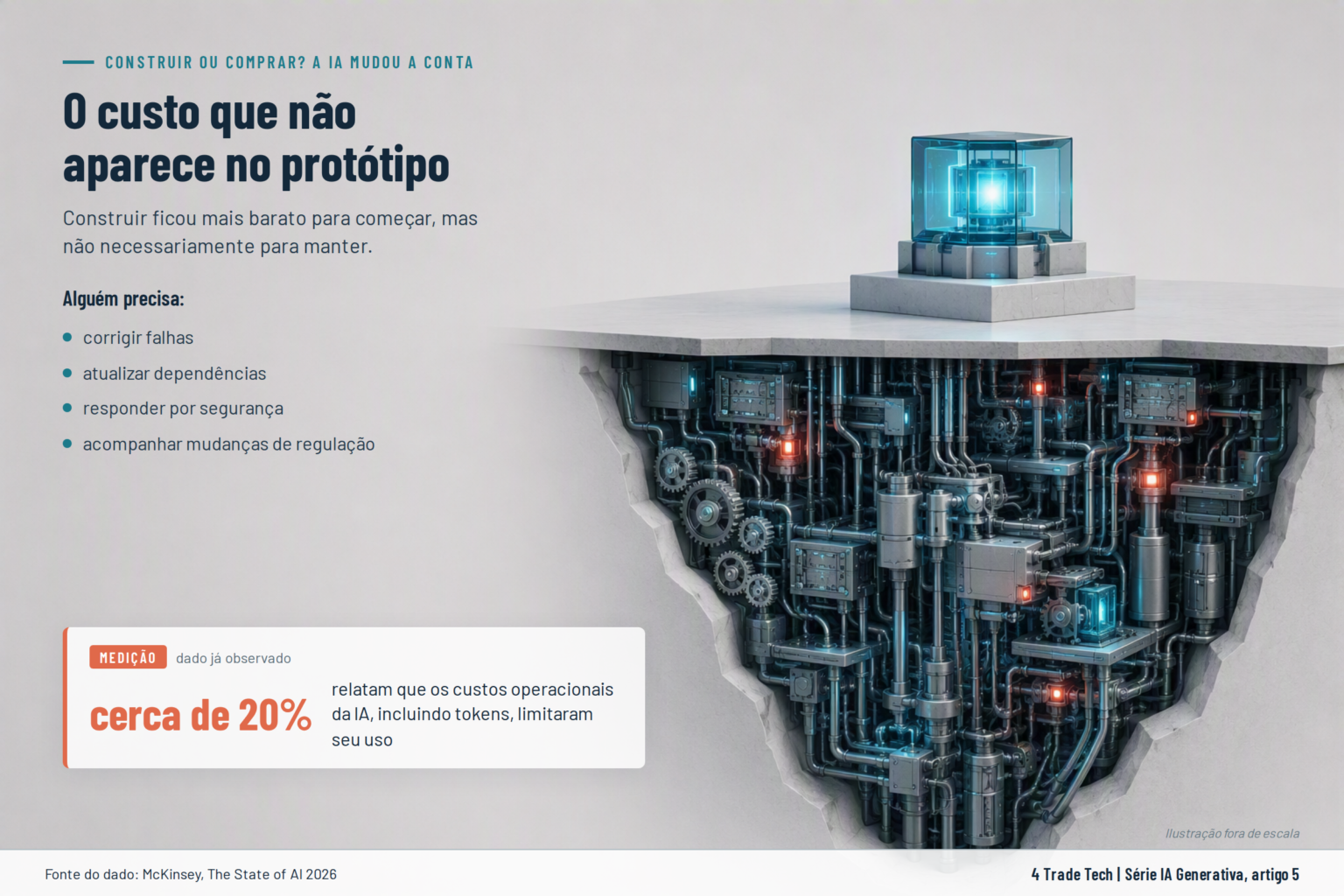
Building became cheaper to start, but not necessarily to maintain. Every in-house system needs someone to fix bugs, update dependencies, answer for security and track regulatory change. Using AI carries its own cost: about 20% of McKinsey respondents report that AI operating costs, including token consumption, have limited their use.
Gartner recommends balancing automation and human oversight in AI in software development according to business criticality, risk and workflow complexity. A system running payroll cannot be treated like a weekend prototype.
What this means for deep techs and companies
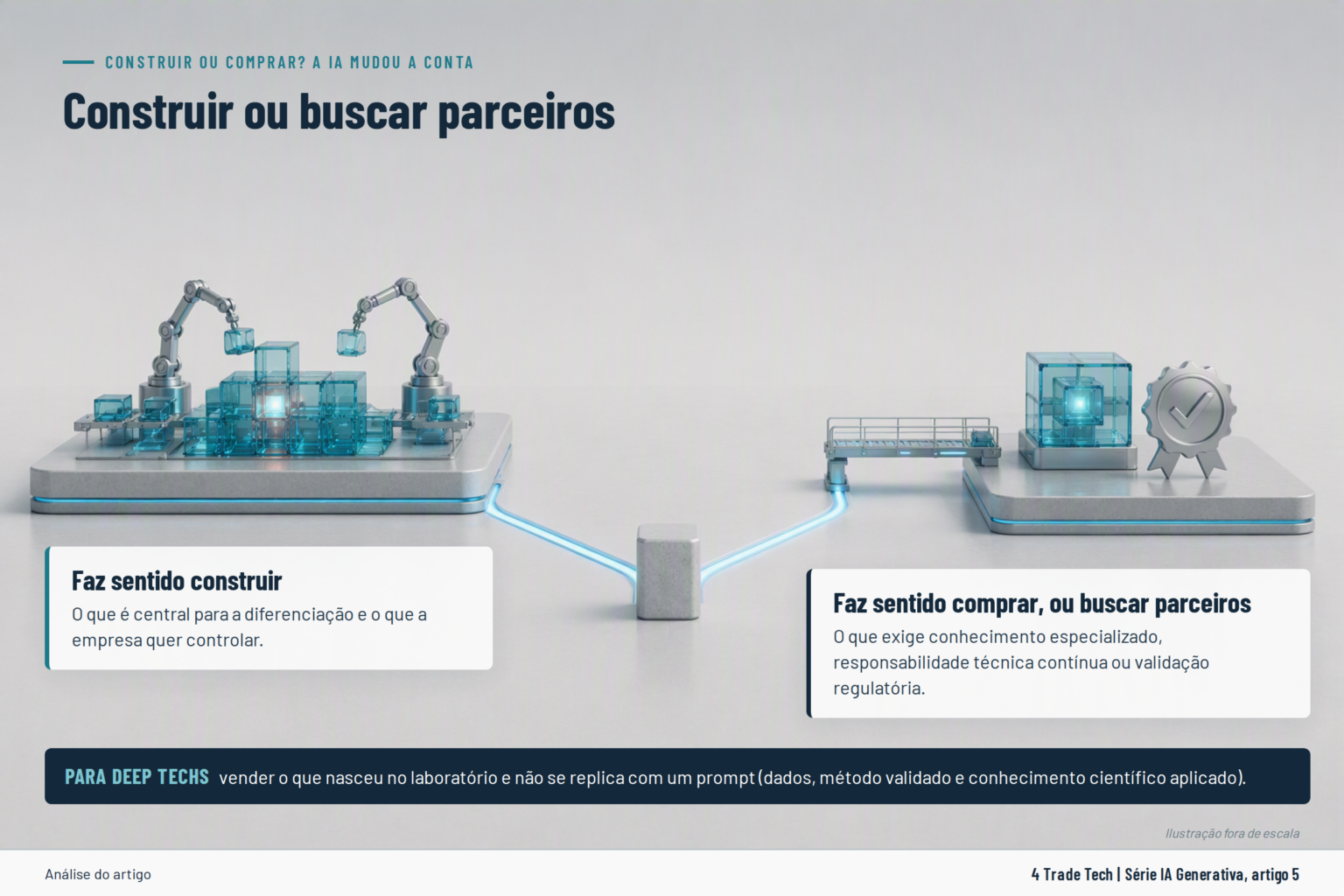
For a deep tech, the news is ambiguous. On one hand, AI tools allow building products faster and with smaller teams. On the other, the same is true for the customer and for any competitor. The strongest defence is selling what was born in the laboratory and cannot be replicated with a prompt: data, validated method and applied scientific knowledge.
For established companies, the build-or-buy decision gains new criteria. It makes sense to build what is central to differentiation and what the company wants to control. It makes sense to buy, or to seek partners, for what demands specialised knowledge, continuous technical responsibility or regulatory validation. When in doubt, the useful question is not “can we build it?” but “do we want to maintain it for the next five years?”.
This is the fifth article in the series. In the previous one, we covered computer vision and synthetic data on the factory floor. In the last, we gather the lessons into five practical steps for turning generative AI into results.
4 Trade Tech exists to turn science into business decisions.
Is your company deciding between building and buying, or does your deep tech need to show what in its product cannot be replicated with a prompt? 4TT can help map what is real differentiation and what is commodity.
[email protected] · +55 (11) 93244-4141 · linkedin.com/company/4tradetech
Sources
- McKinsey & Company · The State of AI: Global Survey 2026 · Aug. 2026.
- Gartner · Gartner Identifies the Top Strategic Trends in Software Engineering for 2025 and Beyond · press release, 1 Jul. 2025.
- Gartner · Top Emerging Adoption Trends for Generative AI, by Vibha Chitkara · 22 Jun. 2026.
- Gartner · Gartner Announces Top Predictions for Data and Analytics in 2026 · press release, 11 Mar. 2026.