On 17 August 2026, FAPESP announced the new PIPE rules, an update to the rules of PIPE, its innovative research programme for small businesses in the state of São Paulo. The new rules took effect on 15 September.
The news of the new PIPE rules was framed as a simplification: fewer documents, fewer steps, a faster journey for the entrepreneur. Nothing surprising so far. But there is a more interesting story behind the list of changes.
1What changed
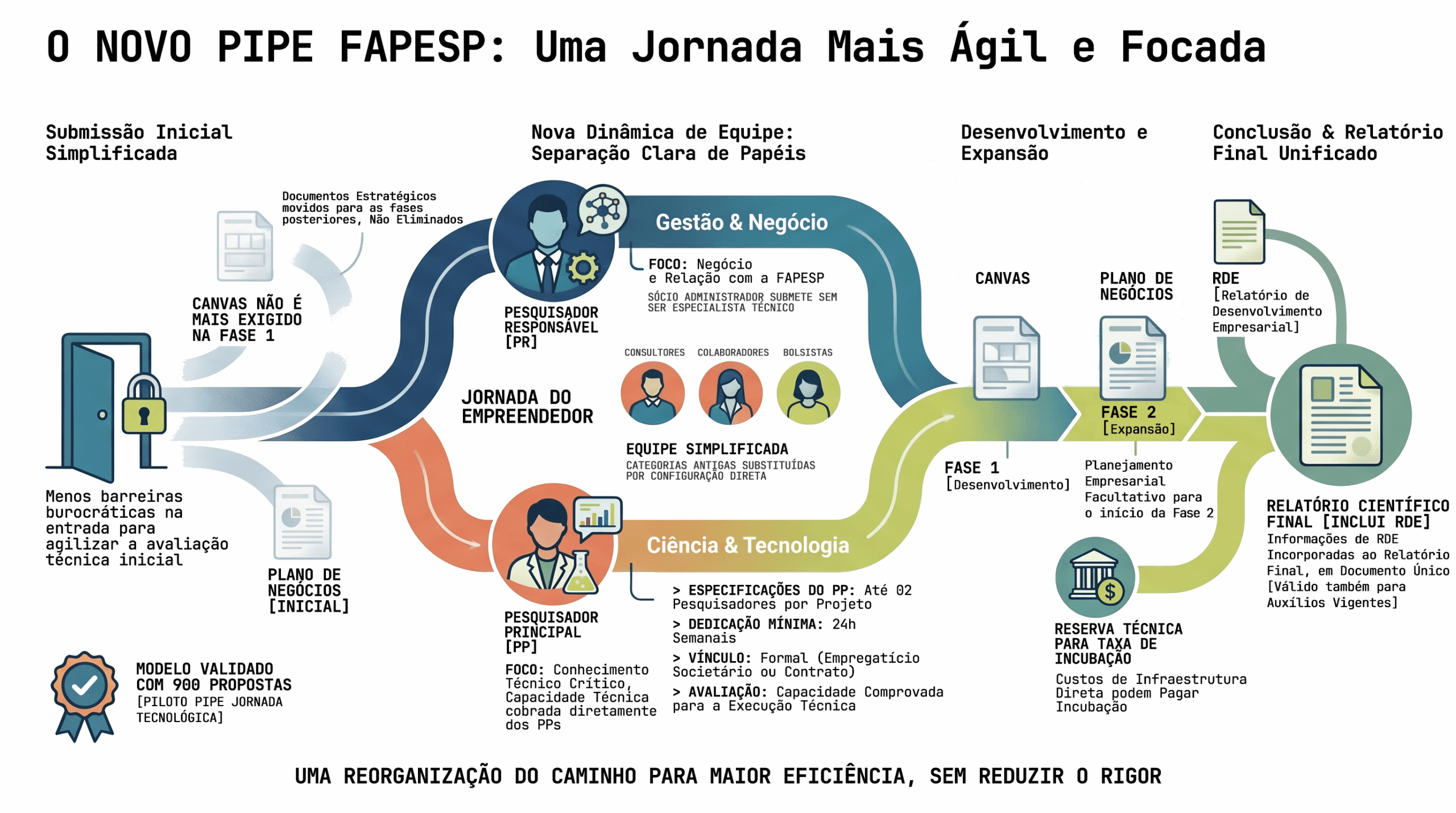
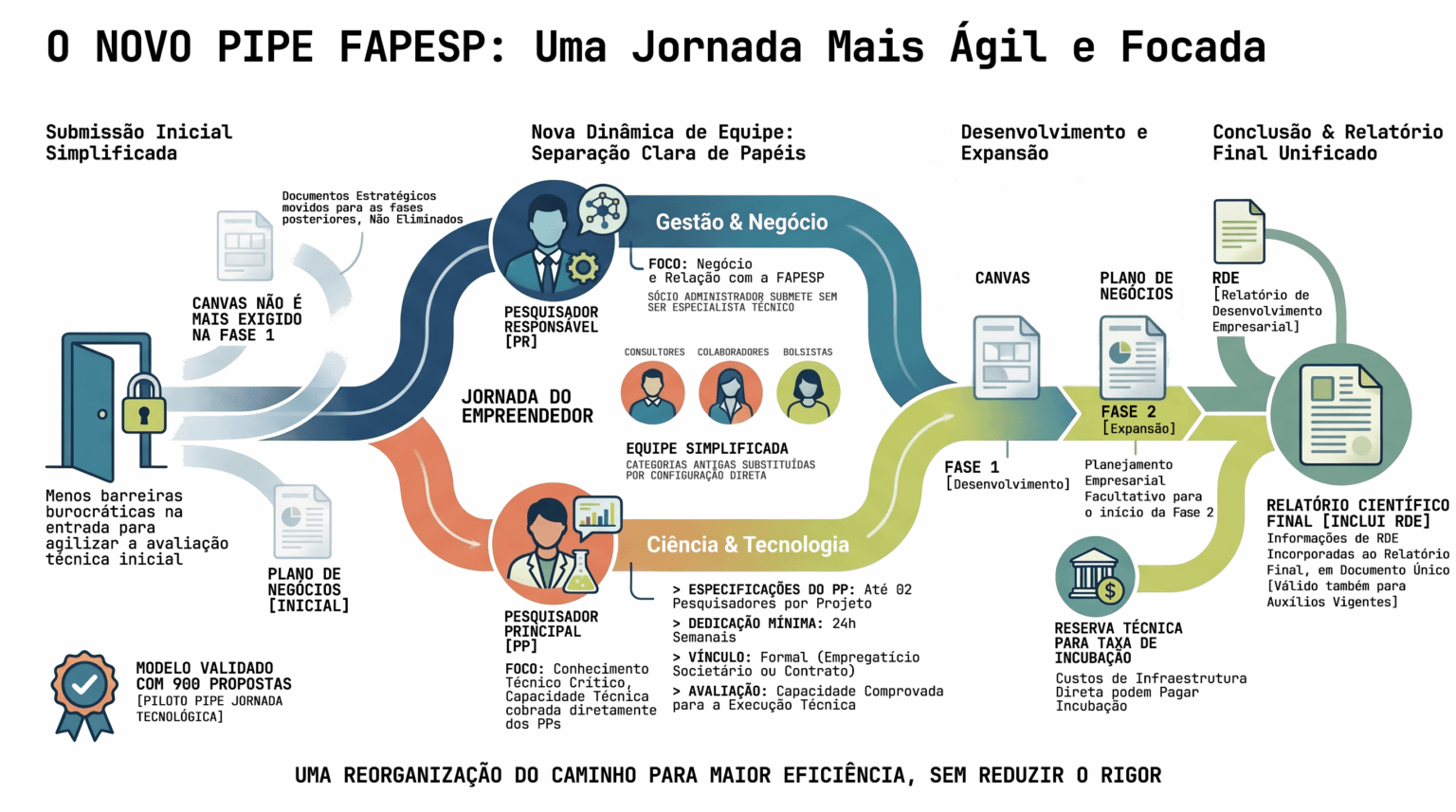
The new PIPE rules: six changes at the front door
- the Canvas is no longer required when submitting a Phase 1 proposal;
- the Business Plan is no longer a prerequisite for starting Phase 2;
- the information from the Business Development Report (RDE) has been folded into the final Scientific Report — a change that also applies to PIPE grants already under way;
- the Principal Investigator (PR) no longer needs scientific or technical qualifications in the project’s field, and may appoint up to two Lead Researchers (PP);
- the Associate Researcher and Technical Support categories have given way to a simpler team structure made up of consultants, collaborators and fellowship holders;
- the Technical Reserve, through its Direct Project Infrastructure Costs portion, may now be used to pay incubation fees.
FAPESP presents the new PIPE rules as a way to reduce the administrative burden and make the entrepreneur’s journey faster. The reduction in paperwork also covers PIPE Invest.
2The requirement did not disappear
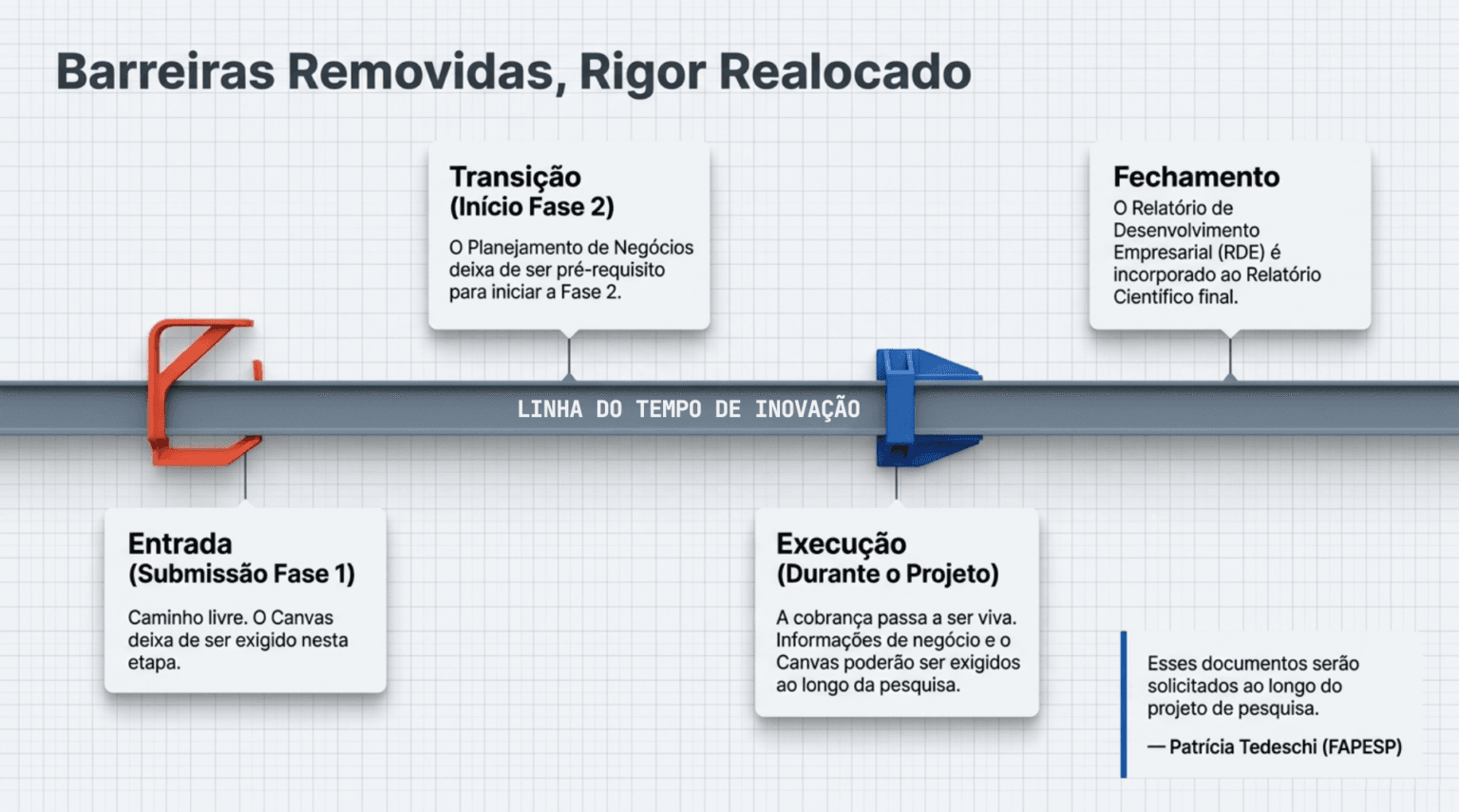
Under the new PIPE rules, documents moved in time, not out of existence
The documents that left the front door have not vanished. The Canvas and the business information may be requested during the project, and business planning remains part of the PIPE journey.
“These documents will be requested over the course of the research project.”
Patrícia Tedeschi, Innovation Manager at FAPESP, to Agência FAPESP
Rodolfo Jardim de Azevedo, FAPESP’s general coordinator for Technologies and Innovation Partnerships, explains the reasoning:
“That volume of documents creates an unnecessary barrier at the submission stage.”
Rodolfo Jardim de Azevedo, FAPESP, to Agência FAPESP
In other words, the question is not whether the information matters, but when it needs to enter the process.
3A clear separation of roles
The entrepreneur answers for the company; the researcher, for the research
There is an even more significant change. The PR remains the company partner responsible for the proposal and for the formal relationship with FAPESP — and if the company has not yet been incorporated at submission, the applicant must be a partner in the future company. But the PR no longer has to be the project’s technical expert.
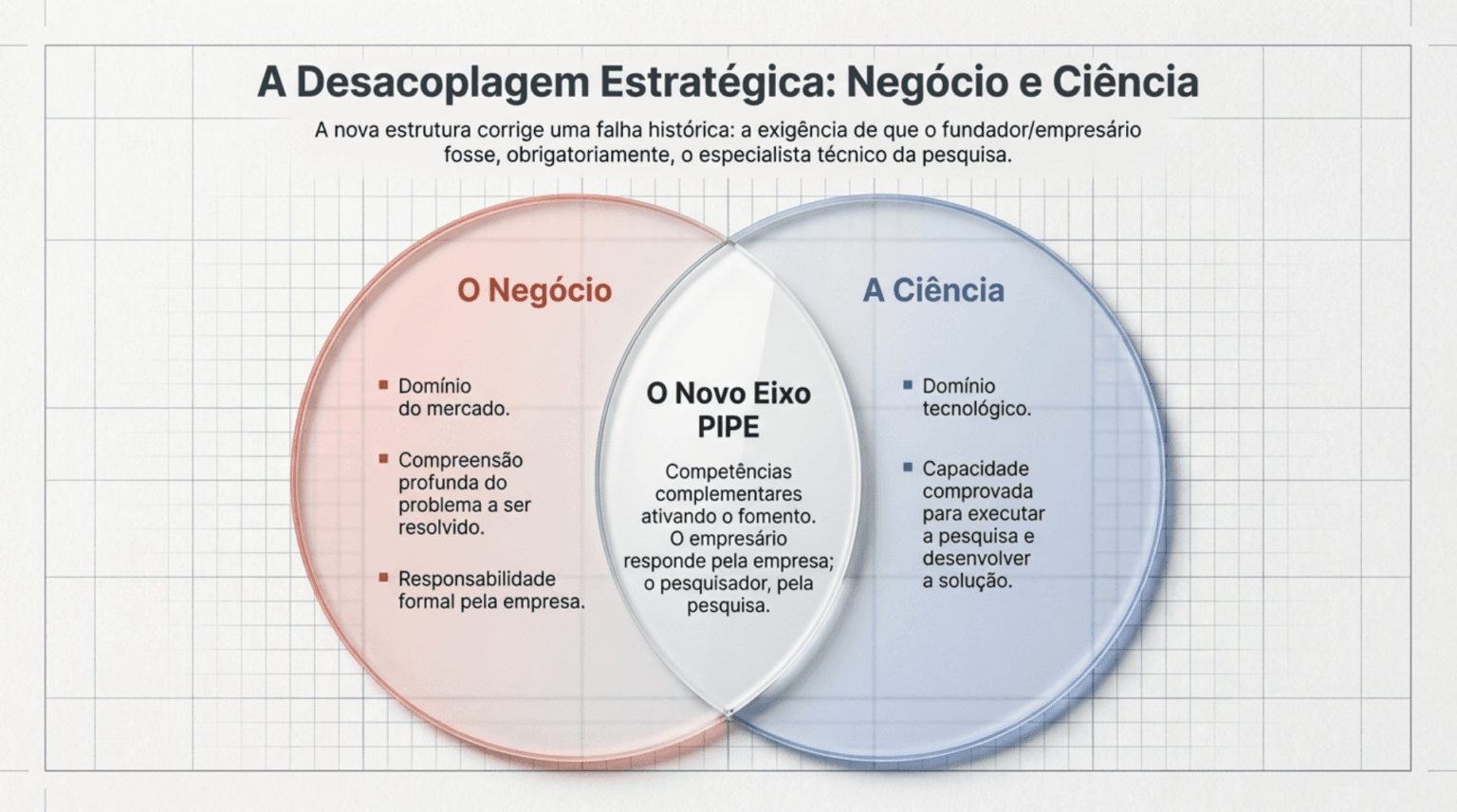
The company may now appoint up to two Lead Researchers — the professionals who actually hold the critical knowledge needed to carry out the research. The rules set three requirements:
The Lead Researcher must demonstrate the capability to execute the proposed innovation research project.
Employment, partnership or a formal contract with the small business, setting out access to infrastructure, intellectual property and confidentiality.
A minimum dedication of 24 hours per week to the project.
Picture a startup whose founder understands the market and the problem deeply but is not a specialist in the technology needed to build the solution. The new structure allows those competences to be complementary.
And there is a practical effect that tends to go unnoticed: the assessment of the proposal now also weighs the competence of the two Lead Researchers. Under the previous rules, when the responsible party was, say, the company’s administrator with no technical competence to lead the project, the proposal would not be accepted by reviewers. What changed was not the rigour of the technical assessment — it was who is held to it.
4The model was already being tested
PIPE Jornada Tecnológica was the rehearsal
The new configuration did not appear out of nowhere in the regular programme. Since March 2026, FAPESP had been using a similar arrangement in PIPE Jornada Tecnológica, created to speed up the arrival of new technologies on the market.
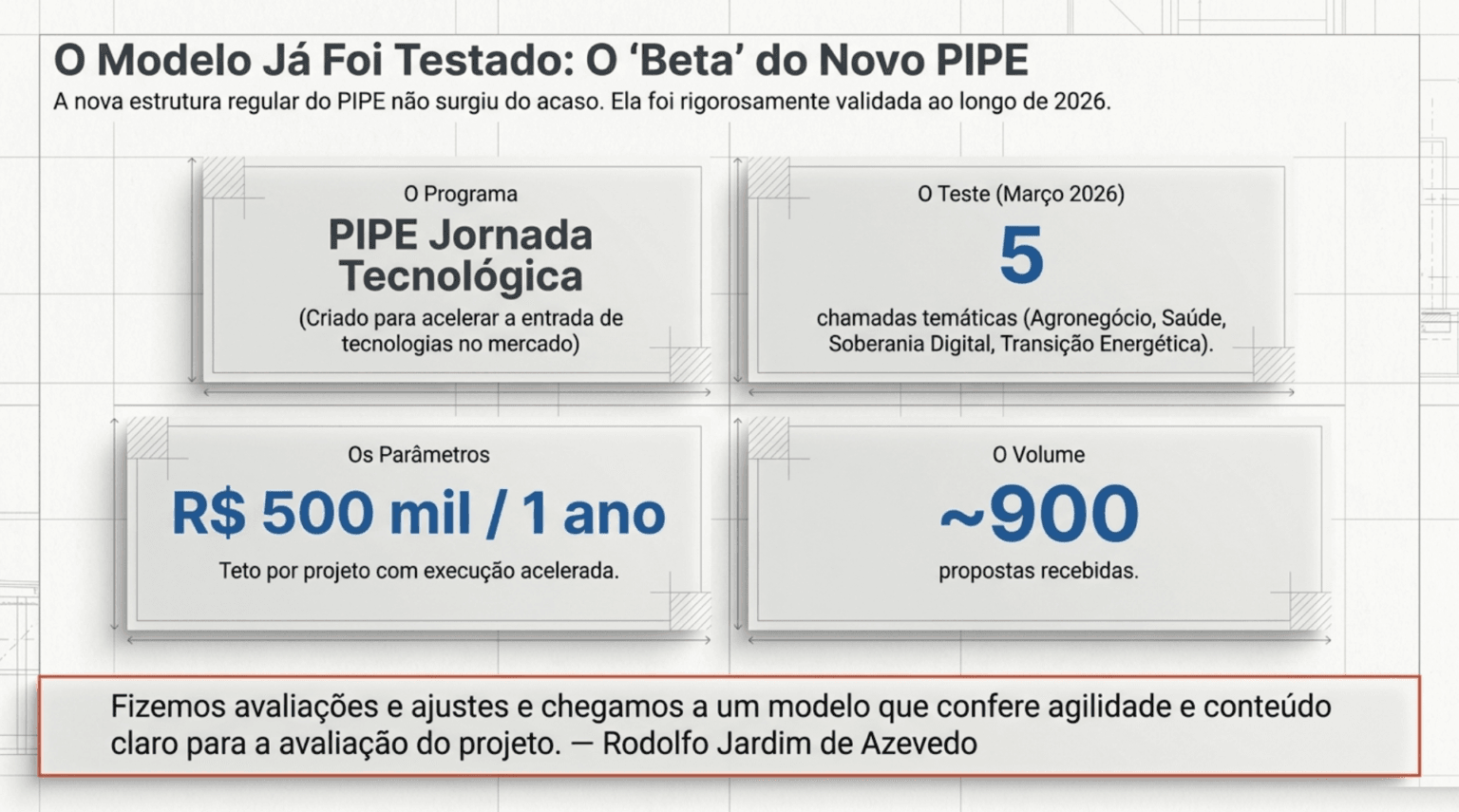
Evidence — The scale of the test. The model was applied across five thematic calls covering agribusiness, health, digital sovereignty and the energy transition, with a ceiling of BRL 500,000 per project and a one-year execution period. Since March, FAPESP has received around 900 proposals under this modality.
Source: Agência FAPESP, August 2026
“We ran assessments and adjustments and arrived at a model that delivers agility and clear content for evaluating the project.”
Rodolfo Jardim de Azevedo, FAPESP
FAPESP tried out a new way of organising how companies enter the programme, assessed the experience, and folded that logic into the regular track.
54TT’s reading
With the new PIPE rules, the requirement moved
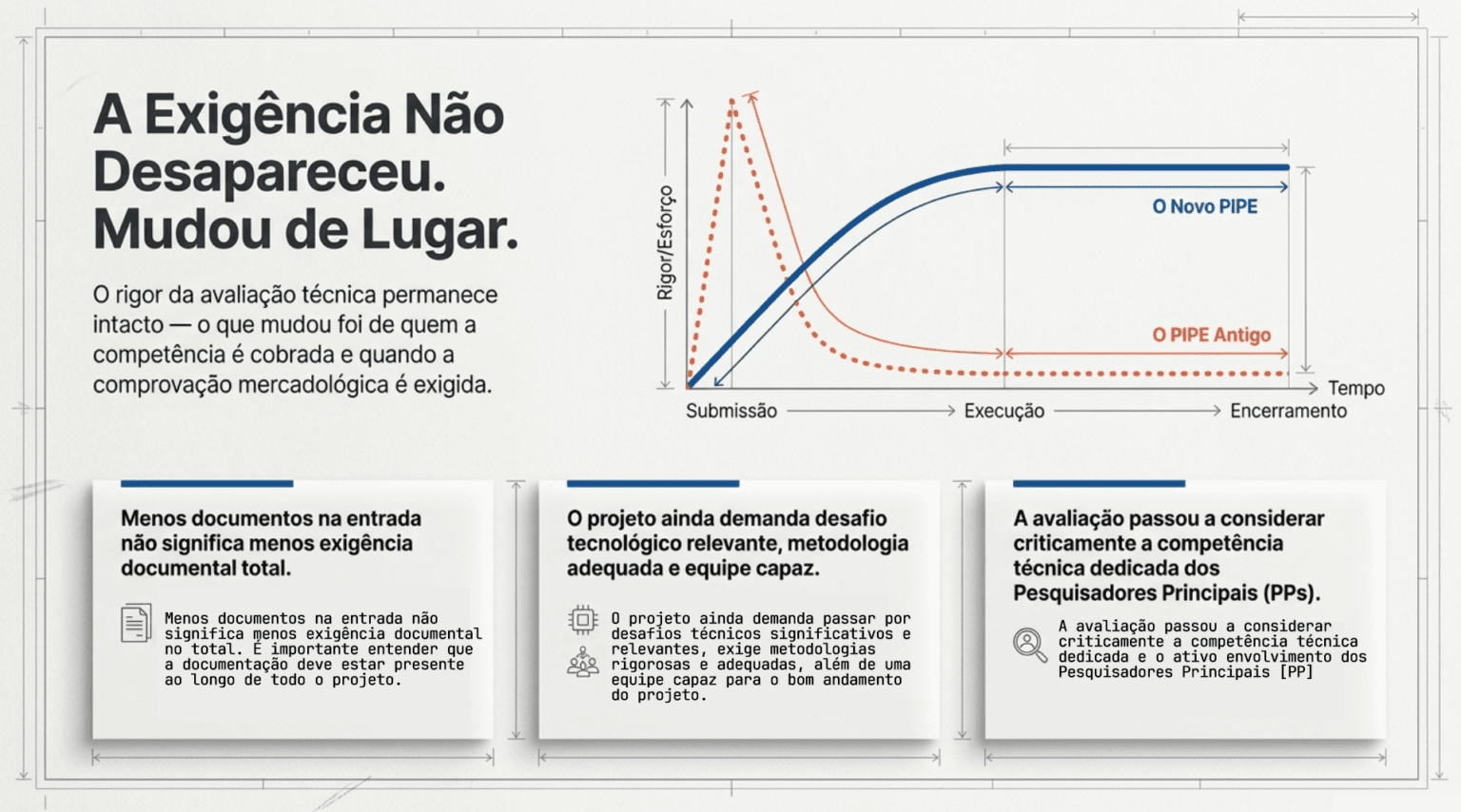
FAPESP did not remove stages. It reorganised the path.
Fewer documents at the door does not mean less technical demand. A project still has to present a relevant technological challenge, a consistent research question, an adequate methodology and a team able to deliver the work — and FAPESP still assesses market potential and the company’s ability to take results to market. The difference is that this information now occupies different moments of the journey.
In 60 seconds
- What left the submission stagethe Canvas in Phase 1, the business plan for starting Phase 2, and the set of corporate documents required when the PR was a researcher.
- What is still requireda relevant technological challenge, adequate methodology, a capable team and market potential — now across the life of the project.
- The structural changethe PR answers for the company and the contract; up to two PPs answer for technical delivery, with a formal relationship and 24 hours a week.
- The effect on assessmentthe technical competence of the PPs is now weighed when the proposal is reviewed.
- Where the model came fromfive calls of PIPE Jornada Tecnológica and around 900 proposals since March 2026.
- Who should act nowcompanies preparing a submission: assembling the PR/PP pair has become a strategic decision, not a formality.
4 Trade Tech exists to turn science into business decisions.
Is your company considering a PIPE proposal? 4TT can help assess eligibility, structure the PR/PP team and prepare the submission.
[email protected] · +55 (11) 93244-4141 · linkedin.com/company/4tradetech
Sources
- FAPESP — PIPE portal, News · “FAPESP simplifica submissão de propostas do PIPE”, 17 August 2026 · date of the official announcement of the new rules.
- FAPESP — PIPE rules, in force from 15/09/2026 · Lead Researcher requirements (item 5.3), team composition (5.4), Technical Reserve and use of the Direct Project Infrastructure Costs portion to pay incubation fees (8.2).
- Agência FAPESP · “FAPESP simplifica submissão de propostas ao PIPE”, by Cláudia Izique, 24 August 2026 · statements by Patrícia Tedeschi and Rodolfo Jardim de Azevedo, the change in assessment criteria, and figures from PIPE Jornada Tecnológica.