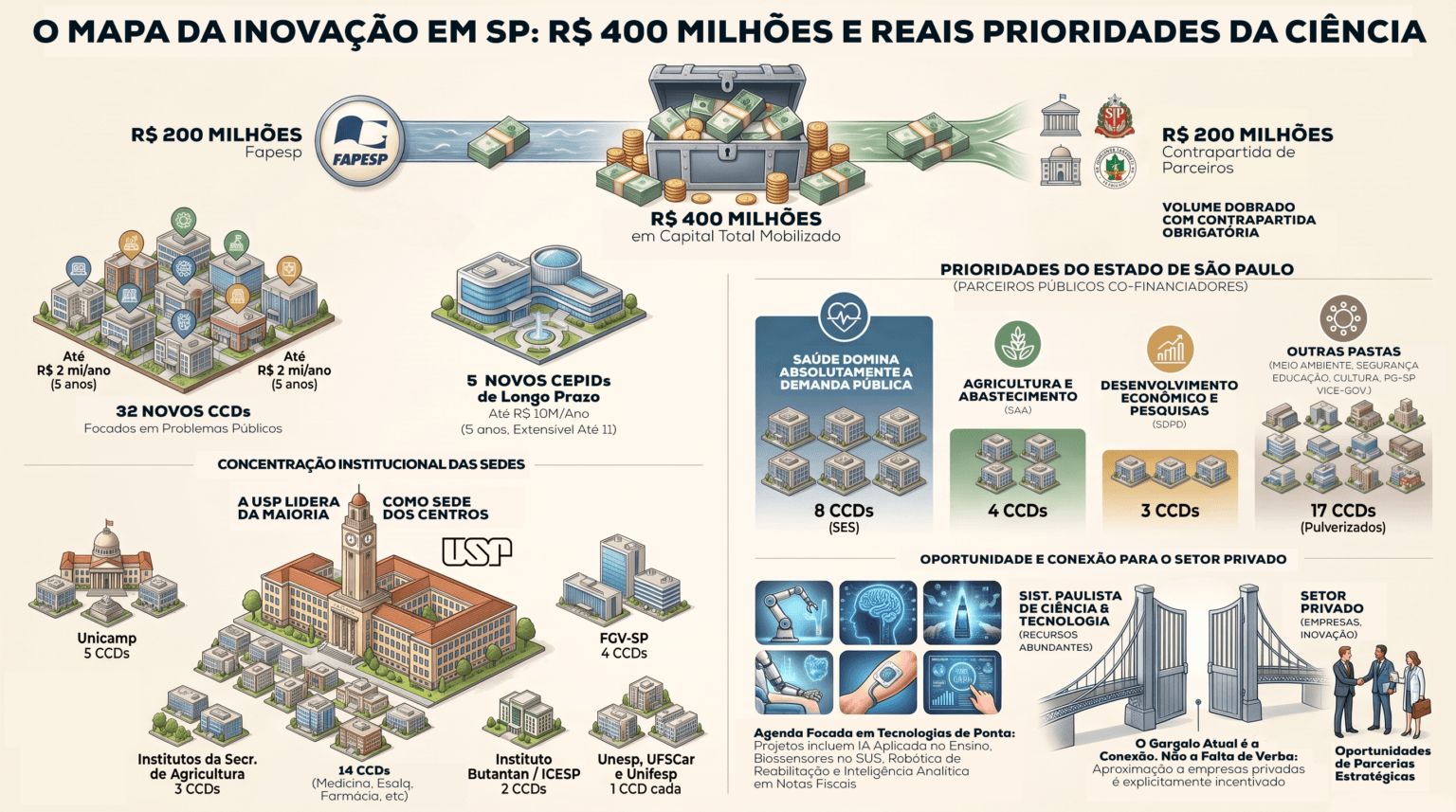
On 18 September 2026, FAPESP — the São Paulo State Research Foundation — announced the new FAPESP CCDs: 32 proposals selected in the fifth call of its Science Centers for Development programme, with a budget of up to BRL 200 million. The same round brought five new RIDCs, each eligible for up to BRL 10 million a year in its initial phase.
The headline figure for the new FAPESP CCDs travelled fast. What barely travelled at all was the list of approved centres — and that is where the useful information sits. Each line names a specific public problem, the government department that took it on, and the research group that got there first. It is a map of what the State of São Paulo will be demanding from science over the next five years, published openly and read by almost no one.
1What was announced
The new FAPESP CCDs and the mandatory partnership with the public sector
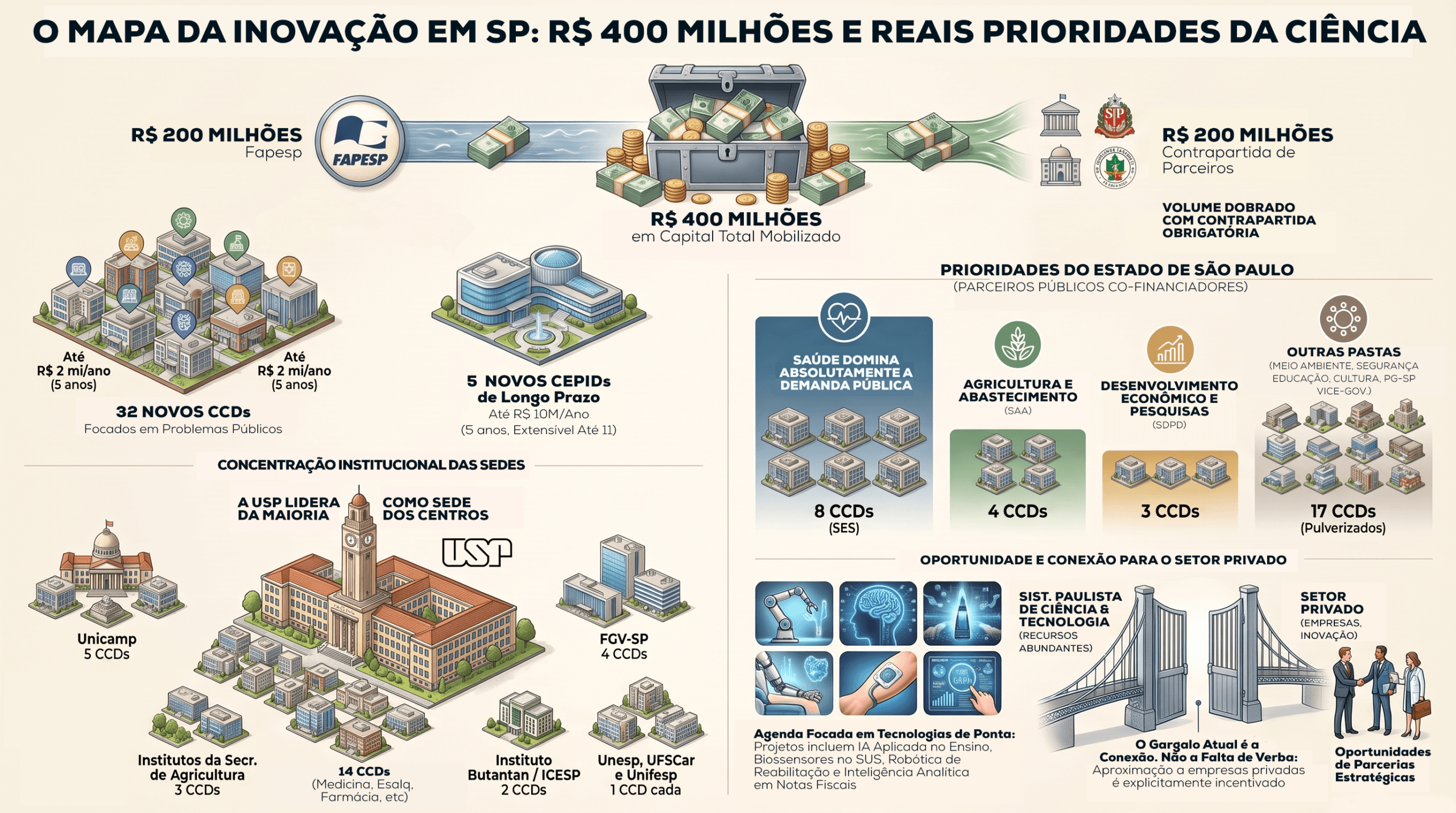
The new FAPESP CCDs are research centres created in mandatory partnership with a public body — a state, municipal or federal department — which joins as a co-funding partner. Each project may request up to BRL 2 million a year, for up to five years.
One detail went largely uncommented and it changes the scale of the programme.
Participating institutions must provide a financial or economic matching contribution equivalent to the amount requested from FAPESP. In practice, the BRL 200 million announced is half the table: the total volume mobilised is in the order of BRL 400 million.
The five RIDCs follow a different logic: long-horizon research in Health, Biological, Agricultural and Veterinary Sciences, funded at up to BRL 10 million a year during an initial five-year phase, with support possible for up to 11 years. They join the 12 centres already running.
2What the headline figure hides
Three cuts of the list say more than the total
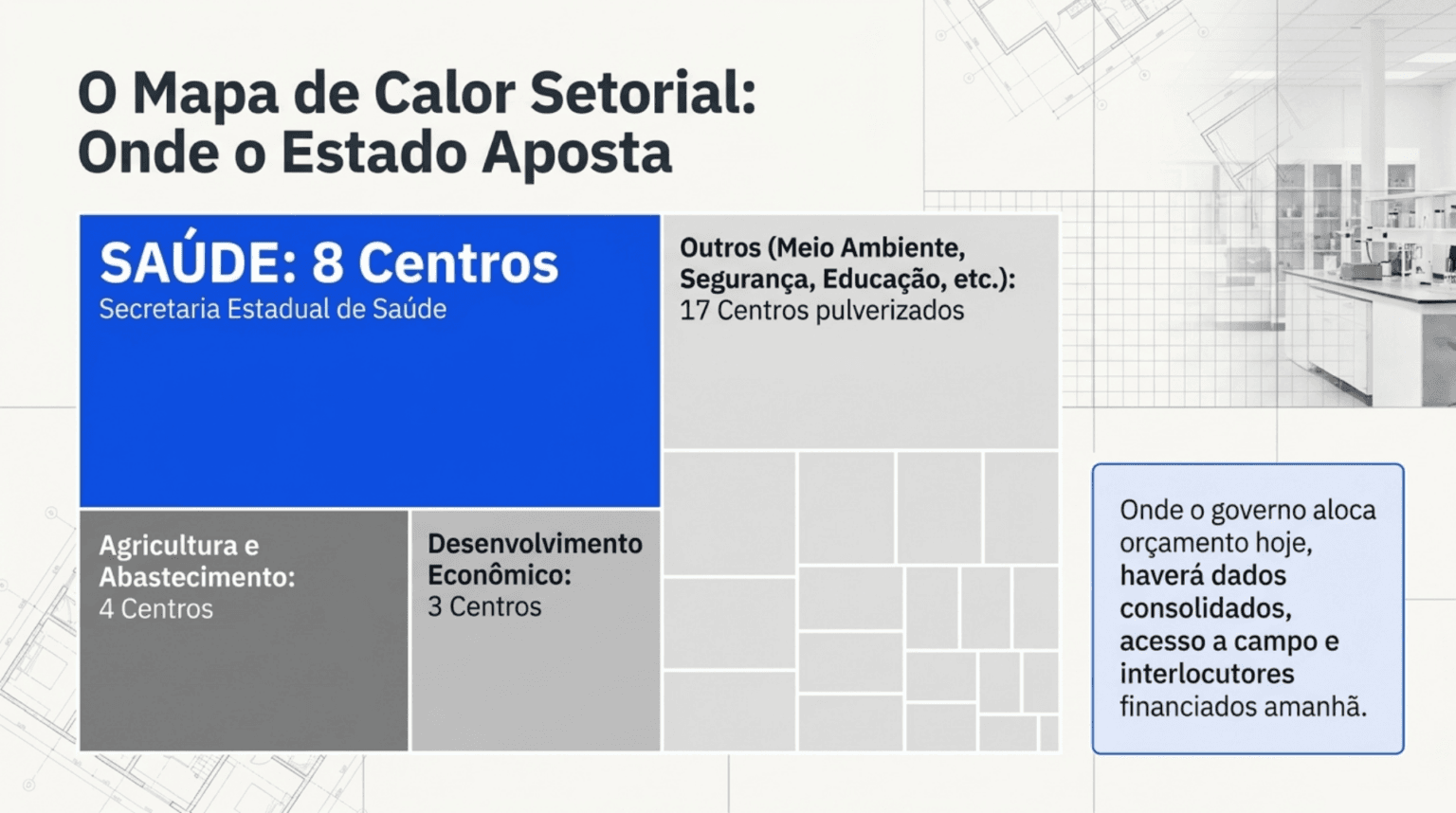
Cut 1 — Health dominates demand. Of the 32 proposals, 8 have the State Health Department as their partner, twice as many as the second-placed department. Agriculture and Food Supply follows with 4, and Economic Development and Research with 3. The rest are spread across Environment, Public Security, Education, Culture, the Attorney General and the Deputy Governor offices.
Source: official list of selected proposals, FAPESP
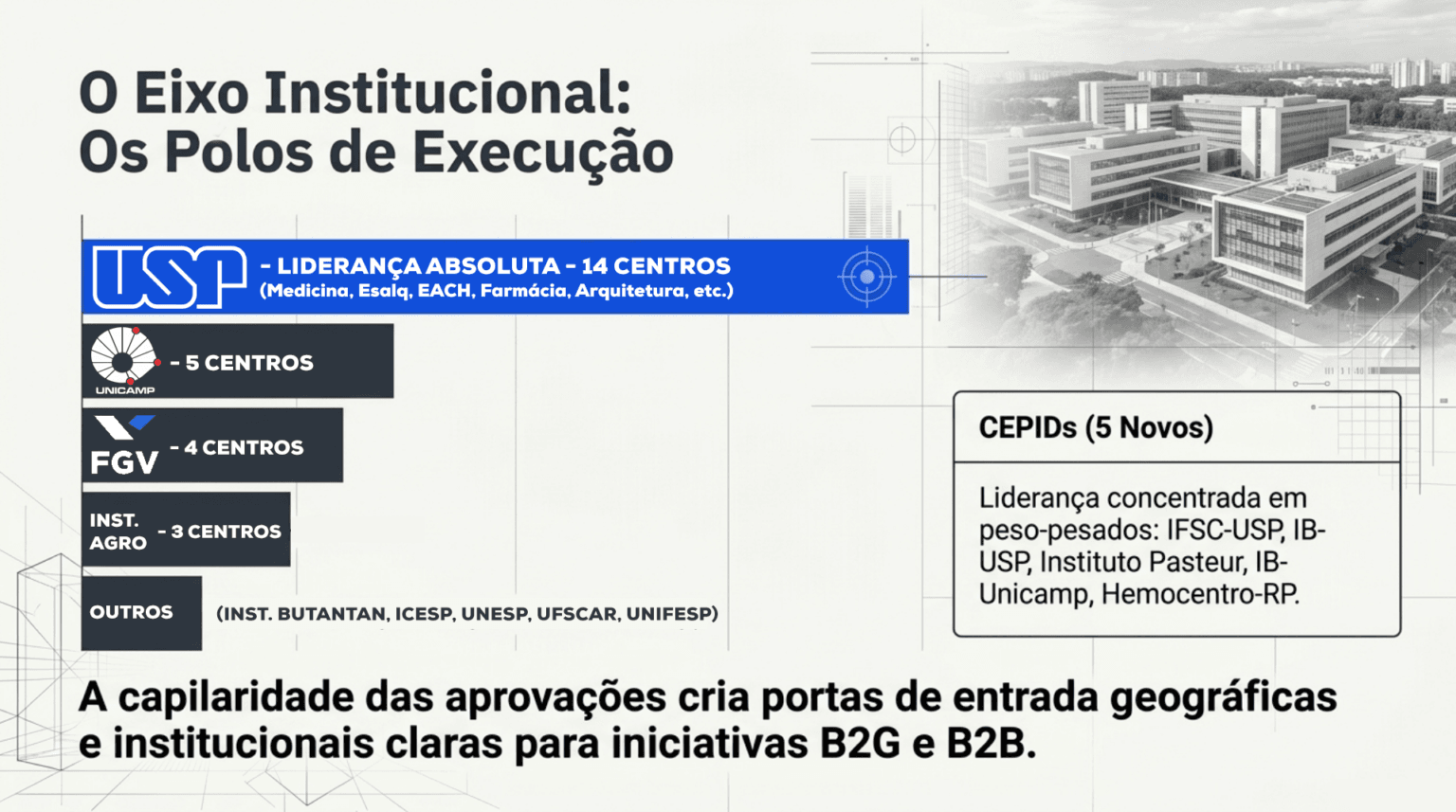
Cut 2 — Institutional concentration is real, but capillary. Fourteen of the 32 centres will be hosted by units of the University of São Paulo, spread across Medicine, Esalq, EACH, Pharmacy, Architecture, Nursing, Bauru Dentistry, Communications and Arts, and the Economics and Business schools. Unicamp takes 5, FGV-SP 4, institutes tied to the Agriculture Department 3, Butantan and Icesp 2, and Unesp, UFSCar and Unifesp one each.
Source: count by host institution in the official list
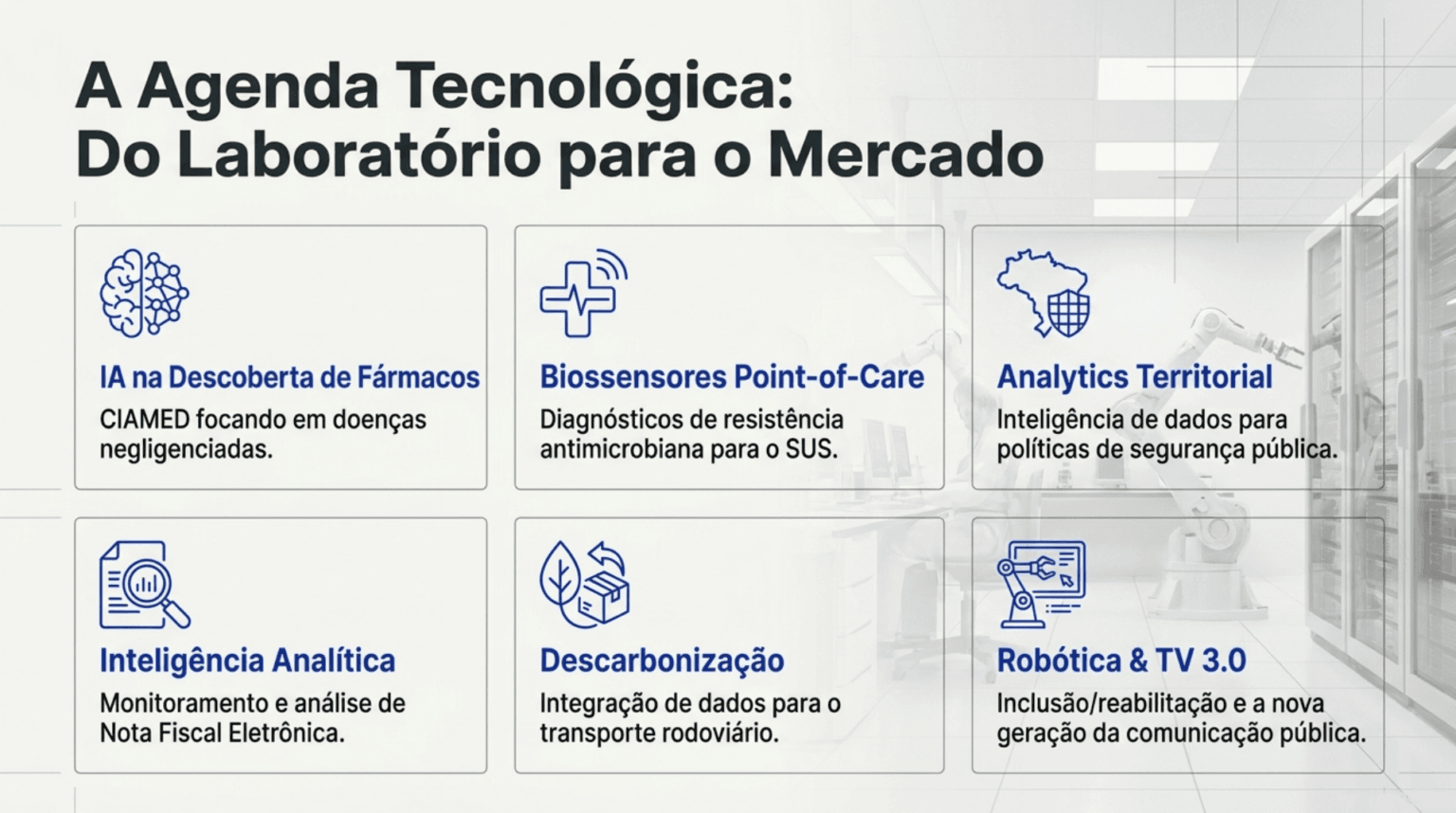
Cut 3 — The titles reveal the technology agenda. They include artificial intelligence applied to assessment in higher education, point-of-care biosensors for antimicrobial resistance in the public health system, robotics for rehabilitation and inclusion, territorial analytics for public security policy, data integration for decarbonising road transport, 3.0 broadcasting in public communication, and a centre for analytical intelligence on electronic invoicing.
Source: titles of the 32 approved centres
Among the RIDCs, leadership sits with heavyweight institutions: the São Carlos Institute of Physics and the Institute of Biosciences at USP, Institut Pasteur de São Paulo, the Institute of Biology at Unicamp, and the Hemocentro Foundation in Ribeirão Preto, tied to the State Health Department. One of them, CIAMED, applies artificial intelligence to drug discovery for neglected diseases.
3Why this matters beyond the university
The list of new FAPESP CCDs is a document about government priorities
A funding call is usually read as a fundraising opportunity by those eligible to apply for the money. That reading misses the point.
When eight centres form around the Health Department, that tells you where budget, consolidated data, field access and institutional willingness to test technology will sit for the next five years. For a company building hospital management software, diagnostics or medical devices, that information is worth more than the size of the call — because it identifies a public counterpart that is already mobilised and already funded.
Each of the new FAPESP CCDs allows the same reading for agribusiness, energy, mobility and public security. Every approved CCD is an identifiable point of entry: a principal investigator, a host institution and a partner department, all public.
4The counterintuitive point
The bottleneck of the new FAPESP CCDs is not money
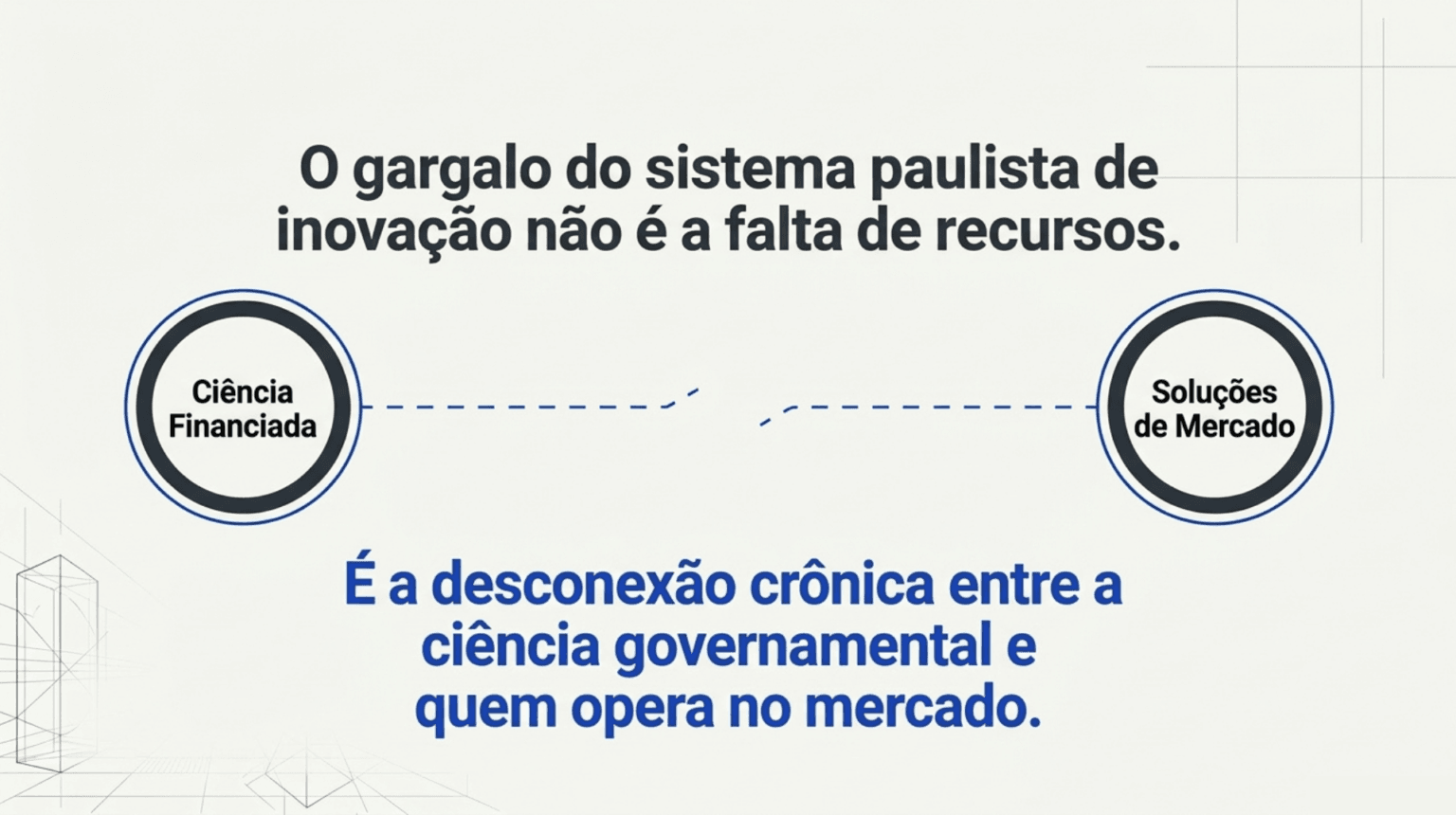
The bottleneck in the São Paulo innovation system is not a lack of funding. It is the lack of connection with those outside the university.
The BRL 200 million in CCDs is joined by an equivalent matching contribution, by the RIDCs, by the PIPE programme and by a dozen other schemes. The money exists and is announced openly. What rarely happens is the right company finding out, in time, that a funded research centre is working on exactly the problem it solves — or could solve.
Company participation in CCDs is, incidentally, explicitly desirable under the call, though not mandatory as the public body is. The door is open and little used.
In 60 seconds
- What was announced32 CCDs with up to BRL 200 million from FAPESP, and 5 RIDCs with up to BRL 10 million a year each in their initial phase.
- The detail that doubles the mathsa mandatory matching contribution equal to the amount requested — the real volume mobilised approaches BRL 400 million.
- Where the concentration sits14 of the 32 centres at USP, across nine different schools; Unicamp with 5 and FGV-SP with 4.
- Which problem leads the queuehealth, with 8 centres tied to the State Health Department.
- What the list actually isa public map of government priorities for the next five years, not merely a funding announcement.
- What to do with itread the list by sector, find the centre that touches your operation and approach the counterpart — company participation is desirable by design.
4 Trade Tech exists to turn science into business decisions.
If one of these centres touches your sector, 4TT can help map the right counterpart and structure the approach.
[email protected] · +55 (11) 93244-4141 · linkedin.com/company/4tradetech
Sources
- Agência FAPESP · “FAPESP anuncia 32 novos Centros de Ciência para o Desenvolvimento”, 18 September 2026 · budget of up to BRL 200 million, 32 selected proposals, ceiling of BRL 2 million a year for up to five years, mandatory co-funding government body and equivalent matching contribution from institutions.
- FAPESP · “FAPESP anuncia 32 novos CCDs” — full list of selected proposals · basis for the counts by host institution and public partner, and for the centre themes.
- FAPESP · “FAPESP anuncia cinco novos CEPIDs”, 18 September 2026 · funding of up to BRL 10 million a year in the initial five-year phase, support for up to 11 years, the 12 RIDCs already running and the host institutions of the five new centres.